Last week we tried to summarize semantic search results with small language models running in your browser. They weren’t great at it, hallucinating often. But a 0.6B-parameter model doesn’t need to know everything, it just needs to read four passages, and either summarize them or say they don’t answer the question. “That sounds like a fine-tuning problem, and maybe a follow-up post.”
So here’s that follow-up. It took four rounds of training data to get there, and the ones that didn’t work were just as interesting. The short version: the fine-tuned Qwen3-0.6B is now the default on ask my blog. It’s right about as often as the original, it’s wrong a third as often, and it never answered a question the blog doesn’t cover. It’s also a smaller download. The model, the dataset and the code are all public, so you can put it on your own site and try for yourself.
The job, and the plan# #
The model gets a system prompt (“answer in at most two sentences, using only these passages, or say the blog doesn’t seem to cover it”), four numbered passages that the semantic search found, and a question. That’s it. A good answer either states what the passages say, or says “The blog does not seem to cover this.” when they don’t answer it.
For fine-tuning a model that can do that we need a few thousand examples that show it how to do that job well. I don’t have a few thousand blog posts, so this is the plan:
- Training data from openly licensed (technical) writing. My blog’s 45 eval questions from the last post are the test set, so training on my posts would basically be cheating (there are only 16 of them anyway). Instead I used theGo blog , theRust blog , theRust RFCs and thePython PEPs : 2,193 documents of technical writing, which all have a very permissible license to use them.
- Same retrieval mechanism. Each document is chunked and embedded exactly like thesemantic search on this blog , and each training question gets the top four passages that search returns. So the model trains on passages that are as noisy as the ones it gets in production: sometimes the answer is in passage 1, sometimes in passage 4, sometimes a near-duplicate from a different post sits next to it.
- Have Claude write examples. Claude Sonnet 5.5 wrote the questions, about a single passage. Some have the answer among the four chunks, for some I removed the document the question came from (so it’ll train on refusing to answer), and some are near-misses: related questions the passages don’t really answer. Claude Opus 5.5 then answered every one of them based on the chunks, using the same system prompt the blog uses.Technically , that makes this a form of distillation: a big model demonstrates the job, a small one learns to imitate it<sup>1</sup> .
- Train on my Mac.LoRA<sup>2</sup> withmlx-lm on an M4 Mac mini with 24 GB of memory (also my home lab/media servier). Each version trains for one epoch, a single pass over the 4,500 training examples: 2,265 iterations of two examples each, updating the weights every second iteration, and saving a checkpoint every quarter epoch. That takes about 1h20m.
- Export it for the browser in the same 4-bit format the page already loads, and run the same eval as last time: 30 questions the blog answers, 15 it doesn’t, graded by Opus against the passages.
One more thing about that last step: I compare each fine-tune against the base model exported the same way, so the fine-tune is the only difference. That base model scores 17 of 30 faithful answers, not the 18 from the last post<sup>3</sup>.
v1: it got worse# #
The first dataset had about 4,500 example questions, with Opus written answers: usually two dense sentences. After training, Qwen3-0.6B was faithful on 8 of 30 questions, against 17 before I touched it. It did learn to refuse: it never made up an answer for any of the 15 questions the blog doesn’t cover, against 2 for the base model. But on the questions the blog does answer, it got a lot worse.
It had picked up two habits. The first came straight from the training data. When Opus could answer part of a question, it would answer that part and add something like “the blog does not go into more detail about why”. That’s a perfectly good answer from a beefy model that can tell what’s missing. About 10% of the training answers had one of those clauses, and the fine-tune learned to add one regardless (to a third of its answers in fact), usually about something the passages did explain.
The second habit was worse: it packed in more details, and straight up hallucinated them if it had to. Here’s what the base model and v1 say to “What does the blog say about embeddings and cosine similarity?”:
“The blog discusses embeddings as a way to capture semantic relationships between words, using cosine similarity as a measure of similarity between vectors.” (Qwen3-0.6B)
“The blog says embeddings capture semantic relationships, not just lexical ones, and that “King” and “bicycle” are close together, “King” and “bicycle” are far apart, “Beer” and “alcoholic beverage” are neighbors.” (v1)
The base model is vague, but right. v1 sounds like it read the post, and it’s wrong: in the semantic search post “king” and “queen” are close together and “bicycle” is far away. It took the shape of Opus’s answers (several specific facts, quoted terms, a second sentence) without the careful reading that produced them.
v2: the loss went down, the answers got worse# #
The hedges were the easy fix: a quick script that stripped the “the blog doesn’t explain X” clauses from the training answers (and dropped the examples that started with one), and training again. The hedges disappeared. The answers didn’t get that much better: 9 of 30.
This time I also looked at the checkpoints along the way (after a quarter, half and a full epoch), and that’s where it got interesting:
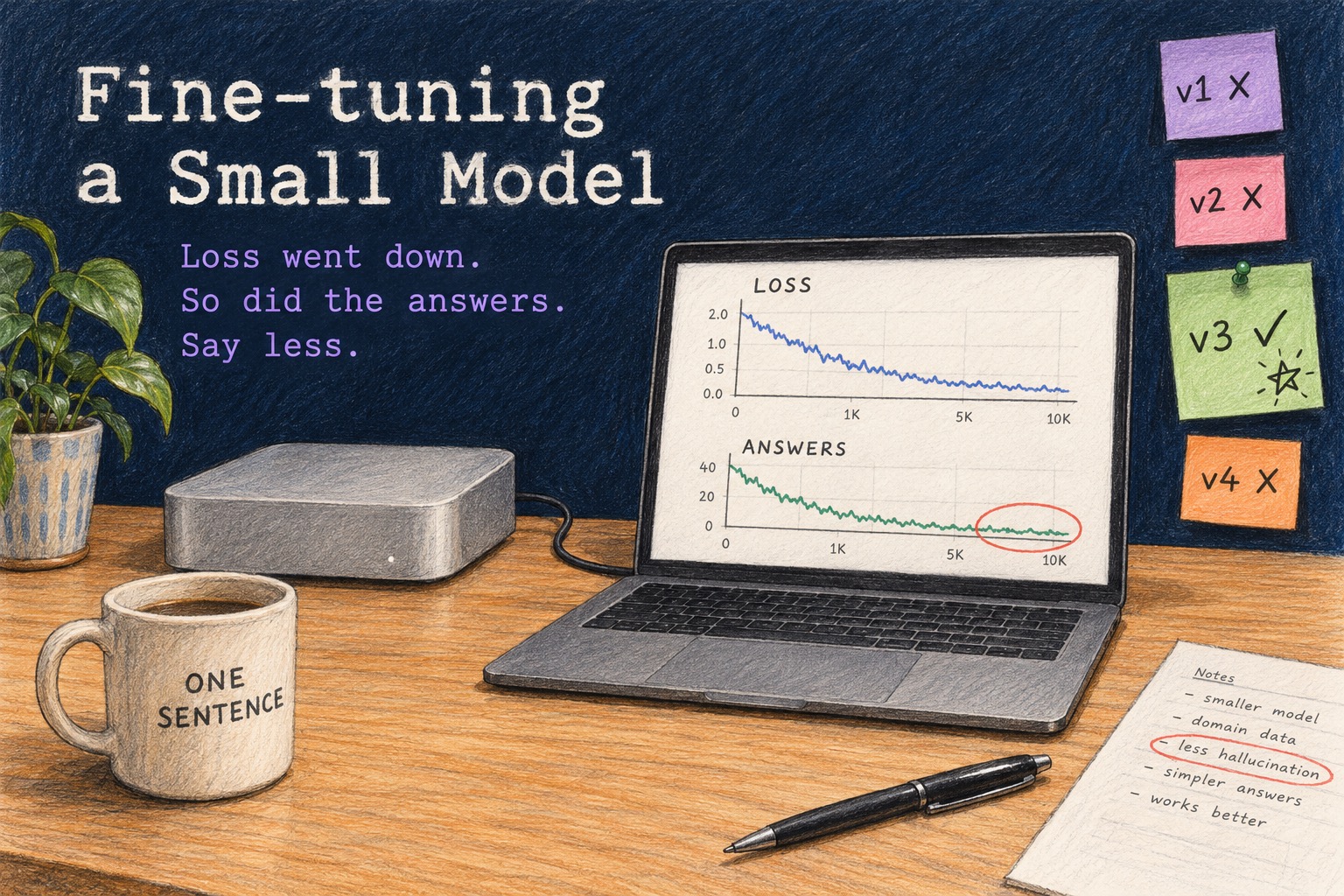
Validation loss, the number to watch while fine-tuning, improved at every checkpoint. On the blog’s questions though, the model got worse at every checkpoint: 18, 11, 9 faithful answers: i.e. the loss doesn’t measure what I care about. It measures how closely the model imitates Opus’s answers, word for word, on held-out Go, Rust and Python passages. These types of dense answers that combine several facts are exactly what a 0.6B model can imitate in form but not in substance, so the better it imitated them, the more specifics it stated, and the more of them it got wrong.
Two lessons from that. If the model can’t really do what the training answers do, more training just makes it worse. And look at your checkpoints: carefully look at what the model is doing on the thing you care about, don’t blindly follow the loss number. As always, what ends up happening is that you’re replicating patterns from the training set, and if it’s not constructed carefully (i.e. you generated a bunch of it with a vague prompt to Opus), you’ll not end up doing what you set out to do.
## v3: say less[#](#v3-say-less)

For v3 I kept the questions and the passages and changed only the answers. Opus regenerated all of them with (much) stricter instructions: one short sentence with the fact the question asks for, in the passage’s own words; don’t combine facts from different passages; don’t comment on what’s missing. A second sentence only if the question asks for two things. The answers went from 180 to 123 characters on average, and the embeddings question now gets this:
“The key insight is that these vectors capture semantic relationships, not just lexical ones.” (v3)
That’s not a great summary, but every word of it is in the post. And that’s the trade v3 makes across the board:
v3 is faithful on 16 of 30 questions, pretty much the same as the base model got (16 vs 17; with 30 questions and smol models like this, a difference of one is noise). But it’s wrong on only 3 vs 9, and it said “The blog does not seem to cover this.” to all 15 questions the blog doesn’t cover. Asked which GPU to buy to run Llama 70B, the base model spun a paragraph about choosing the right GPU out of passages about embeddings and a coding agent which maybe kinda sounds similar; v3 straight up declines. Winning!
There’s a cost to that caution: on 11 of the 30 answerable questions v3 says the blog doesn’t cover it (or gives an extract that doesn’t answer the question), against 4 for the base model. For “ask my blog” that’s the right trade, I think. The passages are on the page right below the summary, so a refusal costs the reader a few extra seconds of reading; a confidently wrong summary costs them a wrong idea about what I wrote and it looks stupid.
v4: more of what it was bad at made it worse# #
Most of v3’s wrong refusals were in the “broad questions” category: “What has the blog written about hashing and bit arrays?”, “How can I turn my written articles into something readers can listen to?”. We specifically trained on finding one fact in one passage, so for v4 I had Opus add 1,200 navigational and conceptual examples, because those also live in the eval set (who says we’re overfitting?). For each document I added a “what has the blog written about X” and a “how do I do Y” question, wich I had Opus answer in one or two short sentences.
It made things worse: 13 of 30. v4 stopped refusing the broad questions, and started garbling them instead and making up stuff, in exactly the way v1 did:
“The blog explains that embeddings capture semantic relationships, not just lexical ones, so words like “king” and “bicycle” are close together, not just words that look similar.” (v4)
An answer to a broad question has to combine several passages, and combining passages is the thing a 0.6B model will struggle with, no matter how short the target answer is (or maybe because of how short the target answer is). What it can learn is to find the sentence that answers the question and repeat it, or to say nothing. So at this point I decided I spent enough tokens at API pricing and that v3 is the one for the ask page right now.
Takeaways# #
- Training data design matters, a lot. Repeat after me, a LOT. v1, v3 and v4 used the same training setup; only what the answers looked like changed. A small model copies the style of its training data far more readily than the actual skill behind it, so the style has to be one it can actually pull off.
- Don’t rely on the loss. Evaluate checkpoints on the task, by hand (I know, ew), with a held-out set from documents the model never saw, and keep the real test (in my cae, the 45 questions from previous iterations) for the very end, once.
- Small models can extract; they don’t really summarize. Ask for the sentence that answers the question, not a synthesis or something you’d expect (a modest amount of) reasoning for.
- Negative results are cheap at this size. Each experiment was an hour and a half of training on my Mac Mini, and a few dollars worth of grading. That made it easy to try the obvious next thing, and to find out it didn’t work. What a time to be alive.
Also, lets be real for a second. Thirty questions is a small test: v3’s 16 versus the base model’s 17 is a pretty much a tie, and the difference between 3 and 9 wrong answers is barely significant enough to call “science”. And I had Claude write the training answers and grade the results, so there’s a decent chance the grader may have liked answers in its own style<sup>4</sup>. The 260 held-out examples and my blog’s questions blunt that a little (neither was ever trained on), but they don’t remove it.
Do it yourself# #
Nothing in this finetune is specific to my blog: it never saw a single one of my posts in training. So there are three levels of doing this yourself if you wanted to:
- Use the model.
bartdegoede/qwen3-0.6b-small-ragis on Hugging Face, in the q4f16 formattransformers.js loads on WebGPU or in WebAssembly, and as regular weights for Python. There’sa browser example . It’s a single static page: build a search index from a folder of markdown posts with one command, serve the folder, and ask away. - Try it on your own posts/data. Write (or generate) 30 to 50 questions about the posts on your own blog, ideally some your posts answer and some they don’t, andrun the eval : it’ll retrieve passages from your posts exactly like my page does, it runs the model, and it’ll have Opus grade the answers (insert your own API key here). It’ll be about 20 cents for 45 questions at current pricing. On my posts as they are today, it gets 18 of 30 right and correctly refuses 13 of 15.
- Train your own. Thedataset and thecode are available for your perusal. The most likely reason you may want to retrain: the system prompt and the refusal say “blog” a lot, and if you’d have something like a documentation site for a lib you’d want them to say “the documentation”. That means rewriting/regenerating the answers, and an hour or two of training on an Apple Silicon Mac (recent one).
There’s another small win in there. The official Qwen3-0.6B files are 579 MB; the fine-tune is 358 MB, because its export uses one 4-bit matrix for both the input embeddings and the output layer, which the model ties anyway. That’s close enough to the 350 MB budget I set for the page in the last post.
What’s next# #
The obvious next experiment is a bigger student. In the last post Gemma 4 E2B was faithful 28 times out of 30 without any fine-tuning, at 3.1 GB. Somewhere between 0.6B and that, there’s probably a model that can learn to summarize rather than extract, and still be a reasonable download. In the meantime, try ask my blog something, and if you want to see the difference for yourself, the original Qwen3-0.6B is still there under the “Other models” tab if you wanted to compare (it runs on your machine after all).
- Don’t tell Dario 🤫 To be transparent: this whole project leans on Anthropic’s models, the dataset card says which model wrote what. ↩︎
- Low-rank adaptation: instead of updating all 600 million weights, you train small extra matrices next to some of them (here rank 8, on every layer), under 1% of the parameters. It’s much cheaper, it fits in a Mac’s memory, and afterwards the extra matrices are merged back into the model so it’s the same size as before. ↩︎
- The last post used the ONNX files from onnx-community ; here everything goes through my own export (more on thatbelow ). There’s one question that has a different answe, which we’ll consider noise.↩︎
- At my day job we have Codex review Claude written code and vice versa, and we tell it that the other model wrote it to fan the flames of competition; it definitely feels more critical when reviewing work from a competing lab’s model.↩︎