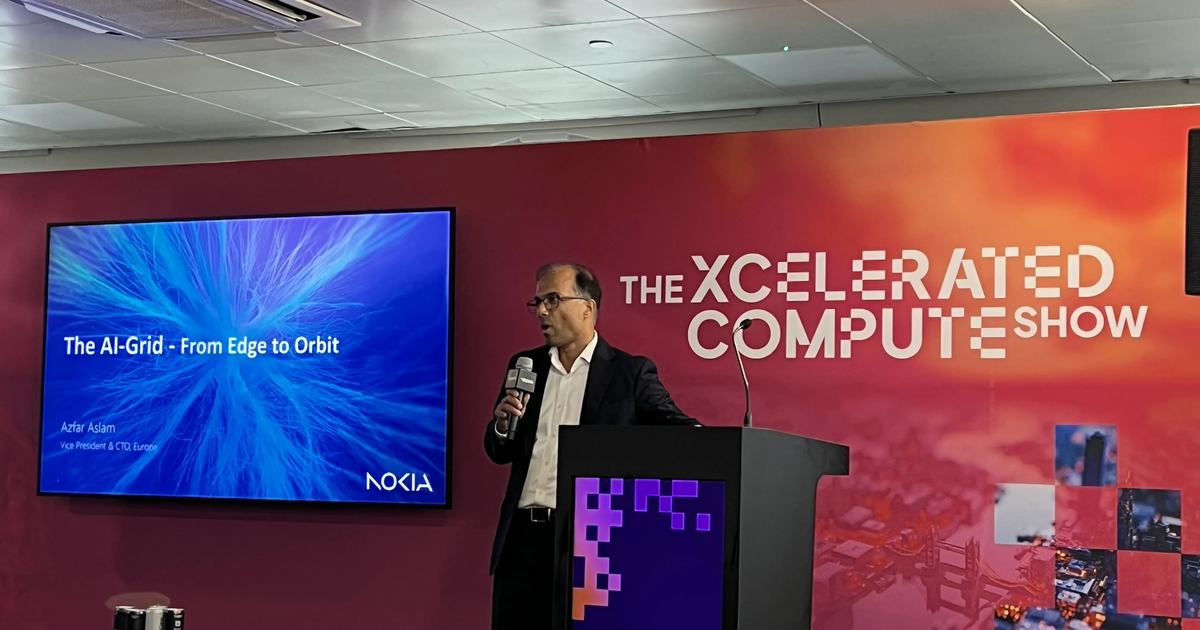
LONDON - AI infrastructure can reach far beyond the core data center, encompassing edge environments and space-based connectivity. For AI workloads that need low latency, resilience, or remote connectivity, a distant cloud will not be enough.
Speaking at this week’s Xcelerated Compute Show in London, Nokia’s VP and CTO for Europe, Azfar Aslam, spoke about how AI compute is spreading worldwide in various forms and shapes – but that ultimately AI workloads need to run closer to the point of use.
“Nokia used to connect people, and now we connect intelligence. We’ve been talking about the AI supercycle, from edge to orbit…but there are some challenges in the build-out of the AI infrastructure,” he explained. “What we’re finding in Europe is that it will grow by at least 3x by 2030.”
Tracking the ‘AI supercycle’ #
Edge, telecom, satellite, and space-based infrastructure can support distributed intelligence closer to users, devices, and assets. This creates new opportunities, but also new challenges around bandwidth, operations, security, and reliability.
Technology giants continue to spend trillions in these areas, with Aslam highlighting how AI infrastructure budgets have grown.
“We’re seeing projects like the European Commission AI gigafactory, with many conversations circulating around sovereign compute,” he added. “Eventually, all businesses will have some kind of AI applications in service form, but the current question is around if countries will have enough AI compute.”
With the level of gigawatts required inevitably expanding, energy demand is also booming. This has perhaps caught some by surprise, with AI now shifting from training to inference faster than expected.
For Aslam, the message is clear: “The amount of investment is still going up, and the adoption of AI capabilities in the wider economy is increasing rapidly too,” he said. “Traditional cloud services have been increasing dramatically in terms of the money that we spend as consumers, but mostly as cloud service enterprises.
“This tells us there’s a lot of economic development, but also a lot of revenue opportunity – and that’s the revenue opportunity that a lot of companies are chasing right now, building data centers, building AI cloud services, and new clouds.”
Capacity, connectivity, constraints #
With the number of players increasing, bottlenecks are inevitable. To achieve the revenues AI promises, companies require energy and the power of data centers. However, rising demand has led to overwhelming constraints of power and energy, challenging what the future of the AI industry could look like.
“Power is not arriving fast enough,” Aslam added. “We need more reliability, and that’s the element Nokia brought from its traditional networking suite into the data center.”
Nokia is currently working with hyperscalers and cloud providers on both front-end and back-end networking. This comes as a pivotal moment for the industry, as data center architecture conversations start to change to include space or the edge cloud.
Yet, as Aslam explained, the amount of energy required to build AI data centers is not arriving fast enough, meaning that compute will need to be distributed in more places.
“There have been radical ideas from small modular reactors (SMRs) all the way to putting the data centers right next to renewable sources,” he said. “What we want to do is find wherever the power is, so we’re now chasing power to place compute.”
He explained how the strategy over the next couple of years will be businesses seeking out power, which is where the notion of the edge cloud starts to come into play.
“We are having to deal with the reality, so we’re distributing AI factories in smaller locations wherever we can get power in the next year or so,” he said. “That distribution of data centers is effectively the way forward in Europe, but turns out the Americans are doing the same.”
Strengthening the network #
The innovation that’s required to support AI infrastructure is massive, but companies like Nokia are trying to build the smallest compute nodes with basic connectivity. That’s the spectrum of AI networking and the AI grid that is starting to materialize moving forward.
“There needs to be a lot of automation in the data center. Cloud providers are coming to us and asking for control of our networking capabilities too,” Aslam said. “New innovations are needed to deliver these services – and some countries want their data to stay in their own territories, so the whole networking environment to support that compute is changing both inside and outside the data center.”
And it doesn’t stop there. Nokia is now witnessing AI-RAN and the extension of 5G services, so Nokia can put GPUs at a mobile base station.
“If you can put the GPU compute in those locations, you use some of that for your mobile services for all of us, but the rest of the compute goes to the enterprises, industry, and other public sector services,” Aslam added. “That’s an extension of the AI grid.”
His comments come during a time when it’s difficult to transform mobile infrastructure quickly. This has led to conversations about being able to access compute quicker, which has prompted debates over space data centers.
“There’s no land issue or planning permission there,” Aslam said. “There are engineering issues like heat projection and connectivity, plus the amount of bandwidth that would be required, so you would need optical networking in space.”
Alongside its partners, Nokia is modifying equipment and working with satellite-based communication to provide optical networks and conceptualize space data centers.
“We know the building blocks to deliver in space are there,” he added. “Very soon, when we have big AI factories, edge AI locations, and cloud service provider locations, you’ll have the possibility of connecting AI data centers when they are ready, practical, and economically justifiable.”
Turning challenges into profit #
Despite satellite costs and payloads decreasing, engineering challenges remain. However, Aslam is confident that these will be tackled by taking advantage of the rapid pace of innovation – something he calls the planetary AI brain.
“Don’t just do it on the planet, you might end up doing it in space as well,” he said. “The world believes it needs a lot of AI infrastructure to support many services and use cases.”
He added; “AI may just follow the same regime where we use X number of tokens today, but it will explore over the next few years. The whole idea is: compute, wherever you can get it.
“That’s where the AI brain comes in.”