Sci-fi authors and AI researchers have dreamed for decades of a day when interacting with humanoid robots will feel natural, perhaps even indistinguishable from chatting with another flesh-and-blood human being. And although we now have access to chatbots that routinely trick people into believing that they’re conscious beings, we still seem to be a long, long way away from living amongst embodied, truly humanlike robots.
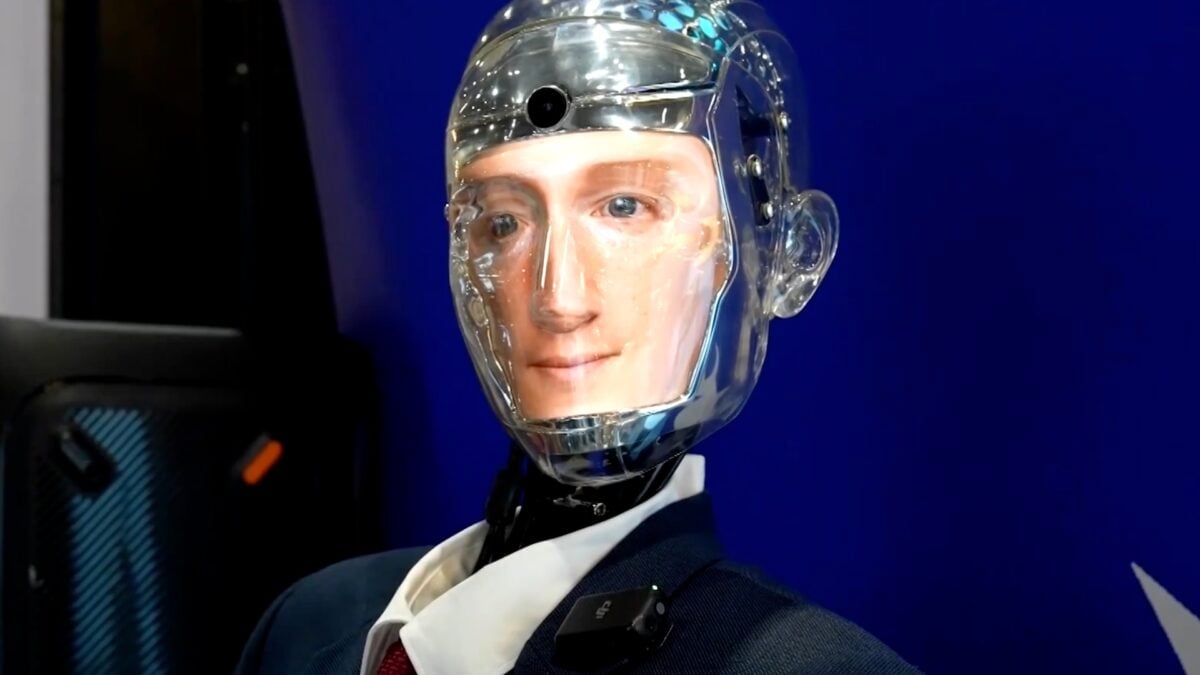
At the United Nations’ AI for Good Global Summit in Geneva this week, visitors could meet and mingle with Robert the Robot, a six-foot-something Tesla Optimus lookalike wearing a suit and tie, whose digital screen-for-a-face would alternate with images of Trump, Obama, and Mark Zuckerberg. Robert (not to be confused with Robby the Robot, the iconic character from the 1956 film *Forbidden Planet) *was built by a Swiss robotics firm called RB Labs, and designed to mimic the subtleties of nonverbal facial cues that make up every human-to-human interaction—even if we’re not consciously aware of them.
“In the future, we think it will be important to communicate with a robot and for humans to receive information from its expressions, like seeing a smile to know if it’s happy or not,” RL Labs cofounder Robin Kranbroekers told Reuters in recorded interview, while in the background, Robert, seen wearing a digital mask of Trump’s visage like Leatherface, stared blankly at some point just off-camera. “So if I make [Robert the Robot] do something silly right now, I don’t think people will mistake him for the real Donald Trump. I don’t believe we’re falling into that uncanny valley trap.”
A Swiss humanoid robot displaying the faces of world leaders debuted at the AI for Good Global Summit in Geneva, with its maker saying the tech aims to make human-machine interaction more natural
[pic.twitter.com/KnAcEoknc6]— Reuters (@Reuters)

[July 9, 2026]
On that, we can agree. (And in the interest of time, we’re not going to begin to parse what it’s even supposed to mean for a nonconscious robot to feel “happy.”) In the video posted by Reuters, Roberts’ eyes at one point seem to haphazardly drift in different directions. And in another clip, its heterochromatic eyes wear a blank expression while it frowns, cartoon-like, before suddenly switching to a gleeful smile. There are many reasons to feel alarmed while watching the video, but the possibility that humans might be tricked into mistaking Robert for the actual Mark Zuckerberg or Donald Trump is definitely not one of them.
To be fair, humanoid robot R&D has made significant strides in recent years, driven in large part by AI models that can predict how they ought to respond to novel situations based on vast troves of real-world training data. But as the interminable struggles of the autonomous vehicle industry have shown, researchers have yet to build robots—humanoid or otherwise—that can competently respond to the limitless unpredictability of the real world. When videos of Optimus serving drinks emerged online in 2024, it seemed to many like a legitimate breakthrough, until it was revealed that it was basically a mechanical marionette, with human operators pulling its strings behind the scenes.
Disembodied large language models that communicate solely via text are much better at fooling human users into believing that they, too, are conscious beings, as has been repeatedly demonstrated in recent years. None other than Richard Dawkins, the staunchest of materialists, has fallen into this trap. Voice models are also getting better at imitating the subtleties of human speech, but these too have a long way to go before they start to truly veer into uncanny valley territory.
Robert the Robot can be booked for trade shows, conferences, and other events (not birthday parties, sadly), according to RB Labs’ website. The company is also hiring for several positions, including a “robot safety assurance engineer” and an engineer specializing in world models, a branch of AI that, for some researchers, is the most promising route to artificial general intelligence, or AGI.