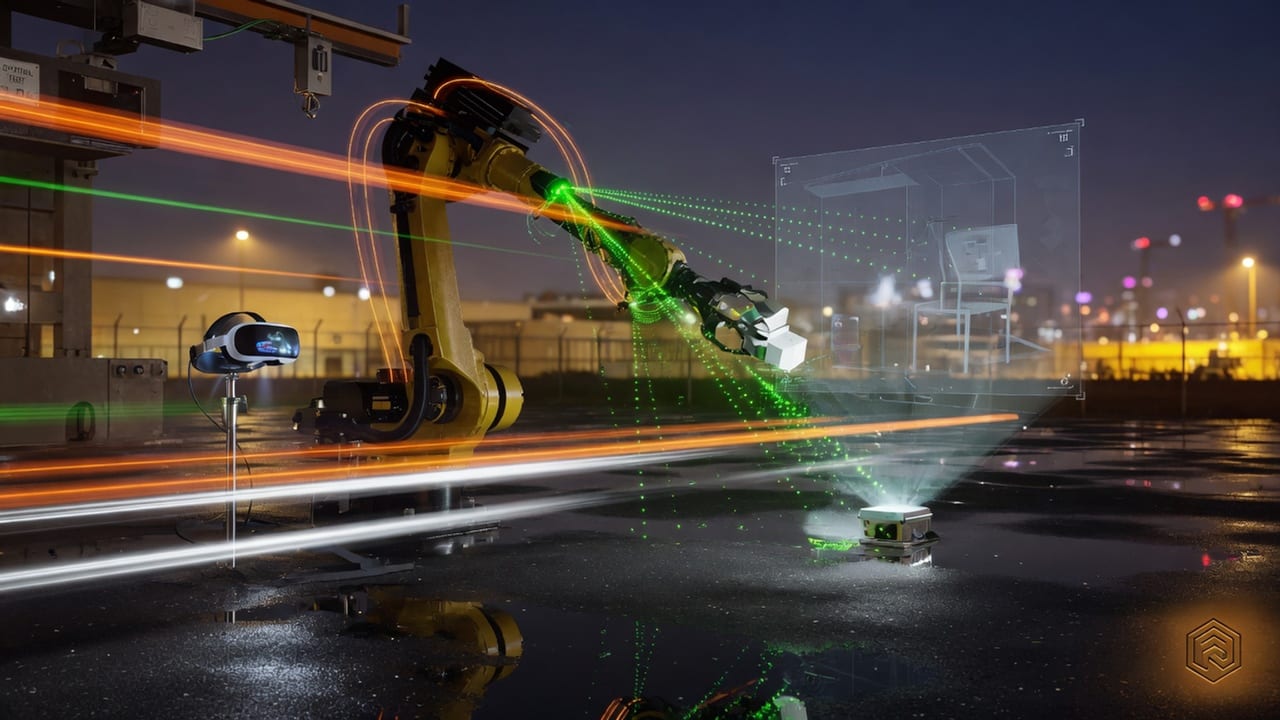
The World Labs co-founder is betting on persistent 3D environments for creators, designers and robotics researchers.
By RuntimeWire Staff · Published
Primary source: Bloomberg Technology
Why it matters #
World Labs has raised at least $1.23B to make spatial models a foundation for creative software and robotics. The bet succeeds only if generated worlds preserve the geometry and physics required for reliable action.
Fei-Fei Li used a Bloomberg Technology interview published Wednesday to sharpen the wager behind World Labs: language models learned to talk, and her next company intends to teach machines how to understand and act inside three-dimensional space.
World Labs is pursuing the gap between language and physical understanding. Chatbots can describe a room. Spatially intelligent systems would model its geometry, predict what happens inside it and eventually help a person or robot change it.
The bet follows the arc of Li's career. She led the creation of ImageNet, the visual database and benchmark that helped accelerate modern computer vision, directed the Stanford AI Lab from 2013 to 2018 and served as Google Cloud's chief scientist for AI and machine learning. World Labs gives her a chance to turn decades of visual-intelligence research into a product company with unusually deep financial backing.
Li co-founded World Labs with computer-vision and graphics researchers Justin Johnson, Christoph Lassner and Ben Mildenhall. Johnson completed his Stanford Ph.D. under Li and worked on visual reasoning, image generation and 3D reasoning. Mildenhall co-created Neural Radiance Fields, or NeRF, a method for reconstructing three-dimensional scenes from images. Lassner previously worked on graphics and 3D-reconstruction research at Epic Games and Meta Reality Labs Research.
Marble is the product version of Li's thesis
World Labs' first named product, Marble, became generally available on November 12th, 2025. World Labs says Marble can generate persistent, navigable 3D environments from text, images, video or coarse layouts. Users can edit and combine those environments, then export them as videos, meshes or Gaussian splats.
That output format is central to World Labs' pitch. A generated video gives the viewer a fixed sequence of frames. Marble aims to produce an environment that can be revisited, edited and inspected from different positions. For designers, game developers and visual-effects artists, the commercial proposition is a faster path from an idea or reference image to a usable spatial asset.
World Labs' stated customer groups include creators, game and visual-effects studios, architects, designers, robotics researchers and simulation developers. That professional focus gives the company a nearer-term market while its larger robotics ambitions mature. Architectural visualization, virtual production, game prototyping and product design can tolerate generated environments that still require human review. A robot-training simulator faces a stricter standard because errors in geometry, motion or physical behavior can produce a policy that fails in the real world.
$1.23B buys time for a difficult technical bet
World Labs emerged publicly in September 2024 with $230M raised. Andreessen Horowitz, NEA and Radical Ventures backed that financing, with Andreessen Horowitz and Radical Ventures each backing Li's argument that spatial intelligence could become a foundation for new creative and industrial software.
On February 18th, 2026, World Labs announced another $1B financing, bringing its publicly announced capital to at least $1.23B. World Labs named AMD, Autodesk, Emerson Collective, Fidelity Management & Research Company, Nvidia and Sea among the investors. Bloomberg reported that Autodesk contributed $200M to the round.
The investor list also shows how quickly world models are becoming strategic infrastructure. Nvidia is financing World Labs while developing its own Cosmos 3 platform for physical AI. Google DeepMind's Genie 3 generates interactive environments from text and emphasizes real-time navigation, consistency and simulated events.
World Labs is drawing its boundary around persistent, editable and exportable worlds, with simulation as the bridge between creative tools and machines. Li separates world models into renderers, planners and simulators. Renderers produce pixels for people to watch. Planners select actions for agents. Simulators attempt to preserve geometry, physics and dynamics so both people and machines can use the result.
World Labs moved further toward that simulator layer on July 21st, when it acquired robotics company SceniX. World Labs said the combination would connect world models, learning-based simulation and feedback from real-world robot training. The deal gives Li a robotics operation alongside Marble's creator-facing product, turning her broad spatial-intelligence thesis into two clearer routes to market.
The physics still has to work
Visual quality alone cannot establish that a generated environment is a reliable model of the physical world. A May 2026 research paper introducing the CRONOS benchmark found substantial counterfactual-consistency failures among the open-source video generators it evaluated. Predictions changed when researchers altered viewpoint, object appearance or scene context while preserving the underlying physical event.
CRONOS did not evaluate Marble, so its findings are not evidence of a World Labs product failure. They define the technical bar Li has chosen. A useful creative environment can survive an imperfect reflection or a small geometric artifact. A simulator used to train a robot must respond consistently when the camera moves or an object looks different.
Li's advantage is a founding group built around computer vision, neural rendering and 3D reasoning, plus enough capital to pursue research and product development in parallel. The burden attached to that advantage is equally clear: World Labs must show that its environments support dependable action, rather than serving as impressive scenes for humans to explore.
Other frontier labs are also searching for interfaces and model capabilities beyond the prompt box. RuntimeWire reported in June that Mira Murati's Thinking Machines Lab was exploring continuous audio, text and video interaction. Li is making a more physical bet. World Labs wants AI to build a representation of the space around an agent before that agent tries to do anything inside it.
The decisive milestone will come when those generated worlds become dependable working environments for designers, engineers and robots. Li has already assembled the researchers and capital for that attempt. Marble and the SceniX acquisition now have to prove that spatial intelligence can become a business as well as a compelling scientific direction.