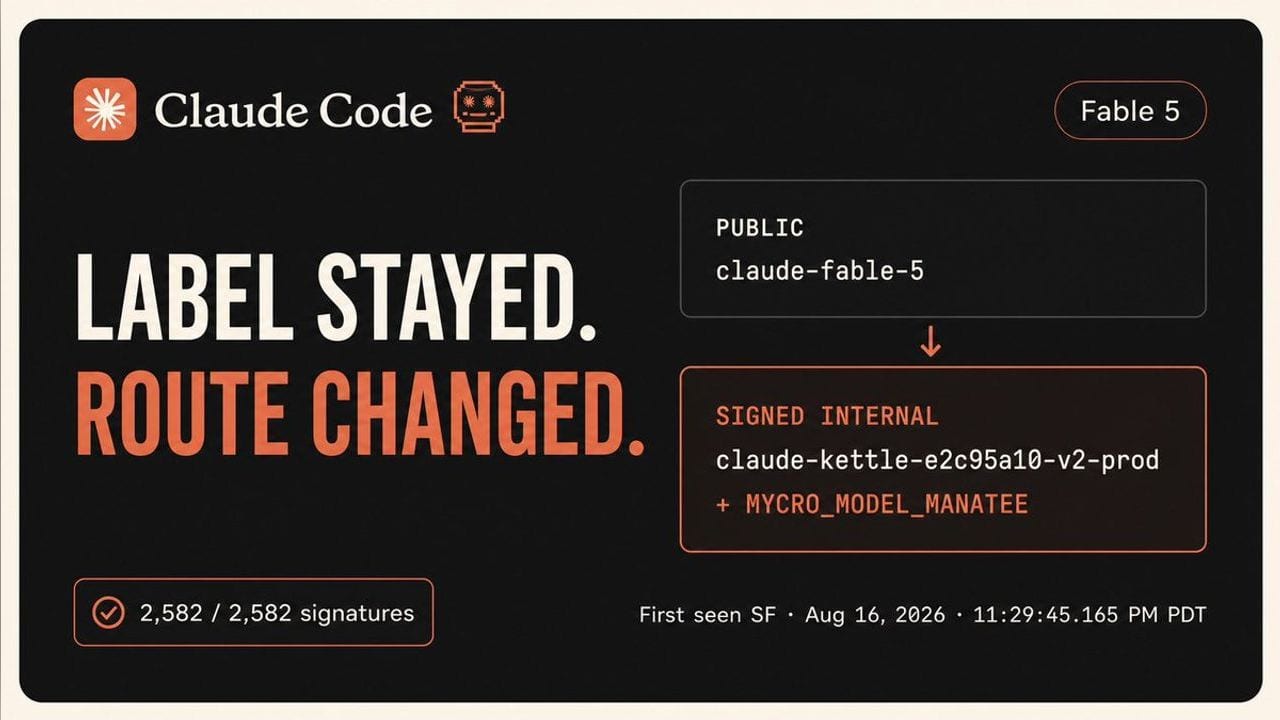
Anthropic's [Claude Fable 5](https://runtimewire.com/models/anthropic/claude-fable-5) began returning server-signed metadata naming an internal route called `claude-kettle-e2c95a10-v2-prod`

late on August 16th, according to [an analysis posted on X](https://x.com/chetaslua/status/2089783170896179632) by [@chetaslua](https://x.com/chetaslua).
The account said it decoded a protobuf embedded in Claude's signed thinking blocks and found the internal identifier in field six. Its graphic says the identifier appeared across 2,582 of 2,582 signatures beginning at 11:29:45 p.m. PDT in San Francisco, alongside another internal label, MYCRO_MODEL_MANATEE
.
That evidence supports a narrow conclusion: responses publicly labeled claude-fable-5
carried a previously unreported internal identifier. It does not establish that Anthropic replaced Fable 5's weights, deployed a more capable successor, or routed the requests to a smaller model. Anthropic has not publicly documented what the Kettle or Manatee labels represent.
What the signature can prove
Anthropic returns a cryptographic signature with each Claude thinking block. The signature contains an encrypted copy of the model's full reasoning, allowing Claude to verify and reconstruct earlier thinking during tool use and multi-turn conversations.
Anthropic's thinking documentation calls that signature an opaque field and instructs developers not to interpret or parse it. The public evidence behind the Kettle claim is a summary graphic. Reproducing the result would require the raw signatures, the decoding method, the inferred protobuf schema, and the complete response metadata.
The internal identifier also needs to be separated from Anthropic's public model ID. Anthropic's versioning documentation says claude-fable-5
maps to one fixed model snapshot. Anthropic says it does not update the weights or configuration attached to an existing model ID.
The same documentation gives Anthropic room to change the surrounding serving stack. Request routers, safety classifiers, sampling logic, and other infrastructure can be updated while the underlying model weights remain fixed. On the available evidence, Kettle could be an internal serving deployment for the existing Fable 5 snapshot. It could also represent a different component in the response pipeline. The codename alone cannot distinguish between those possibilities.
Anthropic already routes some Fable requests
Model switching is already part of Fable 5's documented design. Anthropic says automated classifiers inspect every request and can redirect work involving offensive cybersecurity, dual-use biology, model distillation, and some frontier chip-development tasks to an Opus model.
On Claude's consumer and coding products, Anthropic says these fallbacks are supposed to be visible. Its Fable 5 switching guide says users receive a notice, the answer carries the name of the model that served it, and the model picker moves to Opus for later turns. API fallbacks similarly expose the serving model through the response's top-level model
field and a dedicated fallback
content block, according to Anthropic's developer documentation. The Kettle claim describes something different: an internal identifier appearing underneath a response that retained the public Fable 5 label. The post does not show whether users saw a fallback notice, whether the API's top-level model field changed, or whether billing shifted to another model's rate. Those details determine whether this was an undisclosed model switch or an ordinary infrastructure revision.
Anthropic had recently changed part of that infrastructure. In an August 7th safeguard update, Anthropic said it retrained Fable 5's biology classifier and reduced biology-related fallbacks by about 85% in internal testing. Anthropic estimated the update would reduce total fallbacks by 17% in Claude Code. There is no public evidence tying Kettle to that classifier release, but the timing shows Anthropic was actively modifying the systems surrounding Fable 5.
The label matters because the price does
Anthropic markets Fable 5 as its most capable generally available model and charges $10 per million input tokens and $50 per million output tokens. Customers selecting it are buying a specific capability and cost tier, particularly for long-running coding and agent tasks where small behavioral changes can alter results across hours of work.
A hidden switch to materially different weights would raise questions about billing, evaluation reproducibility, and whether developers can rely on a pinned model ID. An internal deployment name for the same weights would fit Anthropic's stated versioning policy and amount to a routine serving change.
The signed metadata has exposed a name from inside Anthropic's stack. It has not yet shown what changed behind that name.