The work around the frontier model
Frontier models get the headlines. The small models around them decide how long you wait.
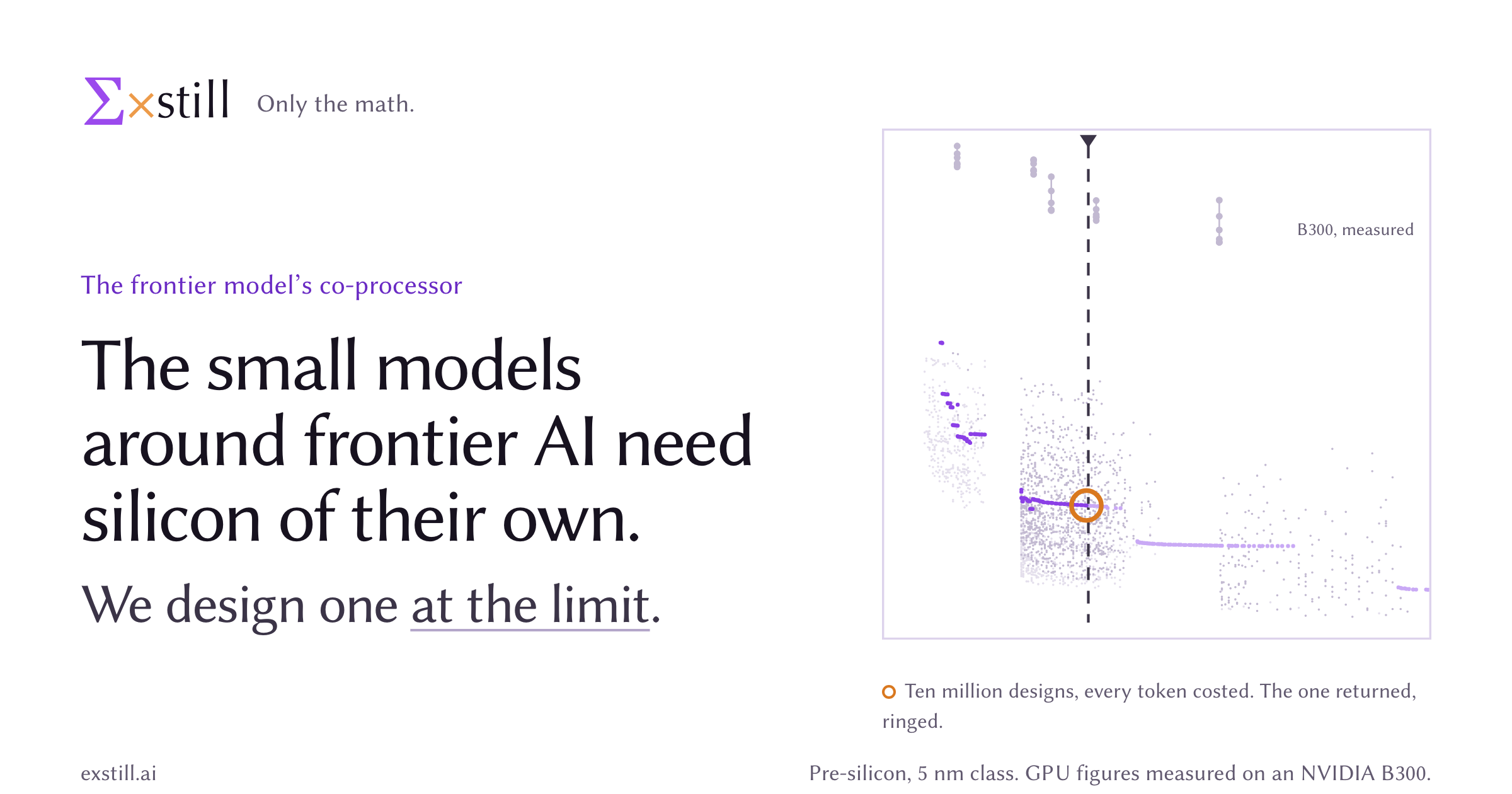
These small models draft answers, screen prompts, run agents and reason in real time. Each sits on the critical path, where a person waits on every millisecond, yet runs on GPUs built for crowds. Polyglot-DC1 is the frontier model’s co-processor: a chip and the model architecture designed with it, beside the GPU, not instead of it. The search that found it costs a multitude of silicon and model architectures, every token of each, and returns the best design within the data-center envelope.
Four distinct workloads, one co-designed model architecture. Change the weights, not the chip. Explore speculative decoding, guardrails, agents, and financial reasoning, with real model outputs replayed at Exstill speeds and NVIDIA B300 reference rates.
Polyglot-DC1-Draft guesses the next tokens on the Exstill chip and the target model checks them on its GPUs, so answers arrive sooner with no loss in quality. One draft architecture serves all five models below; only the weights change. Coding answers at maximum reasoning effort arrive 3.6x to 6.1x faster end to end, reasoning answers up to 7x.
Polyglot-DC1-Guard reads every prompt and every reply, in many languages, and says whether it is safe, which harm it falls under and whether the assistant refused. On the Exstill chip a verdict takes under a millisecond, so screening adds no wait anyone notices.
Three long reasoning-model responses, including their reasoning, are screened approximately every 1,700 characters as they stream. Six standalone messages are screened once each. Every verdict is a real Polyglot-DC1-Guard output, and any blocked content stops the response stream.
Each verdict comes with the guard’s probability for its deciding token. The long answers are held-out Qwen3GuardTest items; the single messages were written for the demonstration. Stopping the answer at a block is how a deployment uses the verdict; the streaming pace is illustrative. Chip pre-silicon B300 measured.
Polyglot-DC1-Agent works a customer case from start to finish: it reads the policy, calls the tools and reasons through each decision. An average turn is 1,145 tokens: 57 ms on the Exstill chip, 2.5 s on a B300.
Eight completed τ³-bench episodes, replayed turn by turn. Each customer is simulated by another model, with neither side seeing the other’s instructions. The original conversation unfolds on the right, while the decoding-time comparison shows how quickly Exstill and NVIDIA B300 would generate the agent’s responses.
Polyglot-DC1-Finance works through filings, accounts and valuations step by step before it answers. On the Exstill chip the reasoning and the answer arrive in 44 ms on average, 38x faster than one B300 serving one person.
Twelve problems from four finance benchmarks, each solved by Polyglot-DC1-Finance and missed by most other models. On the left the problem; on the right its reasoning and answer, word for word, decoded at the chip’s speed and at one B300’s.
One argument at a time, each with its receipts: what we measured, what we simulated, and how.
A GPU serving one person pays for everything but the math. We measured the one dial it has, what each token pays for, and the floor underneath it all, the arithmetic alone.
2.2 ms and 0.99 J a token for one person; the arithmetic alone, 0.89 mJ Three questions for any chip number, ours included: what it rewards, how far down it went, and whether the whole model ran.
Batching tripled tokens per joule and left energy × delay where it was Most chips are designed by choosing an architecture and then measuring it. We measure every token’s time and energy on placed and routed circuits, search the model and the silicon together, and cost every token of every design.
Over ten million design points; 304 circuits placed and routed The small models around frontier AI perform specialized work on the critical path of a request, and that work benefits from silicon designed alongside them. Polyglot-DC1 is one model architecture, co-designed with Exstill silicon and distilled for four distinct roles where every millisecond adds to someone’s wait.
Agent turns 43x and screening 38x faster than one B300 serving one person In speculative decoding, a small draft model proposes the next tokens and the target model verifies them in one forward pass, so answers arrive faster with no loss in quality. Polyglot-DC1-Draft, one draft architecture for five open models, runs on its own silicon and outperforms well-established GPU-based drafting methods.
Coding answers arrive 3.6x to 6.1x faster end to end, across five open models Production AI must account for what goes in and what comes out. Polyglot-DC1-Guard screens prompts and responses across six languages, delivering detection quality competitive with leading open guards while reducing false alarms on held-out evaluations.
0.70 ms projected decode time per typical verdict, 38x faster than the measured NVIDIA B300 reference Reasoning makes language models more capable, but generating thousands of intermediate tokens takes time. Polyglot-DC1-Finance brings specialized reasoning to financial analysis, from filings and valuation to market intelligence, with millisecond-scale decoding on Exstill silicon.
44 ms projected decode time per average response, 38x faster than the measured NVIDIA B300 reference Bring us a model, a workload, a rack or a power budget. Each ends in a number you measure yourself.