There are often tight deadlines, the cases often involve complex issues, and the stakes are incredibly high. It is a high pressure job that often requires long hours, tedious work and an incredibly high standard of accuracy.
One of the things that makes this job so difficult is the fact that your work will be scrutinized heavily by both sides. If you do your job well, you can help your client win the case. If you don’t, you can easily hurt the side you were supposed to help.
That, in turn, appears to be what happened with one expert witness in a Texas courtroom. Originally brought in to testify on behalf of the defense, the expert witness ended up having his AI usage disclosed. Though his clients attempted to disqualify him, he was eventually called by the plaintiffs to address the issue.
Now his former clients have been hit with a $61.5 million jury verdict.
The case is a stark reminder of the dangers of improper and undisclosed AI usage, especially in high-stakes situations. Unfortunately, it’s also unlikely to be the last of case of its kind.
The Story So Far
On January 24, 2020, there was an explosion at the Watson Grinding and Manufacturing facility in northwest Houston. When the dust settled, three people had been killed, including two of the company’s employees. Another 18 people were injured and dozens of homes were damaged or destroyed.
Over three years later, the U.S. Chemical Safety and Hazard Investigation Board (CSB) released its report on the incident. It found that a disconnected propylene hose had led to the buildup of flammable gas, which ignited when an employee turned on the lights. The findings were also summarized in a YouTube video.
As one might expect, lawsuits quickly followed. In addition to Watson Grinding itself, the lawsuits also targeted the company 3M, which was responsible for maintaining the location’s gas detection system. 3M, for its part, denied responsiblity for the incident, saying that it was Watson Grinding’s negligence, not theirs, that caused the explosion.
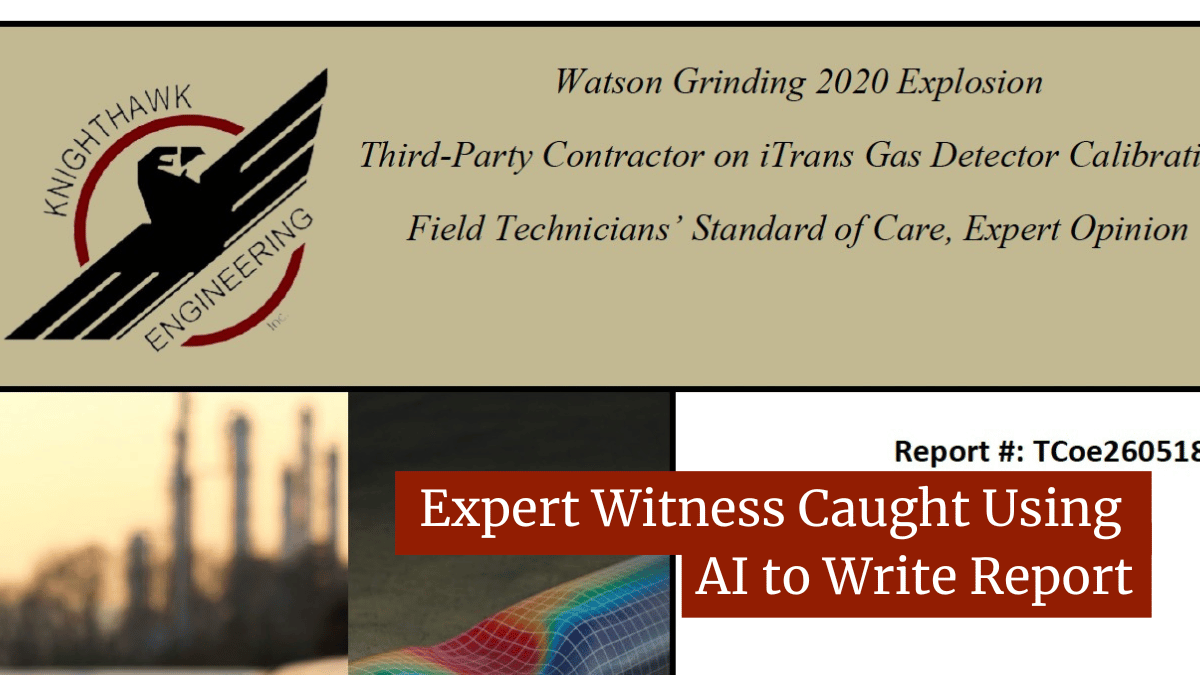
As part of that defense, 3M hired Josh Autenrieth of Knighthawk Engineering to prepare an independent report on the incident. For this 30-page report, he was paid $475 per hour for a total of $90,000.
However, during discovery, one of the plaintiff’s attorneys discovered a five page document called a “citation overlay” that appeared to have been generated by AI. Autenrieth’s deposition was d for three hours while his ChatGPT logs were gathered. What he returned was 350 pages of ChatGPT conversations, it quickly became clear that the document was almost entirely AI generated.
Even more damning was some of the prompts that Autenrieth used. These included asking AI to “create an exceptional expert witness report… and show how 3M is 0% at fault for the explosion at watson grinding”
In another exchange, Autenrieth uploaded images of gas detection equipment and asked ChatGPT, “what am I looking at?”
3M attempted to disqualify Autenrieth as an expert witness. However, the plaintiffs took the unusual move of calling Autenrieth to the stand to explain his use of AI in his report.
Ultimately, the jury found that 3M was 30% responsible for the explosion and awarded the plaintiffs $61.5 million in damages.
3M continues to deny responsibility and plans to appeal this decision along with two similar ones that found the company partially responsible for the explosion.
Lessons Learned
The legal field is no different than any other field. AI has been seeping into it for years and, though much of the usage has not drawn attention, there have been a number of high profile AI blunders.
We’ve already talked at length about how lawyers have been using AI to write their briefs and getting caught by including hallucinated citations. Realistically, it was only a matter of time before a story like this one came to light.
Being an expert witness is a big responsibility. Though those duties aren’t as rigid as those of a lawyer, you have an obligation to ensure that your work is your own, the product of your knowledge and experience and that you faithfully represent both your expertise and your findings.
Quite clearly, Autenrieth did not do that.
However, in all the coverage that the story has received, one question still lingers: Did 3M have a no-AI clause or other AI usage clause in its agreement with Autenrieth?
If they didn’t, there may not be much that they can do. Granted, clawing back $90,000 isn’t going to do much in a $61 million case, but it is better than nothing. When hiring an expert witness, AI usage needs to be considered and the expectations around it need to be made clear. Autenrieth’s AI usage should not have come out in a deposition, it should have been known by 3M and disclosed way before that point.
Though Autenrieth is ultimately responsible for his actions, 3M needs to examine its own role in this story. If they were truly blindsided, which appears to be the case, then they need to examine their practices and policies when it comes to hiring expert witnesses. The same goes for any third party or intermediary involved in connecting Autenrieth to the case.
If 3M was aware that Autenrieth was using AI so heavily, then things get much worse. That said, I don’t think the evidence points taht way at this time. Especially since they tried to disqualify him after the fact. Still, everyone involved in recruiting Autenrieth needs to examine their practices and policies in order to ensure that this doesn’t happen again.
Bottom Line
One thing that is very important to remember about being an expert witness is your reputation is everything. If you are discredited, in particular if your own side attempts to disqualify you, then you are more or less done.
For an expert witness, wins and losses aren’t nearly as important as the integrity of your work. You can lose a case but, as long as your work was authentic and professional, you will likely find others who are willing to work with you. This is especially true in an active field like this one. Though I don’t know Autenrieth personally nor am I familiar with his work up to this point, I know that a story like this one is often the death knell for the career of an expert witness.
That’s not much comfort for 3M, who now has to deal with the fallout of this story.
While there’s not much anyone can do about what has already happened, it’s an opportunity for 3M and others involved in this case to examine their policies and practices around AI usage.

For other companies, law firms and expert witness services, this is a warning shot. What happened in this case could happen to anyone, especially if they don’t have good policies in place.
The best time to act was roughly four years ago, the second best time to act is now.
Want to Reuse or Republish this Content?
If you want to feature this article in your site, classroom or elsewhere, just let us know! We usually grant permission within 24 hours.