NDAs are a real pain in the ass.
Offer letters with an invention assignment are worse. One of the hardest parts of both is the disclosure: your list of prior inventions. It usually shows up as an attachment called Exhibit A.
I find this process stressful for several reasons. Usually I’m under a tight deadline to respond, and then there are the hundreds or thousands of dollars of lawyer fees if it’s a complex situation. This is a lot of effort and cost for what could turn out to be a disappointing 15-minute conversation about an opportunity that’s not a match.
But the consequences of not taking this seriously are high! In case of a legal dispute, it can be used as evidence or admission that no prior inventions were brought to the table. Being sloppy or lazy can be costly if the opportunity turns out to be a big winner.
Exhibit A is a Résumé With Legal Teeth #
Filling it in feels like writing a résumé from scratch. You dig back through years of work and try to remember what you made and when.
But it’s more tedious because the stakes are high, legal. Name another client’s confidential project, and you’ve breached a different NDA. Leave off the library you wrote in 2023, and you may have just handed it over.
And it’s more highly specific, because it has to fit the deal. The other side cares about the work that sits near their field. That’s where a dispute would start, so that’s where your list needs dates and evidence. Everything else can stay general.
That’s days of digging, and you often need a fast response. So most people write “None” and hope for the best.
Luckily, AI is very good at this kind of digging.
Fictitious Example #
Meet Jordan. Jordan is fictional (and one of the skill’s test cases): a backend engineer joining a seed-stage startup that makes inventory software for restaurants. Jordan has a blog on demand forecasting, an open-source library, a consulting client under NDA, a side project co-owned with a friend, and 2 months of free help already sitting in the startup’s repo.
Here’s Exhibit A: the skill drafted for Jordan, the same example that’s on the website.
A few things to notice:
- The blog and the library are dated before the startup’s launch, with public links. That’s the strongest evidence you can have.
- The consulting client shows up as “a regional freight company.” Never by name.
- The free work for the startup gets its own section, and it says whose idea each piece was. Crediting them where it’s due makes the rest of the list believable.
Running It Is Easy #
It’s a free skill for Claude Code, part of my Save Your Startup plugin within my GitHub Skill repo.
- Install it. Paste these into Claude Code:
/plugin marketplace add rickmanelius/skills
/plugin install save-your-startup
/sys:ip-audit
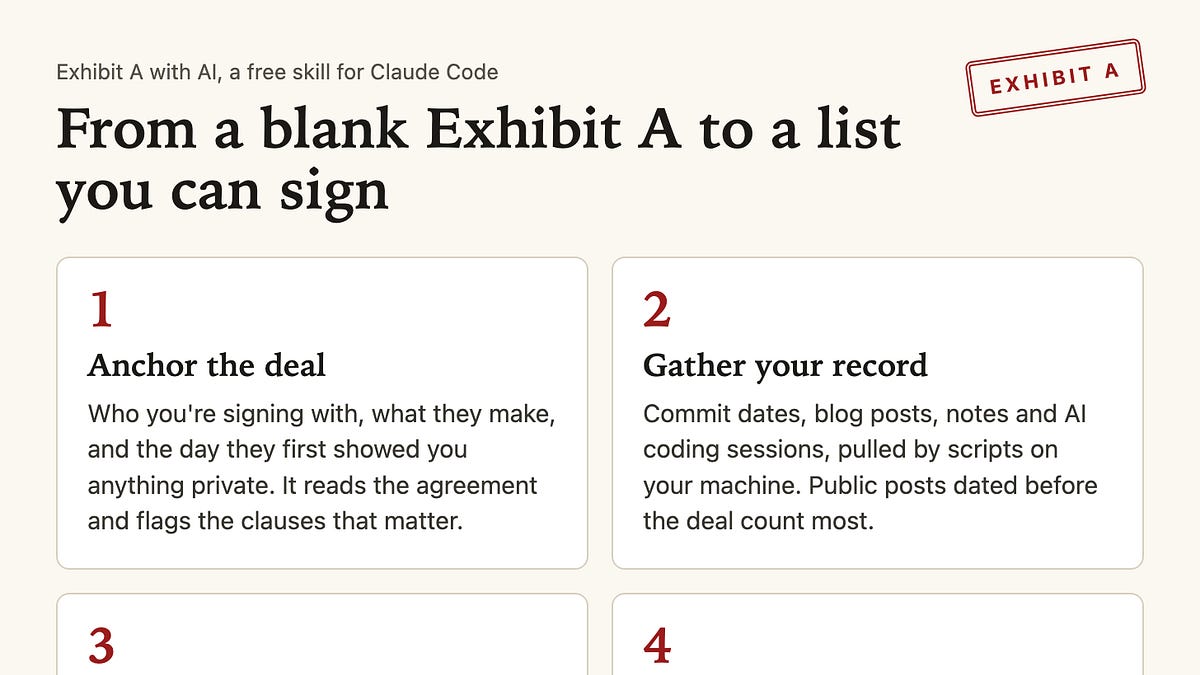
- Answer the context. It asks 5 questions up front: who you’re signing with, what you’re signing, when they first showed you anything private, where your work lives, and whether a paid search is OK (default: no).
- Let it dig. Scripts on your machine pull your commit dates, blog posts, and AI coding sessions, then it sorts everything 4 ways: what you made before, what you built independently since, what you’ve contributed to them, and what belongs to someone else.
- Take your files. The list, ready for Exhibit A, plus a private evidence file, a one-page brief for the conversation, and questions for your lawyer.
It’s not legal advice. It gets you to a lawyer prepared, so the hour you pay for goes to judgment. And because whatever Claude reads goes to your AI provider, it keeps the other side’s files and your clients’ files closed, and tells you so up front.
Bonus idea: run it on a local model. Claude is optional here. The skill is plain Markdown instructions plus a few Python scripts (it’s in my skills repo on GitHub). If you can run a capable model on your own hardware, point OpenCode at the skill folder and use that instead. Then nothing leaves your machine, so it can read your session logs and the other side’s files in full.
Why I Built It #
In the last month alone, I’ve had 4 conversations that needed a mutual NDA signed before they could go anywhere. At that pace, digging through years of work by hand every time isn’t realistic. So I ran this audit on myself. It found work I’d forgotten and dated my public writing well ahead of the deal in front of me. Then I turned it into something anyone can run.
See more #
The walkthrough and the full sample list are at exhibit-a.xyz.
Next time a form asks for your prior inventions, don’t write “None.” Use this ip-audit skill so you have a robust Exhibit A to discuss with your legal counsel.
Writing Disclosure #
I normally default to writing 1st drafts by hand. However, it is Thanksgiving and I want to spend time with my family, so I wrote this article first with AI and then did minor edits.