Adam Jacob, the Chef co-founder who spent six years pursuing a replacement for infrastructure as code at System Initiative, has raised $6.25 million for Swamp, his new attempt to make AI agents reliable enough to run operational workflows.
An SEC Form D filed July 21st by Elder Swamp Club, Inc., the San Francisco corporation behind Swamp, shows $6,249,998 sold toward a $6,999,995 offering. The first sale occurred July 8th. Elder Swamp Club sold Series Seed preferred stock and common stock issuable upon conversion to two investors under a Rule 506(b) exemption.
The filing does not identify those investors or disclose a valuation. Elder Swamp Club also declined to disclose its revenue range. The financing appears to be Swamp's first outside round as a standalone corporation, which was incorporated in Delaware this year. A privacy policy effective May 18th identifies Elder Swamp Club as the operator of Swamp's service.
Jacob is building Swamp with Nick Stinemates, John Watson, Mahir Lupinacci and Paul Stack, the five founders named in the project's GitHub repository. The SEC filing lists Jacob and Lupinacci as executive officers and directors, with Lupinacci signing as secretary.
A second attempt at infrastructure automation
Jacob started his career as a systems administrator and became the original author and co-founder of Chef, the infrastructure automation business that Progress Software acquired for $220 million in 2020. He later founded System Initiative around a visual, collaborative model for managing cloud infrastructure.
Swamp preserves the underlying fixation with repeatable operations while changing the primary user from a human operator to an AI agent. System Initiative's former visual workspace has given way to a local-first command-line tool that agents can inspect, extend and operate directly.
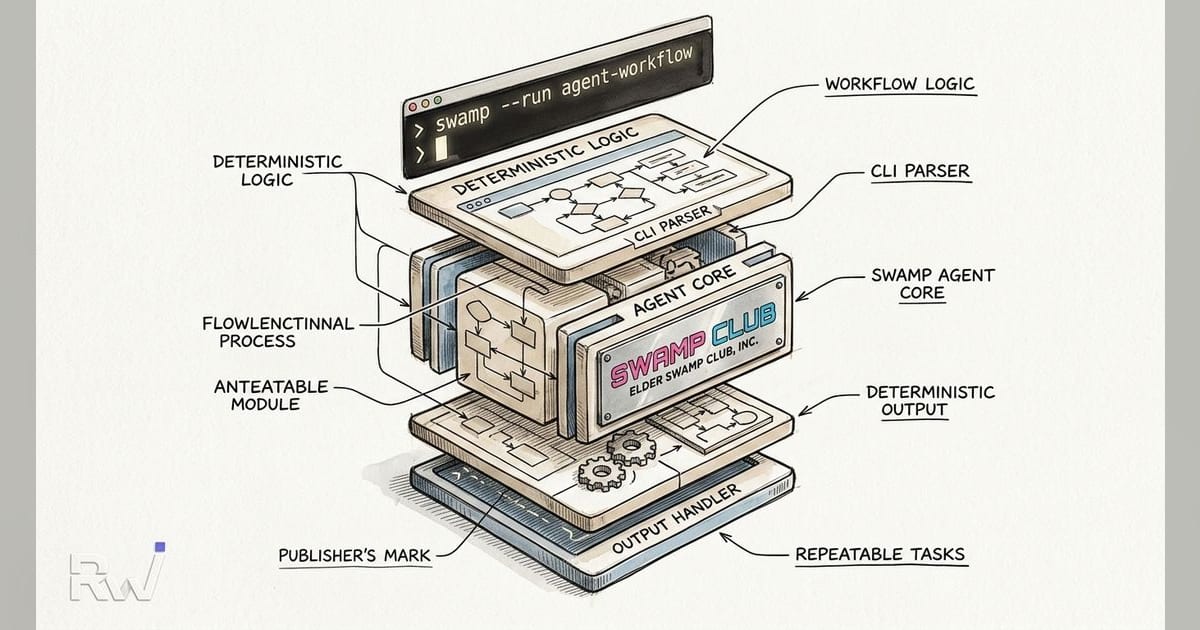
The shift followed a practical realization inside Jacob's group: coding agents could produce working automation quickly, but their output was inconsistent across repeated tasks. Swamp separates the agent's reasoning from execution. The agent designs a workflow once; Swamp validates and reruns that workflow deterministically.
Jacob has described the design as a response to software that can adapt to a user's specific problem. "It adapts to my needs, not the other way around," he wrote in an April essay. His argument is that agents make custom software cheaper to produce, creating demand for reusable primitives that preserve the useful work after a chat session ends.
That is the market Elder Swamp Club's new capital is intended to pursue: infrastructure for capturing an agent's successful work before the result disappears into a transcript or becomes another unmaintained script.
Swamp gives agents constraints, state and memory
Swamp's product architecture is built around typed models, workflows, encrypted vaults, extensions and immutable run data. An agent reads documentation for an API or command-line tool, writes an extension in TypeScript, and creates model definitions and workflows as YAML files. Those artifacts live in a .swamp/
directory that can be inspected and versioned with the rest of a project.
Swamp supports Claude Code, Codex, Cursor and other harnesses capable of reading files and executing shell commands. Its agent integration documentation says Swamp generates tool-specific instruction files such as CLAUDE.md
and AGENTS.md
, while exposing schemas and structured JSON output through the CLI. Secrets are injected at runtime from encrypted vaults rather than placed in prompts.
That architecture addresses a basic problem in agent deployments. Language models remain useful for interpreting an objective and constructing an approach, while production systems need predictable execution, permission boundaries and an auditable record of what happened. Swamp is trying to occupy the handoff between those two requirements.
Elder Swamp Club has also taken an unusually controlled approach to open-source development. Swamp is licensed under AGPLv3 with an extension exception, but its maintainers do not accept external pull requests. Contributors submit issues, which Elder Swamp Club's engineers triage and implement with agents under their control. The repository describes the policy as a supply-chain safeguard against large, plausible-looking AI-generated changes that are difficult to review.
The approach concentrates control with the five founders even as Swamp asks users to publish reusable extensions. That tension will matter as Swamp tries to build a developer community around software whose central promise is trust.
The filing reveals capital, not adoption
Swamp's site currently reports more than 38 million automation events "from agents in the wild," a figure supplied by Elder Swamp Club. It does not disclose how many users, organizations or recurring workflows produced those events.
The public development record shows considerable shipping activity. As of July 20th, GitHub displayed 1,427 commits and 1,260 releases for Swamp. Release volume measures how frequently Elder Swamp Club publishes software, however, rather than customer adoption or revenue.
In a recent Changelog & Friends interview, Jacob said the group had reduced its size from 18 people to five and shipped Swamp 900 times over four weeks. Paul Stack wrote this month that the five-person operation had also built Swamp Club's extension registry, documentation, user accounts, administrative tools and metrics systems while publishing features daily.
The $6.25 million already sold gives that small group time to turn a fast-moving open-source project into a durable business. The missing disclosures remain consequential: the Form D names only two investors, provides no valuation and offers no revenue figure. It also does not explain the ownership relationship between Elder Swamp Club and System Initiative, whose website now presents Swamp rather than the earlier infrastructure product.
What is clear is the size of Jacob's reset. He helped establish infrastructure as code through Chef, then spent years trying to replace it with a collaborative visual system. Swamp puts the agent in the operator's seat and reduces the human interface to instructions, reviewable definitions and approval. Two investors have now put $6.25 million behind that bet.