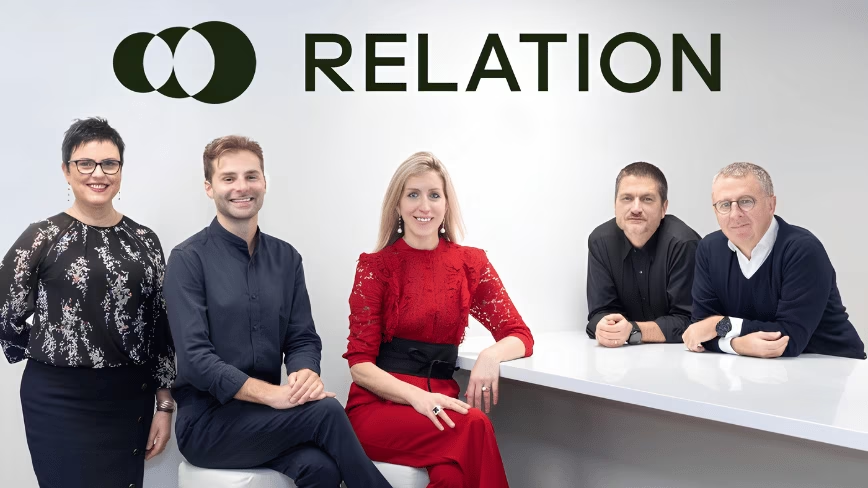
The race to build an AI “foundation model of the cell” has a fuel problem. The biological data needed to train one is scarce, messy and inconsistent. Relation Therapeutics thinks the answer is to manufacture that data itself, and GSK is paying up to $110m to help.
The London startup unveiled two things at once on Thursday. The first is MORGAN, its flagship cellular foundation model. The second is an expanded collaboration with GSK to generate the data that feeds it.
A model of how cells respond #
MORGAN, short for Multi-Omic Regulatory Genomics using Artificial Neural Networks, is meant to predict how a human cell reacts to a genetic tweak or a drug. Get that right, and you can spot disease mechanisms and new drug targets on a computer, before touching a lab bench. It is the same idea behind a foundation model of the chest or the AI-biology work at DeepMind’s Isomorphic.
Relation’s pitch is not the model alone. It is the data behind it. Models like this are only as good as what they learn from, and human biology data is thin. So Relation is building automated labs that run cellular experiments at what it calls “superhuman consistency.” They generate “petascale” datasets of how cells respond to interventions over time.
Why GSK is paying #
That data factory is what GSK is buying into. Under the deal, Relation can receive up to $110m in upfront and milestone payments. In return it will generate large-scale human “perturbation” data and deploy it into models including MORGAN. The datasets capture how cells respond to genetic and pharmacological changes, which GSK wants for finding new drug targets.
“The future of drug discovery depends on our ability to understand how human cells respond to disease and treatment at an unprecedented level of detail,” said Relation’s chief executive David Roblin. He calls MORGAN and the lab behind it “the scientific infrastructure” for the next wave of drug discovery.
A crowded, unproven field #
Relation is not alone in betting biology can be modelled. Well-funded rivals from Chai Discovery to a growing field of AI-bio labs are chasing versions of the same prize. Pharma is signing AI research pacts at a fast clip.
The claims are big. Relation told Endpoints News its approach could deliver “transformationally different success rates” in drug discovery. That remains to be proven. Most drugs still fail in trials, and no cell foundation model has yet produced an approved medicine. What the GSK deal shows is that Big Pharma is now willing to pay for the data, not just the drug.
Get the TNW newsletter #
Get the most important tech news in your inbox each week.