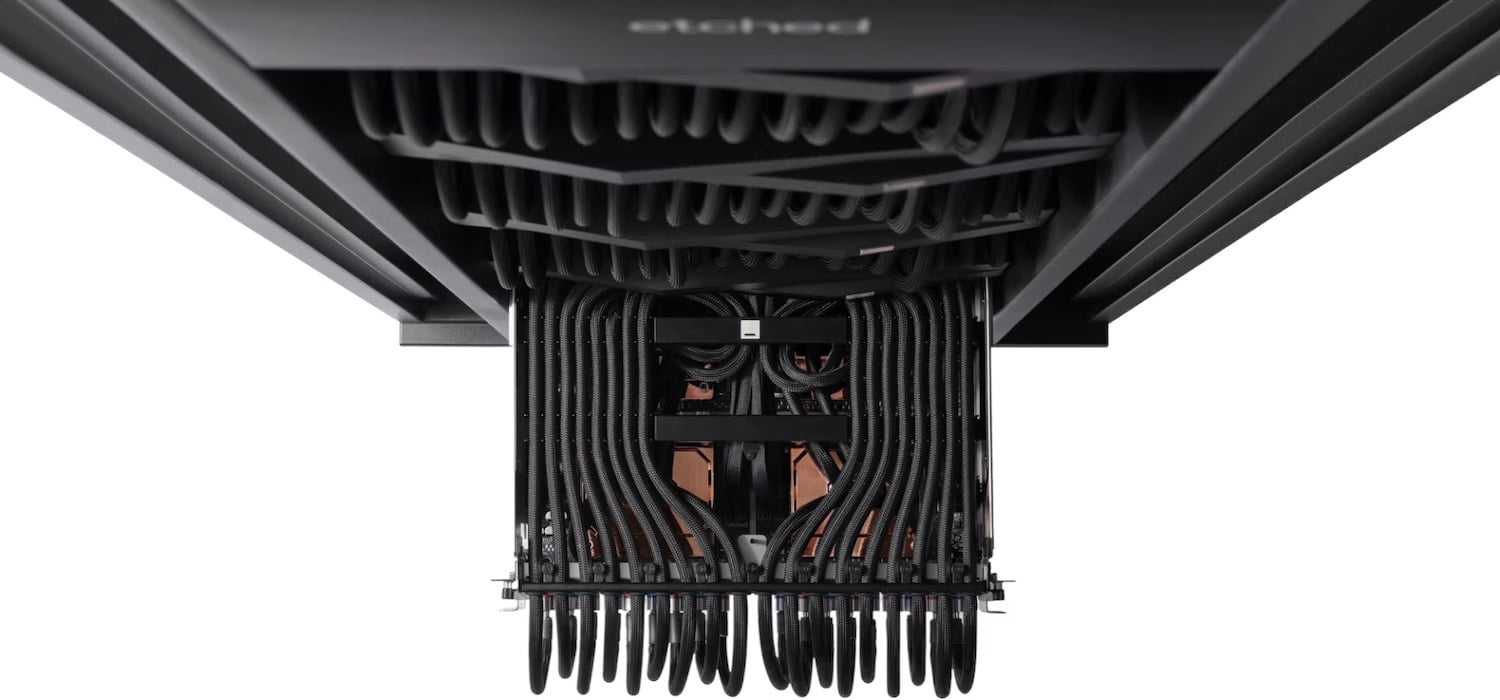
Etched raised $300 million in a Series C funding round at a $10.3 billion valuation, announced in late July, less than a month after the company emerged from stealth. Sequoia led the round, which included participation from a16z, Jane Street, Diffusion, and SK Hynix. The company described it as the highest valuation achieved in a Sequoia-led Series C.
Etched plans to use the funding to expand production and accelerate customer deployments. In addition to its previously constructed Taiwan factory, the company has opened an 80,000-square-foot facility approximately 15 minutes from its main office. The 10 MW Milpitas site will support a new product introduction lab, an in-house surface-mount technology line, prototyping, and broader deployment operations.
The company is focused on purpose-built systems for AI inference, which it views as a central and expanding component of AI workloads. Etched is targeting higher inference throughput, lower operating costs, and improved energy efficiency to support larger-scale deployments than current data center infrastructure can economically provide.
Multiple Model Support #
Etched says its hardware supports multiple model architectures and is not limited to a single model type. Its inference clusters currently run large mixture-of-experts models, including DeepSeek and Qwen, as well as Mamba, a state-space model with a different architecture from transformer-based systems. The approach is intended to allow customers to use the same infrastructure as model architectures evolve.
The company is developing two technologies for its rack-scale systems. Low Voltage Inference, or LVI, is designed to increase FLOP density within an existing power envelope. Conventional systems often encounter thermal limits that constrain clock speeds before reaching their maximum theoretical compute performance. Etched uses hardware and system co-design to target higher throughput at lower power and cost.
Combining SRAM and HBM #
Cluster Scale Memory, or CSM, combines SRAM and HBM in a memory system designed for an entire cluster rather than an individual processor. The architecture creates a shared SRAM pool across the scale-up domain and connects it using a proprietary high-bandwidth, low-latency interconnect. Etched says this design is intended to improve memory access latency while avoiding the cost, yield, reliability, thermal, and compute tradeoffs associated with SRAM-only systems and 3D DRAM-based approaches.
Etched said demand for its inference systems is exceeding supply as customers move from evaluation to production deployments. The company has rapidly expanded its team to 400 people, with engineers recruited from NVIDIA, Broadcom, Google TPU, SK Hynix, and high-frequency trading firms.
The company operates from a San Jose office that includes an NPI prototyping facility and a 2 MW data center running Etched hardware continuously. Sequoia partner Sonya Huang said Etched had made unusual progress for a semiconductor company in less than three years. She said purpose-built inference compute could become dominant as inference expands.
Etched co-founder and CEO Gavin Uberti said the company believes frontier AI infrastructure requires more than incremental hardware improvements. He characterized the company’s approach as a first-principles redesign of the technology stack focused on improving inference speed, cost efficiency, and scalability.
Co-founder and President Rob Wachen said the company has significant work ahead to reach gigawatt scale and is partnering with AI infrastructure investors to move faster. He added that the team is working around the clock with early customers to bring its first product to life.