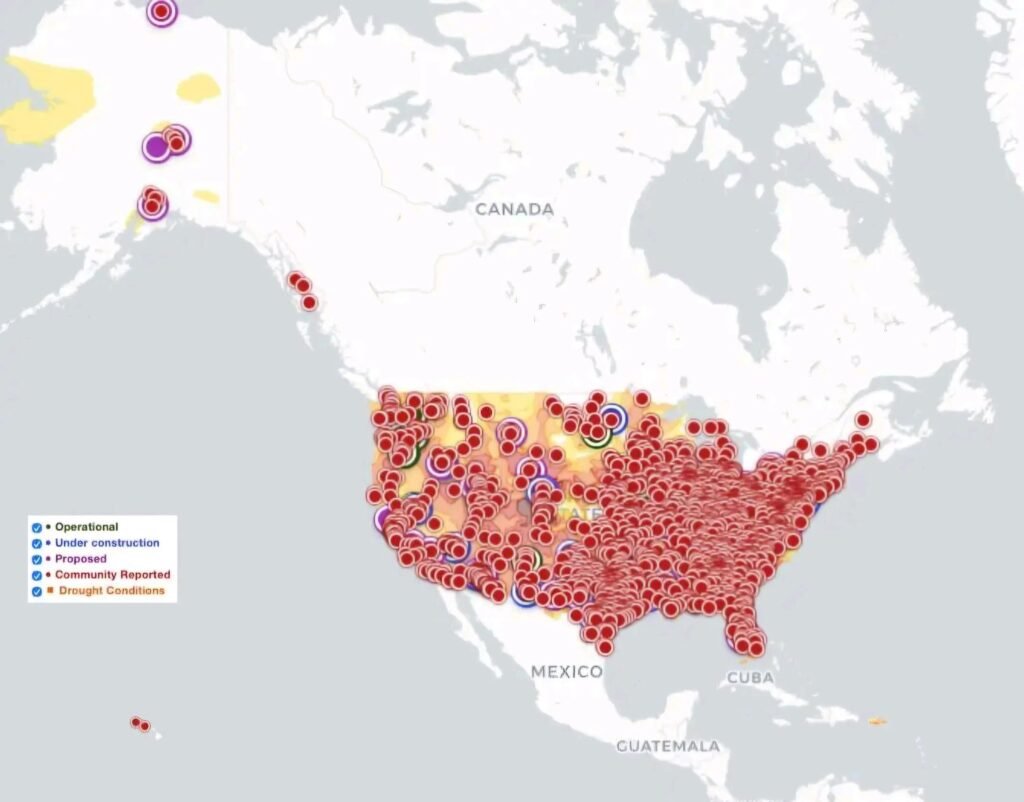
Erin Brockovich’s data center map buckled under demand within its first three days online, overwhelmed by residents rushing to flag artificial intelligence facilities springing up in their communities. The consumer advocate launched the crowd-sourced tracker in late April, inviting Americans to self-report AI-driven data centers that are operational, proposed, or under construction near them. She did not expect the reaction that followed.
Why the Data Center Map Went Down
The volume of submissions crashed the site twice in the first 72 hours after launch. Brockovich has said she woke up on the third day realizing the issue was not isolated to a single town or a single water source. Complaints were arriving from communities all over the country, often from people who had no connection to one another but described strikingly similar problems tied to nearby facilities.
She has recounted opening her inbox to find dozens of messages from residents in one Louisiana community alone, each describing concerns about the same nearby project despite not knowing each other. That moment, she says, is what convinced her the data center boom was a nationwide story rather than a local dispute.
Thousands of Reports and Growing
What began as a modest tracking tool has since ballooned into one of the largest independent records of AI infrastructure concerns in the country. The map has logged more than 8,000 confirmed community reports, with Brockovich citing a running total closer to 16,000 submissions spanning nearly all 50 states. She has described the project as a way for ordinary residents, not regulators or corporations, to document what is happening in their own backyards.
Water Tops the List of Concerns
Water usage has emerged as the single biggest worry among people submitting reports, ahead of electricity demand, health effects, and impacts on local wildlife. Many facilities require enormous volumes of water for cooling, and residents in multiple states have reported strain on local supplies and rising utility costs since construction began nearby.
Transparency Is the Recurring Complaint
Beyond resource concerns, Brockovich says the most consistent theme in submissions is a lack of transparency. Residents frequently report learning about new facilities only after permits were already secured or construction had begun. In some cases, local officials reportedly signed non-disclosure agreements before residents were told a project was even under consideration. Brockovich has described people waking up to find heavy construction underway with no prior notice, developers who do not respond to inquiries, and permitting processes that moved forward with little public input.
A New Chapter for a Longtime Advocate
Brockovich built her reputation decades ago leading a landmark case against a utility company over groundwater contamination, a story later dramatized on film. She says the same instincts that drove that investigation are now pointed at the rapid, often secretive expansion of AI infrastructure. In her view, the resources at stake, land, water, health, and air, are worth defending regardless of the industry behind the threat, and she intends to keep building the map as more communities come forward.
Read more : Anthropic Accuses Alibaba of Largest AI Distillation Attack: 28.8M Fraudulent Exchanges