Architect the Future at AWS re:Invent (Sponsored) This isn’t a conference you sit through. AWS re:Invent includes 2,200+ sessions, and 70% are interactive; workshops, code talks, AWS Jams, GameDays, and the Architecture Rodeo, built for engineers who’d rather work through a problem than watch a slidedeck.
Between November 30 and December 4, you’ll have the opportunity to:
Run demos against real workloads with sandbox access in small groups
Test newly launched AWS services in the AWS Village before your team adopts them
Work through architecture decisions directly with service engineers
This week’s system design refresher:
HTTP vs HTTPS Explained (Youtube video) What is Google’s TPU?
9 Types of API Testing
Common types of AI Agents guardrails on production
Forward Proxy, Reverse Proxy, and API Gateway Explained
HTTP vs HTTPS Explained #
What is Google’s TPU? #
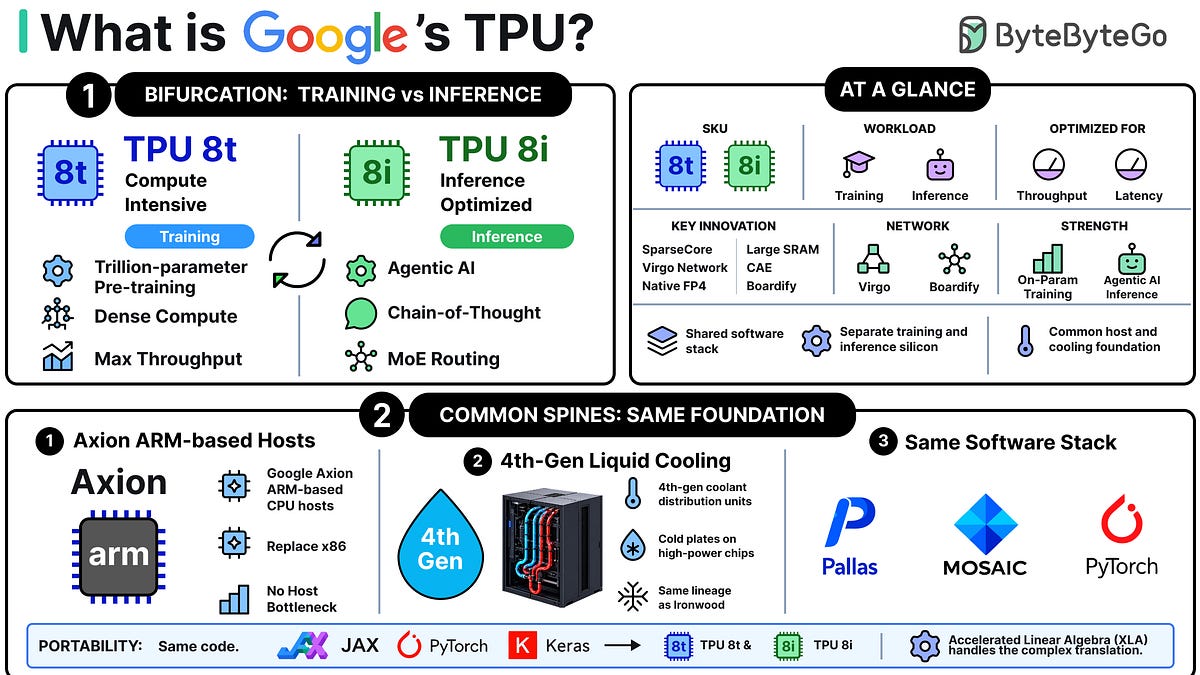
A TPU (Tensor Processing Unit) is Google’s custom AI chip, designed from scratch for the giant matrix multiplications that modern models live on. GPUs were built for graphics first.
TPUs were built for deep learning from day one.
At Cloud Next ’26, Google unveiled its 8th generation, and for the first time it ships in two flavors. TPU 8t is built for training, where raw throughput wins. TPU 8i is built for inference, where latency and chip-to-chip speed matter most.
Both still share the same Axion CPUs, liquid cooling, and software stack, so code written for one runs on the other.
The diagram is a quick study guide to what’s the same, what’s different, and why, based on our understanding of published Google articles.
What Makes an FDE Role Credible? (Sponsored) Strong candidates are skeptical of vague forward deployed engineer postings, and the title alone won’t earn their trust.
The ** free State of FDE Jobs 2026 Report** explains what candidates look for, how the market is evolving, and how employers can make these roles easier to understand.
Hiring? You can also bring your openings to forwarddeployedengineer.com, the focused jobs board for forward-deployed engineers.
9 Types of API Testing #
Here are the 9 most common API tests used to catch different kinds of failures.
Smoke tests run right after a deploy to confirm the critical endpoints still respond, especially things like login, checkout, or health checks.
Functional testing checks whether an endpoint does what the business expects or just returns a clean 200 with the wrong number inside.
Contract testing protects the agreement between services. If a consumer depends on a field, a type, or a status code, the provider should not change it without warning.
Integration testing covers the full workflow across systems. An order endpoint may also use inventory, payment, and notifications, and a- ny of those dependencies can fail.
Regression testing protects existing behavior when new changes are added. A change in discount logic should not break checkout totals or order history.
Load testing asks how things hold up under expected traffic.
Stress testing keeps pushing until something breaks.
Security testing covers auth, access control, unsanitized input, and what your errors leak.
Fuzz testing sends unexpected or invalid inputs to the API to find bugs that normal test cases may miss.
Over to you: Which of these do you rely on most in practice?
Common types of AI Agents guardrails on production #
Input Screening: Every user request is scanned for prompt injection, sensitive data, and off-scope topics before the model sees it. Unsafe inputs return a fallback message.
Context Verification: Every user request is scanned for prompt injection, sensitive data, and off-scope topics before the model sees it. Unsafe inputs return a fallback message.
Response Generation: The LLM reasons only over verified context.
Output Validation: Every response is checked for groundedness, format, and safety before it leaves the system. Failures trigger up to two retries, then a safe fallback.
Operational Controls: A final layer enforces limits, logs every call, and routes low-confidence or high-risk actions to humans.
Reliable agents aren't built on better prompts. They're built on the guardrails wrapped around them.
Over to you: Which guardrail layer catches the most issues in your setup?
Forward Proxy, Reverse Proxy, and API Gateway Explained #
People mix these up all the time, since they all sit between a client and a server. The real difference is which side they represent and what problem they solve.
A forward proxy sits next to the client. Your laptop sends a request, the proxy forwards it out, and the destination never sees your real IP. Corporate networks use this to enforce policy, block sites, and cache traffic.
A reverse proxy sits next to the server. The client has no idea how many machines are behind it. The proxy decides who handles the request, terminates TLS, and keeps your backend off the public internet. NGINX and HAProxy are commonly used here, typically paired with a load balancer in front.
An API gateway is a reverse proxy that does more than route traffic. It also handles auth, rate limits, API keys, versioning, and request shaping. Without it, each microservice has to implement its own version of validation, throttling logic, and request logging.
A forward proxy represents the client, a reverse proxy represents the server, and an API gateway is what you add when ten services need the same authentication and rate limiting rules applied consistently.
In most real systems, all three are running at different layers. The forward proxy filters outbound traffic, the reverse proxy fronts the application servers, and the API gateway sits in front of your APIs to enforce policies before requests reach them.
Over to you: What's your proxy + gateway combo? Always interesting to see what teams pair together.