The physical AI startup founded by two Unit 8200 veterans launched today with a $71 million seed round and put more than 100 live AI-powered robots online for anyone in the world to control right now.
Jonathan Jacobi was writing code before most kids his age had read their first chapter book. He started a computer science degree at 13. He finished it while still in high school, then became the youngest-ever employee at Microsoft at 17. His co-founder Gal Niv began hardware hacking at 10, joined a cybersecurity startup at 17, and compressed a four-year university degree into a single year. The two met in Israel's elite signals intelligence unit, Unit 8200, where they shared a bunk bed. Today, less than a year after founding Enigma, they've raised $71 million at seed to build what they're calling the intelligence layer for the physical world.
The round was led by Index Ventures and Ribbit Capital, with participation from Conviction Partners and angels drawn from the most concentrated talent pool in AI: leaders at OpenAI, Anthropic, DeepMind, xAI, Cognition, and Wiz. That roster matters. These aren't passive check-writers. They're people who have spent years thinking about how intelligence moves from digital systems into the physical world, and they bet on Enigma before it had revenue.
The pitch is hardware-agnostic AI models, plus novel user interfaces, that make controlling any robot as intuitive as adjusting a volume dial. Not a specific robot. Any robot. The idea is that Enigma's software sits on top of whatever hardware a customer already has or buys, bringing intelligence and ease of use without requiring the customer to pick a platform or rebuild from scratch. It's the operating system thesis, applied to robotics: whoever controls the software layer controls the industry.
That's an ambitious frame, and the robotics industry has heard some version of it before. But the timing is different now. Physical AI has moved from academic curiosity to genuine venture priority over the past 18 months, with billions flowing into humanoid robots, warehouse automation, and agricultural machinery. The problem most of these hardware companies share is the same: the robots can move, but they can't think well, and they're brutally hard to operate. Enigma is betting that the software wedge is still wide open.
As TechCrunch reported today, the company's aim is to make controlling a robot as easy as adjusting the volume - a framing that suggests the interface problem, not the locomotion problem, is where they're planting their flag.
The demo is the point #
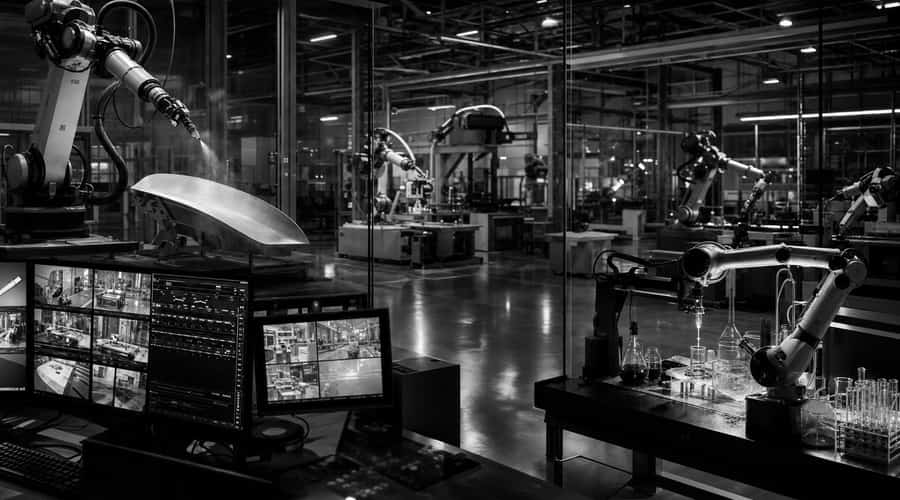
Alongside the funding announcement, Enigma launched what it calls the world's first live public AI robotics experience at robots.online. More than 100 of its proprietary AI robots, housed in hangars in Israel and California, are available right now for anyone online to interact with. The robots can draw pictures with a paintbrush, fight each other with swords, and run simple chemistry experiments by picking up and mixing flasks of liquid.
That last detail is easy to scroll past, but don't. This isn't a polished product demo produced for a press release. It's a large-scale public experiment designed to study how real humans - not trained operators - engage with robots when they're given access. Enigma has said explicitly that the data from these interactions will feed directly into how they build more intuitive interfaces and, potentially, a different kind of robotic brain. The demo isn't just marketing. It's a data collection engine, and it's also the company's strongest argument for why its UX thesis is worth $71 million at the seed stage.
There's a parallel here to what the early consumer internet companies understood: put something live in front of real users and learn faster than anyone building in a closed lab. Most robotics companies demo at trade shows for industrial buyers. Enigma put their robots on the internet and let anyone in the world poke at them today. That's a different philosophy, and it's a more honest test.
Frankly, the bet Index and Ribbit are making isn't purely on the founders' pedigrees, impressive as they are. It's on the thesis that physical AI needs a universal intelligence layer the same way cloud computing needed AWS, and that the company with the best user interaction data and the most hardware-agnostic models will own that layer. Whether Enigma can actually build it across every robot form factor - not just the ones sitting in their own hangars - is the question that a $71 million seed round buys them time to answer.
Also read: Washington threatens to sanction Chinese AI firms over distillation theft as Beijing fires back • Nvidia takes a stake in Safe Superintelligence and gets access to Ilya Sutskever's research in return • Brian Armstrong tells crypto founders who pivoted to AI they got it backwards