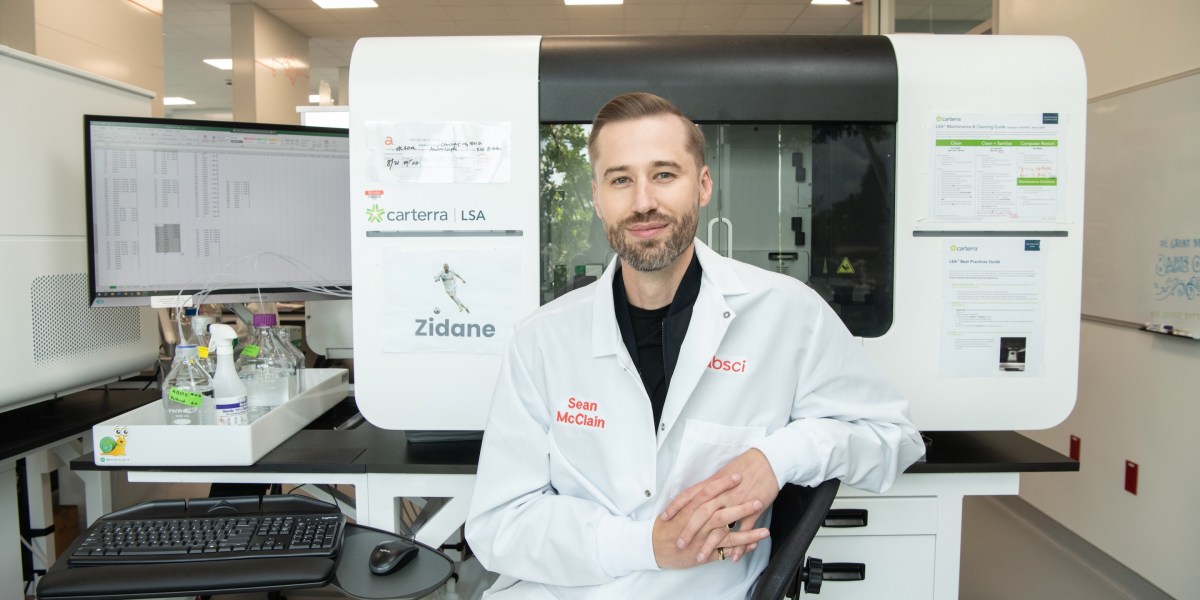
Eli Lilly just wrote a $40 million check to cure baldness.
The pharma giant behind Zepbound and Mounjaro—which made the injectable culturally normal for millions of Americans—led a $100 million stock offering in Absci, a generative AI drug company. Adage, BVF Partners, Columbia Threadneedle, Invus and Redmile also participated. Absci used AI to design ABS-201, an injectable antibody targeting the prolactin receptor (a hormone receptor connected to both hair growth and reproductive health). The injectable is meant to treat both androgenetic alopecia (commonly known as male or female pattern baldness) and endometriosis. No approved existing injectable antibody treats either one.
Last week, Lilly’s deal with Absci closed the same day Absci released positive Phase 1 safety data on ABS-201. Absci CEO Sean McClain told me the $40 million buys Lilly “tickets to the game.” In short, proximity. They share a DTC ambition—Lilly has LillyDirect, and Absci wants to sell biologics almost like a consumer brand. McClain floated the idea of eventually fusing his drug with a GLP-1 compound: one shot for hair regrowth and weight loss. “You could see in the future where you’ve combined those products,” he told me. “Total vitality at an affordable price.”
That’s the market this deal is actually pointing at. GLP-1s have made injecting yourself unremarkable.
The broader injectable market is a $650 billion opportunity in 2026. GLP-1s alone are projected to hit $190–$200 billion by 2030. But oral GLP-1 versions from Lilly and Novo Nordisk are already on shelves, and the convenience argument for shots is getting harder to make—unless the biology demands it. Absci’s CMO Ransi Somaratne’s case for why ABS-201 stays injectable: proteins get destroyed in the stomach, and a pill version would reach the brain in ways a shot doesn’t.
McClain’s bigger argument is about where value actually lives in AI drug discovery—as AI tools become cheaper and more widely available, pharma companies will pay less and less to license them, meaning the only real leverage is owning the drug itself.
Absci’s thesis is to use AI-designed drugs plus clinical trials run in China at a fraction of U.S. cost to compress the path from target to Phase 2 proof-of-concept from $150 million to $15–$20 million. “AI, China, and DTC,” he said. “That is going to change the game in healthcare.”
The money flooding into this space tells its own story. Isomorphic Labs—Alphabet’s AI drug design spinout—raised a $2.1 billion Series B in May. Earendil Labs, a U.S.-China AI biologics startup backed by Sanofi and Pfizer, pulled in $787 million in March. And Xaira Therapeutics launched with $1 billion before it had a single drug in the clinic. Against that backdrop, Absci (the only publicly traded company in the group) has raised over $530 million total and is already in Phase 1.
Whether ABS-201 becomes the first AI-designed antibody to prove it truly works in people is still unknown. But Lilly putting its name (and $40 million) on the cap table means the race just got a very powerful backer.
See you tomorrow,
Lily Mae LazarusX:
@LilyMaeLazarus Email:
lily.lazarus@fortune.com Submit a deal for the Term Sheet newsletter
here. Joey Abrams curated the deals section of today’s newsletter. Subscribe here.
VENTURE DEALS
- Beeline Medicines, a Boston, Mass.-based clinical-stage biotechnology company focused on precision therapies for autoimmune and inflammatory diseases, raised $126.3 million in a Series A extension from
Bain
Capital,
Canada Pension
Plan
Investment
Board, and others.
- Dominion Dynamics, an Ottawa, Canada-based defense technology company building Arctic surveillance networks and autonomous drone systems for national security, raised CAD $139 million ($100 million USD) in Series A funding.
Georgian led the round and was joined by
Valor Equity Partners,
Expeditions, Lakestar,
OMERS, and others.
- Higharc, a Durham, N.C.-based AI software company designed to help homebuilders design, sell, and manage new homes, raised $95 million in Series C funding.
Insight
Partners led the round.
- Stathera, a Montreal, Canada-based semiconductor company, raised $55 million in Series B funding. Maverick
Capital led the round and was joined by
Celesta
Capital,
BDC
Capital,
MediaTek
Innovation
Fund,
TXC
Corporation, and
Ultratech Capital
Partners.
- Queue, a Palo Alto, Calif.-based developer of a fully-autonomous robotic pharmacy, raised $12.6 million in seed funding. AlleyCorp led the round and was joined by
House
Capital,
Ubiquity
Ventures,
Grep
Ventures, and
Banter
Capital.
- MDOTM, a London, U.K.-based AI-powered portfolio management platform for institutional investors and asset managers, raised $27 million in funding.
Expedition
Growth
Capital led the round.
- Pie, a New York City-based AI-powered growth platform for small businesses, raised $19.5 million in Series A funding. Lightspeed
Venture
Partners led the round and was joined by Capital One Ventures,
SciFi VC,
F-Prime,
Commerce
Ventures,
WEX
Venture
Capital, and existing investors.
- Build.inc, a San Francisco-based company designed to improve AI-native infrastructure and developer tools to help teams build, deploy, and scale AI applications, raised $8.5 million in seed funding.
Index
Ventures led the round and was joined by
Pebblebed,
Puzzle Ventures, and
Tiny.vc.
- Arcturus, a Los Angeles, Calif.-based advanced materials company developing materials for energy, aerospace, and industrial applications, raised $8 million in seed funding.
Initialized
Capital led the round and was joined by
1517,
Breakthrough
Energy
Discovery,
Toyota
Ventures, and
Wireframe
Ventures.
- Dawnguard, an Amsterdam, Netherlands-based cybersecurity company, raised $6.3 million in pre-seed funding. BNVT
Capital led the round and was joined by
Curiosity
VC and
eCAPITAL.
- Acti, a Singapore-based agentic keyboard designed to automate workflows and text generation to help users work faster, raised $5.3 million in funding.
BITKRAFT
Ventures led the round.
PRIVATE EQUITY
-
Martis Capital acquired a majority stake in Deerfield Group, a Conshohocken, Pa.-based marketing, communications, and media partner for the healthcare and life sciences sectors. Financial terms were not disclosed.
-
PestCo Holdings, a portfolio company of Thompson Street Capital Partners, acquired Arrow Pest Control, a Morganville, N.J.-based pest control company. Financial terms were not disclosed.
-
ServiceTrade, backed by JMI Equity, acquired Mura, a Durham, N.C.-based agentic AI platform that automates field service billing and collections. Financial terms were not disclosed.
EXITS
- Authentic Brands Group acquired Care Bears, a Cleveland, Ohio-based family entertainment brand, from
Cloverlay. Financial terms were not disclosed.
- The Visualize Group agreed to acquire eCOGRA, a London, U.K.-based testing, inspection, certification, and compliance services provider for the gaming industry, from
Hanover
Investors
Management. Financial terms were not disclosed.
FUNDS + FUNDS OF FUNDS
- Tapestry VC, a London, U.K.-based venture capital firm, raised $80 million for its third fund focused on repeat founders.
Subscribe to Fortune Gulf Brief. Every Tuesday, this new newsletter delivers clear-eyed, authoritative intelligence on the deals, decisions, policies, and power shifts shaping one of the world’s most consequential regions, written for the people who need to act on it.