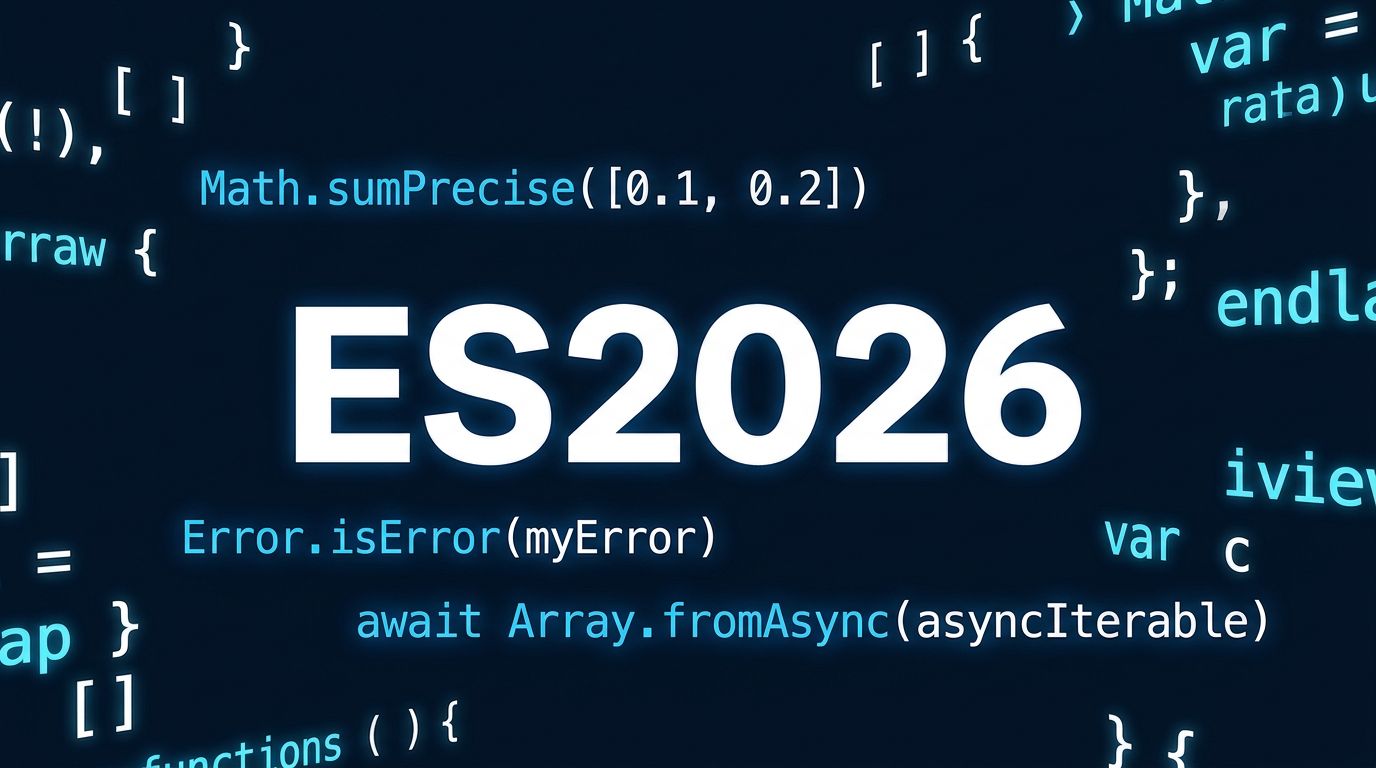
JavaScript’s annual spec update landed on June 30. ECMA International ratified ECMAScript 2026 — the 17th edition — and if you’re waiting for an ES2015-level revolution, this isn’t it. What TC39 shipped is a set of long-overdue API repairs and utility additions that quietly eliminate entire categories of bugs. Seven things made it. Three didn’t. The three that didn’t are arguably more interesting.
What Actually Landed in ES2026 #
Math.sumPrecise — The Silent Bug Killer
Run this in any JavaScript console today:
[1e20, 0.1, -1e20].reduce((a, b) => a + b, 0); // 0
The answer is 0. The correct answer is 0.1. This is floating-point arithmetic failing silently in code that looks perfectly reasonable. Math.sumPrecise
fixes it:
Math.sumPrecise([1e20, 0.1, -1e20]); // 0.1
This matters in financial calculations, scientific computing, and anywhere you’re summing token budgets across LLM requests where floating-point drift compounds. It also kills the .reduce((a,b) => a+b, 0)
boilerplate pattern entirely.
Error.isError — Cross-Realm Error Checking That Actually Works
Here’s a problem you might not know you have: instanceof Error
returns false when an error crosses an iframe boundary or a worker context. It lies. If you’re building micro-frontends or using module federation, you’ve probably hit this and blamed your code.
// Works correctly everywhere — including iframes and workers
Error.isError(new Error("boom")); // true
Error.isError("string thrown");   // false
Small addition. Large impact in modern distributed frontend architectures.
Array.fromAsync — Async Data Collection Without the Loop
Collecting async generator output into an array used to require a manual loop:
// Before
const results = [];
for await (const item of fetchItems()) {
  results.push(item);
}

// After
const results = await Array.fromAsync(fetchItems());
It also accepts an optional mapping function, mirrors Array.from
for sync iterators, and handles both async generators and sync generators that yield promises.
Iterator.concat — Sequence Without the Spread
Combining iterators previously meant either a custom generator or converting everything to arrays first. Iterator.concat
sequences them lazily:
const merged = Iterator.concat(iteratorA, ["extra"], iteratorB);
No intermediate arrays. No custom generator boilerplate. Plays well with streaming data pipelines.
Map.getOrInsert — One Method Instead of Three
Cache initialization patterns in JavaScript have always been verbose:
// Before — this pattern is everywhere
if (!cache.has(key)) {
  cache.set(key, defaultValue);
}
return cache.get(key);

// After
return cache.getOrInsert(key, defaultValue);
Also available on WeakMap
. Shows up constantly in state management, memoization, and AI agent memory implementations.
Uint8Array Base64 and Hex Conversion
Native encoding/decoding — no more btoa()
workarounds or external packages:
const bytes = new Uint8Array([72, 101, 108, 108, 111]);
bytes.toBase64();                   // 'SGVsbG8='
bytes.toHex();                      // '48656c6c6f'
Uint8Array.fromBase64('SGVsbG8='); // back to bytes
This eliminates a class of dependencies (base64-js
, Node.js Buffer
workarounds) for binary data handling in cryptography, file uploads, and API payloads.
JSON.parse Source Text Access
The reviver callback in JSON.parse
now receives a third argument — the original source text — before JavaScript’s number parsing loses precision:
JSON.parse('{"amount": 9999999999999999}', (key, value, { source }) => {
  if (key === "amount") return BigInt(source);
  return value;
});
// → { amount: 9999999999999999n } — no precision loss
Financial APIs, scientific data, anything with large integers in JSON: this is the fix you’ve needed.
The More Interesting Story: What Didn’t Make It #
Three proposals that developers have waited years for — all mature, all partially implemented in browsers today — didn’t make ES2026. They’re headed for ES2027.
Temporal — JavaScript Finally Gets Real Dates
Temporal reached Stage 4 at the March 2026 TC39 meeting and will land in ES2027. This is the overhaul of JavaScript’s Date
object that the ecosystem has needed since 2010: immutable types, explicit timezone handling, calendar support, no more midnight-UTC surprises. Bloomberg’s Rob Palmer put the cost of the status quo plainly — developers are forced to ship “tens, maybe hundreds, of kilobytes” of date library just to get reliable behavior that should be built in. Jason Williams called Temporal “the biggest addition to ECMAScript since ES2015.”
Chrome and Firefox already ship Temporal. TypeScript 6.0 has the type definitions. You can use it today with a polyfill. It just won’t be in the formal spec until next year.
The using
Keyword — Automatic Resource Cleanup
Explicit resource management (using
and await using
) gives JavaScript a with
-statement equivalent for guaranteed cleanup. File handles, database connections, network streams — when the scope exits, [Symbol.dispose]()
fires automatically. TypeScript has supported it since version 5.2, and Chrome, Node.js, and Deno already ship it natively. Firefox has it behind a flag.
import defer
— lazy module evaluation — follows the same trajectory: already supported by TypeScript, Babel, and webpack, with V8 and WebKit implementations progressing. Both are on track for ES2027.
Why These Three Got Cut
ES2026’s batch was deliberately conservative: API-only additions, no new syntax, all backward-compatible. The omissions require engine-level changes or had outstanding browser consensus gaps at the June 30 cutoff. This is how TC39 works — ship what’s ready, don’t hold the safe additions hostage to the complex ones. The result is a spec cycle that moves predictably, even if it means waiting one more year for the features everyone actually wants.
What to Do Right Now #
Most ES2026 features will arrive in stable browsers through 2026 as V8, SpiderMonkey, and JavaScriptCore ship their implementations. A practical breakdown:
Check per-feature support before adopting without transpilationTemporal: use the@js-temporal/polyfill
— the API is stable and worth learning now: available in TypeScript 5.2+, Chrome, Node.js, and Deno today — no waitingusing
/await using
Math.sumPrecise, Error.isError, Map.getOrInsert: polyfillable, minimal risk, high reward** Array.fromAsync, Uint8Array base64**: check your target environments; Node.js support is landing
ES2026 won’t rewrite how you think about JavaScript. But Math.sumPrecise
will quietly save you from a financial bug, Error.isError
will unblock a micro-frontend mystery, and Temporal is close enough that you should learn the API now. The spec ratified on June 30. The useful stuff is already in your runtime — or will be before the year is out.