15 min read
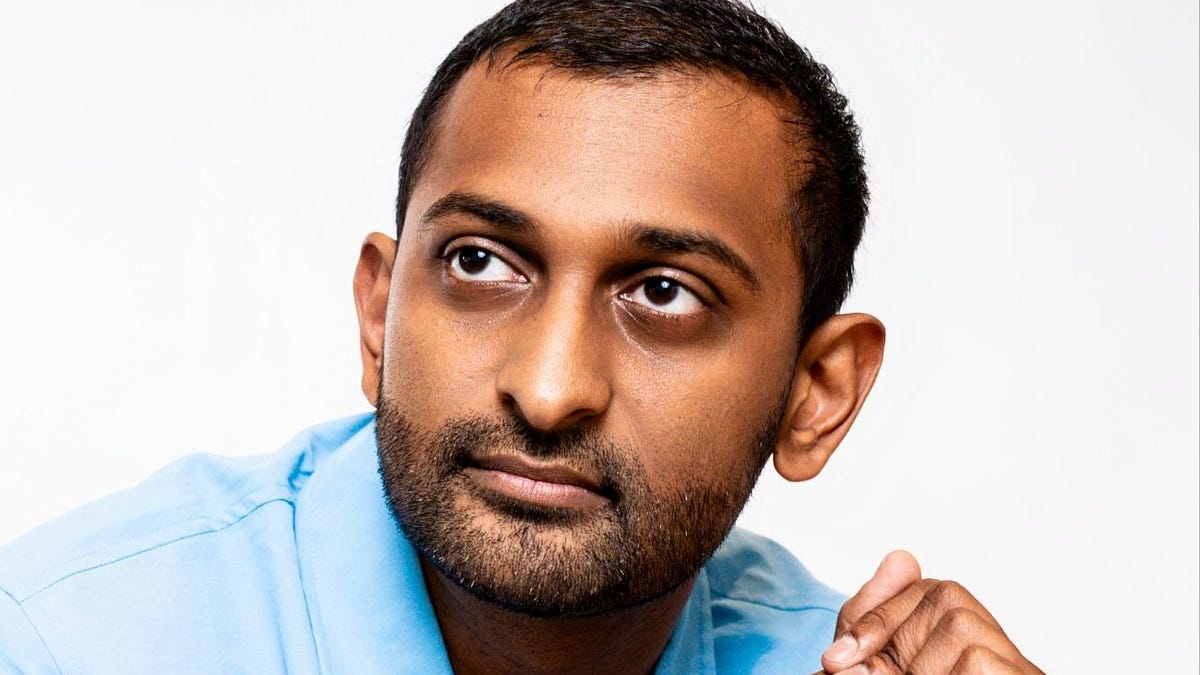
How u/dylan522p created SemiAnalysis: the intelligence firm informing a trillion-dollar AI infrastructure buildout.
On a mid-March Monday morning, thousands of hardware geeks – computer science students, hyperscaler execs, accelerator architects – assembled under a formidable Jensen Huang. Welcome to the accelerator industry’s favorite conference, Nvidia GTC. A WWE-style championship belt was projected onto a 100-foot wall behind Huang. Mid-keynote, he pulled up Nvidia’s performance metrics. “This is from SemiAnalysis. This is the largest, most comprehensive sweep of AI inference that has ever been done.” The chart, advertising 50x increased performance on Nvidia’s GB300 NVL72, depicted a decisive Nvidia victory. It also established a once-niche newsletter as the tastemaker of the largest infrastructure buildout of all time.
In the past three years, AI excitement has produced a surge of previously-unthinkable infrastructure investment, with hyperscalers projected to invest $600B this year and total investment already past $1T. Amid the frenzy, SemiAnalysis’s sharp headlines guide readers through the previously sleepy world of datacenters, supply chain, and memory markets.
SemiAnalysis counts the vast majority of the world’s largest companies among their customers. Revenue is projected to beat $100M this year. But its contact book is as valuable as its pocketbook. Its analyses turn heads, especially those of its subjects. A piece titled “Nvidia’s Christmas Present…” triggered a series of emails from Huang. AMD followed suit when Lisa Su called the SemiAnalysis team for 90 minutes after their harrowing 2024 analysis of the MI300X. Mark Zuckerberg, Satya Nadella, and Sam Altman also count themselves among the newsletter’s star-studded readership.
SemiAnalysis President Doug O’Laughlin confides, “Dylan’s going to be the greatest analyst of this generation. I’ve always thought that.” He is of course referring to SemiAnalysis’s maverick founder, Dylan Patel.
The name “Dylan Patel” pops up with metronomic regularity in San Francisco’s notoriously shoes-off house parties, narrow hallway conversations, and anxious text messages of venture capitalists. I met him a few months after first arriving in the Bay Area. I was told this was inevitable – Dylan is deeply integrated into San Francisco’s social scene. At this particular house party, Dylan was hobnobbing with Interact fellows, math PhDs, and Nikita Bier under dim lighting in the Mission. A friend summoned him closer to review a particular semiconductor startup. Dylan responded with a grin, throwing a long arm over the questioner’s shoulder and giving a rueful shake of his head in pantomime of the ever-cheery executioner whose work is also his vocation. “Bearish man, so bearish.”
SemiAnalysis was officially founded on a WordPress blog in 2020. It was Dylan’s 255-word 24th birthday present to himself (“Moore’s Law is Dead for DRAM and that is Great for Semicap”). But, his hardware obsession began more than ten years prior. Dylan was twelve when he pseudonymously began his career and sixteen when he shed his burner account for u/dylan522p. Though the handle has gone quiet in recent years, it was once the bedrock of Dylan’s deeply opinionated online presence. He got his start as many hardware aficionados do: on Reddit. The handle is still a moderator on r/hardware, r/google, r/tpu, and, eventually, obviously, r/SemiAnalysis.
Dylan’s internet addictions — Alien Blue, video games, AnandTech, Linus Tech Tips — were initially hosted on that notorious computing powerhouse, the iPod Touch. When his parents agreed to buy his first phone, he fixed his sight on one in particular. “The HTC One M7 was the sexiest phone ever.” Dylan s our conversation to show me photos, a man recalling a first love affair. The device is indeed sleek, an embedded camera winking knowingly from the center of its aluminum back. At the time, HTC was the dominant smartphone producer, but Samsung was nipping at its heels with relentless marketing strategies. Through his Reddit modding, Dylan noticed that Samsung had paid influencers to post about its phones and to post negatively about HTC. He took up arms. “It felt like I was a warrior, defending the unibody aluminum, the stereo speakers, the low megapixel camera, the LCD screen with the cooler temps.” In a fit of uncharacteristic sentimentality but characteristic stubbornness, Dylan stayed loyal to Android for the next 14 years. (After years of green text prejudice, he bought a personal iPhone earlier this year to supplement his work phone.)
Dylan’s digital defense was a sign of things to come. Seven years later, he quit his job, began traveling through Asia and South America, and blogged full-time. Friends and family were confused; sentiment was something like, “Dylan, what the fuck are you doing?” It was too late to go back. He boomeranged from Argentina to Taiwan and kept posting. “LAM Research (LRXS) Dry Deposit and Resist Could Become a Multi-Billion Dollar Business” and “Mediatek Stands to Gain the Most from the New Cold War” were early efforts. As the pandemic progressed, the newsletter rode its characteristic supply chain disruptions to ever-greater notoriety.
By 2021, Dylan’s itinerary had become a succession of acronyms: ISSCC, DAC, ECTC. The semiconductor conference circuit is a curious combination of suit-wearing analysts, white-haired industry veterans, and young-but-younger-looking hardware geeks wrapped in ill-fitting company t-shirts. The scripted talks and too-choreographed product reveals lean corporate, but Q&As will sometimes yield novel insights. As always, the real action happens away from the main stage, or any stage at all – in hushed sideline conversations, de facto networking sessions, and lunchtime tete-a-tetes conducted over white tablecloth-covered folding tables. Conferences are often at most a few hundred people, so Dylan quickly became familiar with the circuit’s regulars, many of whom he’d already sparred with on Reddit. One of them, Doug, also known as Fabricated Knowledge’s @mule on Substack, suggested Dylan move to the platform and begin collecting emails under a subscription model.
Dylan was convinced, and the results spoke for themselves. “The Semiconductor Heist Of The Century | Arm China Has Gone Completely Rogue…” was his first viral post. Arm China sent a cease and desist. Remembering it, Dylan smiles. “It was really sick.” Even in the early days, SemiAnalysis moved markets. When Nvidia announced their Hopper GPU, Dylan noticed, “Holy shit, [Vicor’s component] is missing.” He wrote a “Short Report” on the longtime Nvidia component supplier and paywalled the piece. Revenue jumped roughly $100K in a single day while Vicor’s stock plummeted over 20%. Despite initially charging a paltry $200/year, SemiAnalysis shot to seven figures in revenue by 2023.
If ChatGPT’s release marked the beginning of the model development race, the starting gun on infrastructure sounded six months later, during Nvidia’s 2024 first-quarter earnings call. Longtime CFO Colette Kress began simply: “Q1 revenue was $7.19B.” Nvidia had crushed market expectations by over $600M. Shares spiked 28%.
Everyone wanted to know what next-quarter revenue would look like. It was clear that Nvidia would sell all its GPUs. The only question was how much inventory would they have to sell. GPUs are bottlenecked at the CoWoS, or chip-on-wafer-on-substrate, stage. CoWoS is the final packaged product before chips are shipped from the humbly-named Taiwan Semiconductor Manufacturing Company (TSMC) to their designers (Nvidia, AMD, or otherwise). Allocation is a bloodbath. Dylan reasoned that if you could track TSMC’s CoWoS output, you could predict the amount of product Nvidia got out the door and, by extension, the company’s earnings.
“We’re able to look at TSMC and the equipment suppliers. Supply chain orders were coming in…[tool companies] would talk about it in their earnings calls. You’d figure out the cost per tool, the throughput of these tools. How much CoWoS is TSMC able to do? What’s the lag from them producing to Nvidia making the server and making revenue? So we’re able to figure out the lag, the capacity expansion. Then we’re like, ‘Look, this doesn’t make any sense. Either Nvidia’s going to have a load of inventory, or – as we clearly know, they’re sold out of everything. They’re going to sell everything – in which case their revenue has to be here, not here.’” At this point, Dylan gestures, illustrating the gap between others’ forecast and his own with hands spread wide apart.
Confident in his predictions, and facing ever more demand for them, Dylan began hiring. Equity investor Myron Xie rushed to Discord to connect. “Hi Dylan, I’m reaching out about the analyst role you advertised in your latest piece, which I’m very interested in…Would love to chat further, and happy to email through a copy of my CV, too.” Quick reply from Dylan: “Yes sir let’s chat.”
Myron and Dylan published their research in July. In AI Capacity Constraints - CoWoS and HBM Supply Chain, they uncovered CoWoS shipments and predicted that Nvidia would ship 400,000 H100s per quarter. “I would,” Dylan admits, “slightly overpromise on what we had, and then we would work on building it and selling it.” Prospective clients – mostly hedge funds – were interested.
SemiAnalysis doubled down. Each CoWoS package typically has between 4-12 stacks of high-bandwidth memory (HBM), another key component, depending on the type of accelerator chip used. HBM movement and volume can therefore be estimated working backwards from CoWoS numbers. Today, clicking on “Accelerator & HBM” on the platform for SemiAnalysis institutional clients takes you to Shipments, where the firm tracks hundreds of SKUs from Nvidia, Broadcom, Tesla, AMD, and other major chip designers. The Accelerator & HBM Model is one of SemiAnalysis’s most sought-after products, only recently overtaken by the Datacenter Industry Model.
Today, SemiAnalysis has twelve models spanning networking, wafer fab equipment, foundry buildouts, energy, and more. Its newsletter, number one on Substack’s Technology category, is pure lead generation. Less than 5% of revenue comes from Substack. The vast majority derives from models, Core Research (the company’s institutional newsletter), and consulting. It’s fueled by customer demographic shifts (from hedge funds to the AI infrastructure industry), and product expansion. In recent months, they released open-source compute benchmark InferenceX, rated neoclouds with ClusterMAX, and published a report from their teardown lab in Oregon. The firm is ending the year around 100 full-time employees.
“Sometimes, we joke we should call it AI Analysis,” Doug tells me. The firm is AI-pilled, not only in their Claude Code usage but in their priors. The analysts know the AI researchers (Anthropic RL researcher Sholto Douglas is Dylan’s roommate), and they share the same assumptions. Tokenomics analyst Max Kan tells me, “I don’t think anyone who has a traditional equity research background would even try to figure out where $3T in [the AI labs’ combined] ARR in 2030 comes from, because that’s not in the realm of possibilities from their point of view.” In theory, the ecosystem is open-access. The drinks and board game nights are often public on San Francisco’s favorite event app, Partiful. Anyone can buy a DAC conference ticket. But SemiAnalysis shows up when no one else does.
Outside of events, AGI assumptions are also X-native. “You have to be chronically online to be successful at SemiAnalysis,” says Michelle Shen, Dylan’s Chief of Staff. Max agrees. “The Goldman Sachs equity research team does not know what is happening in AI…There’s maybe two people on that team who are on AI Twitter, which is where you get a lot of the disclosures.” The analysts – fifty or so, some hired from Reddit – spend their days scrolling through X, Substack, email newsletters, SEMICON West conference slides, and Signal group chats. And, of course, they click through the company’s lifeblood: Slack.
Messages go in public channels by default because Dylan polices the proportion of private Slack DMs employees can send. The limit is roughly 30%. In signature Dylan fashion, he names and shames. He occasionally shares a table in Slack that shows team members who have breached the threshold.
Slack visibility matters – analyst Wayne Ma, who joined SemiAnalysis from The Information, notes that, “50% of [an analyst’s] job is to have sources in the industry that can inform the inputs of models.” Inputs – call summaries, data, and supply chain updates – go on Slack. Analysts combine this with other publicly available numbers. They might mimic a typical Bridgewater associate’s workflow by combing through financial filings, disclosures, and leaks to parse information alongside expert and investor calls. The net result is that searchable channels provide a constant flow of information.
The next step is quantitative modeling. Take the datacenter model, which tracks hyperscaler buildouts. Jeremie Eliahou Ontiveros runs the model. He tells me, “People had estimates for datacenters, but no one actually did it from the ground up.” Beyond working back from CoWoS numbers and unit shipment estimates, Jeremie hunts for other supply-side model inputs site by site: property records, permits, and datacenter electrical and cooling systems. At one point, the team began using real-time satellite imagery and trained a computer-vision model to analyze their images.
The team cross-references datacenter numbers against the accelerator model: volumes need to match. Dylan dubs the tetris of information “mosaic theory”. The datacenter team can estimate megawatt demand by multiplying chip volume by power draw per accelerator based on the chips’ full power budget assumptions. “Almost all of the other models leverage the data from the accelerator model,” Myron says. There are also timing considerations: projected datacenter capacity and availability dates must align with quarterly accelerator shipments.
Dylan can be a picky editor. He recalls, “[An external analyst would] write descriptions and primers and…I’m like, ‘This is fucking wrong,’. I’d write the same thing but better.” Still, most newsletter pitches are approved in #articles. They’re drafted in Google Docs, where multicolored cursors drop in chunks of research and a “quarterback” drives the piece to completion. SemiAnalysis’s deeply technical work requires expertise in multiple domains, so analysts tend to specialize. Prior background is appreciated, but not required – wafer fab analyst Jeff Koch came from ASML, but early hires like Myron, Jeremie, and Dan Nishball had minimal semiconductor background. Bylines, then, end up quite collaborative. To Boldly Go: The Case For Space Datacenters includes writers across the accelerator, foundry, and energy teams.
At semiconductor conference Hot Chips, industry attendees – engineers, sales reps, VPs – receive name cards printed on plain white paper. But press badges are distinct. The front side is seafoam green, and the back is blank. For much of this year’s conference, Dylan’s lanyard is flipped, and his well-known name is hard to spot. SemiAnalysis is not cleanly press, at least not in the style of old-school information shops. Between the company phonebook, Slack, compounding model alpha, and clever quants, they’ve built a flywheel across semiconductors, energy, datacenters, and tokenomics. But what is their information for? What is SemiAnalysis?
In the early 2000s, independent press like AnandTech’s Anand Shimpi began to steal attention from traditional news institutions. Today, the field is healthily populated with writers like Asianometry’s Jon Y, More Than Moore’s Ian Cutress, Stratechery’s Ben Thompson, and neXt Curve’s Leonard Lee. Dylan slots in: from his Reddit-native childhood to his shitposting tendencies, he seems custom-made for personality media.
But SemiAnalysis’s style – both proximal to and consulting the subjects it covers – provokes culture shock between new media and an old industry. His smooth-talking employees are sometimes just a few years out of school and unfamiliar with traditional journalism practices. SemiAnalysis analysts will grill frontier lab employees at happy hours and make pointed ARR jokes at chip conference dinners. Dylan famously got in hot water for breaking the new generation of Blackwells while serving as Nvidia’s guest at GTC (most traditional journalists would – at the very least – give a heads up).
And, Dylan is not only ideologically but also financially close to the frontier tech scene. He recently raised the SemiAnalysis Capital Fund I, a $500M venture fund for early-stage startup investing. SemiAnalysis and a former employee, Wei Zhou, also have ongoing mutual lawsuits. Wei’s suit alleges that Dylan, an investor in neocloud Fluidstack, asked him to put material non-public information from Fluidstack into a SemiAnalysis model. SemiAnalysis has no comment on the lawsuit.
Dylan is aware of potential conflicts and raises an example. “Hyperscalers are my biggest customers. If you look at the top 10 companies in the world – besides Saudi Aramco – they’re [in] my top 15 customers. And yet we’ll post negatively about Meta, or we’ll post negatively about Google.” He also separates private and public markets: the fund is for early-stage private investing, and SemiAnalysis employees are not permitted to hold public investments in SemiAnalysis’s coverage areas. Still, the AI infrastructure industry is not constrained to public markets. Many of the most influential companies (notably both Anthropic and OpenAI) in the infrastructure buildout are private.
“Maximally truth-seeking is all we care about,” Dylan tells me. His personal judgment here is increasingly important – the AI infrastructure industry’s largest companies leverage SemiAnalysis reports while its founder invests in its future.
When OpenAI unveiled their custom in-house chip, Jalapeño, the sixth slide in their Hot Chips presentation was titled “SemiAnalysis InferenceX: public, power-normalized comparisons”. For the frontier lab’s first and most significant hardware milestone to date, they had trusted SemiAnalysis as their third-party benchmark of choice. SemiAnalysis has become an intelligence factory, churning information the way ASML’s EUV machines churn circuit patterns.
So what’s next? Certainly industry expansion – Doug predicts that energy is next up. Because energy policy varies state-by-state, team members from the datacenter and energy teams are going “boots on the ground” to form relationships with the relevant stakeholders across different grids and utilities. But Dylan has his eye on even larger fish.
When asked about the future, he says, “We’re going to be the spiderweb that connects anything and everything in the supply chain and world.” He’s come a long way from blogging in Peru. Today, the SemiAnalysis office shares an open floor plan with writer and podcaster Dwarkesh’s studio (the two, contrary to implications from a shared last name and extensive X trolling, are not related). The central staircase leads downstairs to a small kitchen and patio, shared with Leopold Aschenbrenner’s Situational Awareness. Dylan has become embedded into the San Francisco ecosystem and built a following for himself. People – mostly mid-twenties to mid-forties men – stop him in SoMa or Potrero to say hello or ask for a selfie.
In each expansion – from accelerators to memory to datacenters to energy – SemiAnalysis enlists expertise, pounds information into its models, and burnishes trust with the industry’s most influential players. As Dylan boasted, “We influence opinion…We’ve written stuff that Nvidia hated at the time, then Jensen read it and changed the organization. We’ve done it for Meta, and we’ve done it for Google, Microsoft, OpenAI.”
Dylan closes our conversation with pride. “Why are these companies buying our data?...My hubris is that they know that our numbers are better than theirs. And we often are.” u/dylan522p types on.
Correction [9/18/26]: After publication, Patel corrected the $3T ARR projection’s date to 2030 from 2028 and confirmed the final amount raised for SemiAnalysis Capital Fund I was $500M.