Monumental has raised a $32m Series B led by Khosla Ventures, money it will spend putting more of its bricklaying robots on building sites in Britain and, for the first time, in the United States.
Plural and Hummingbird, both backers of the company’s $25m round in early 2024, took part again. The Amsterdam company says the funding will grow its engineering team, expand the fleet across Europe, deepen its UK operation, teach the robots more than one trade, and pay for the American launch this year.
The fleet now runs to more than 150 robots, according to Monumental, working on live sites rather than in demonstration yards.
The machines are fully electric, use sensors, computer vision and a small crane arm to place brick and mortar, and are coordinated by the company’s software platform, Atrium.
What they have built so far is prosaic, which is rather the point: the walls of more than 100 homes in the Netherlands and the UK, plus a school, a community centre, a hotel, and a stretch of Amsterdam canal wall.
Nearly half of those homes went up in the past three months, the company says, against eight in the quarter before.
Contractors do not buy the robots. They hire Monumental as a subcontractor and pay for finished wall, an outcome-priced model that leaves the company holding the risk of owning, maintaining and operating the machines.
That structure is unusual in a sector where robotics firms have generally tried to sell hardware to builders who have neither the capital nor the appetite to run it.
It also means Monumental’s growth is bounded by how many robots it can build and staff, rather than by how many it can persuade a contractor to purchase.
“The world simply does not have enough people to build what it needs, and that shortage will not be solved by another app or another robot doing backflips on stage,” said Salar al Khafaji, Monumental’s co-founder and chief executive.
“It takes machines that turn up on site and lay real brick all day, to spec.”
The shortage the robots are aimed at
Britain is the immediate target because Britain has run out of bricklayers. The government wants 1.5 million new homes; the Home Builders Federation reckons the country needs tens of thousands more bricklayers to lay them, a figure Monumental puts at 20,000 and which other readings of the HBF numbers place closer to 25,000.
Set against that, Monumental cites roughly 1,990 completed bricklaying apprenticeships in 2024. Even taken as indicative, the ratio is not one that recruitment fixes in a decade.
The wider hole is bigger still. The Centre for Policy Studies puts the UK’s housing shortfall at 6.5 million homes, with 446 dwellings per 1,000 people, second worst in Europe, behind a continental average of 542.
Construction is also the industry that productivity forgot, which is the argument Khosla is buying into*. *
“Construction costs have exploded while the industry itself has barely changed in decades,” said Vinod Khosla. “We know how to build, we’ve just made it too expensive and too slow.”
Sten Tamkivi, a partner at Plural, said the company had become “one of the most deployed autonomous construction operators in the world, solving a global-scale problem from the heart of Europe”.
Monumental’s pitch to investors leans on that deployment record rather than on any single technical breakthrough.
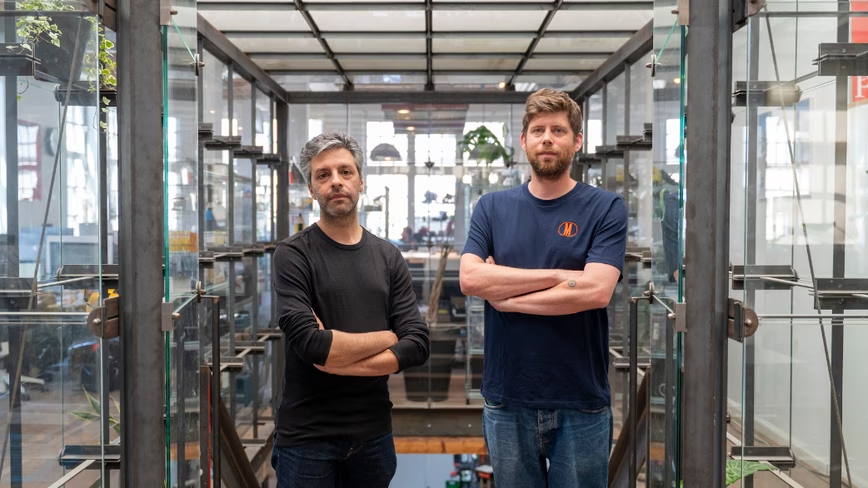
Al Khafaji and chief technology officer Sebastiaan Visser founded Monumental in 2021. They had previously built the Dutch data-visualisation startup Silk, which Palantir acquired in 2016 in what was, in effect, a team purchase, and they have carried Palantir’s forward-deployed engineering habit into robotics: engineers on site, alongside the customer, rather than in a lab.
They are not alone in noticing the opportunity. A crop of European construction startups is chasing the same labour gap, among them All3, which raised $25m for legged robots aimed at housebuilding.
Get the TNW newsletter #
Get the most important tech news in your inbox each week.