Dropbox has evolved Riviera from a file preview service into a universal content processing platform supporting more than 300 file formats and more than 100 transformation capabilities. The platform now performs hundreds of thousands of transformations per second and supports Search, Replay, Sign, and Dash, allowing AI workloads to reuse content processing infrastructure developed for earlier products.
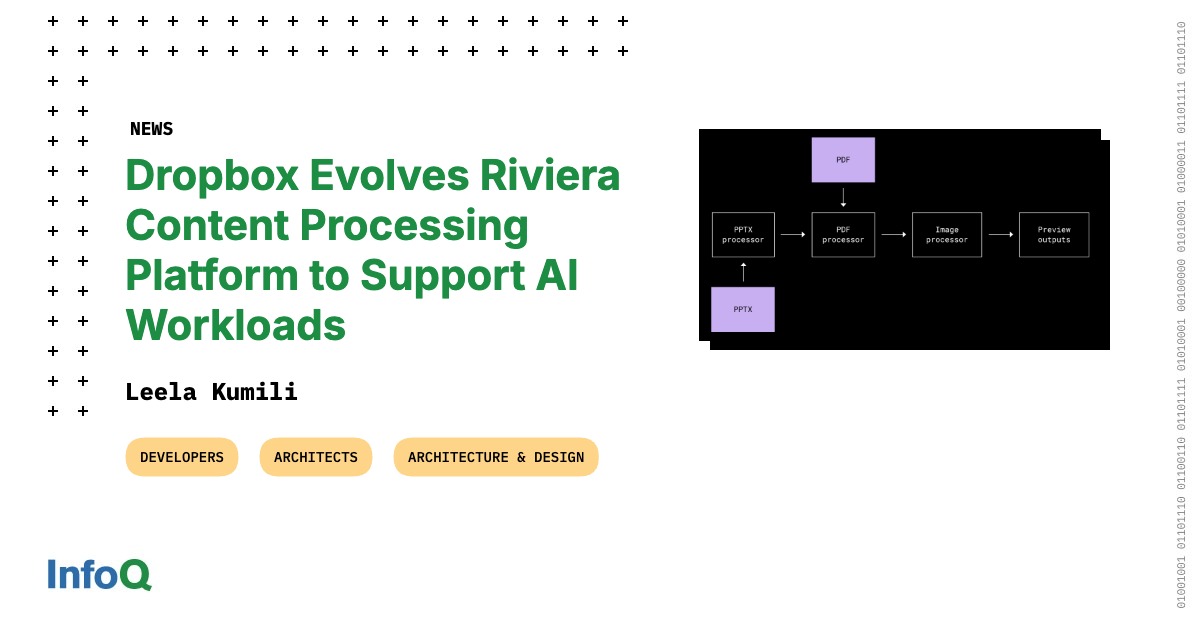
Riviera began as an internal service for generating previews across Dropbox's file formats. Instead of creating separate processing services for individual formats and outputs, engineers decomposed content processing into reusable transformations. A PowerPoint preview, for example, can be generated by converting the presentation to PDF and then converting PDF pages into images. These transformations can then be composed into other processing pipelines.
Riviera's composable transformation pipeline (Source: Dropbox Blog Post) The architecture separates orchestration from execution. A central component validates requests, composes transformation pipelines, dispatches work to backend workers, and manages caching. Individual workers implement specific transformation capabilities, while a plugin model allows new capabilities to be added without changing the core orchestration layer.
Riviera's integration across Dropbox products and core surfaces (Source: Dropbox Blog Post)
Riviera was already being used for AI processing before the latest expansion. Dropbox previously described chaining transformations to convert content into text and embeddings for AI-powered summaries and question answering. At that time, the platform supported roughly 300 file types and processed about 2.5 billion requests per day, representing nearly an exabyte of data. Cached intermediate results allowed multiple AI operations to reuse previously generated content.
Dash introduced additional content preparation requirements because its search and AI capabilities process content from Dropbox and connected services. Riviera provides transformations for extracting and normalizing that content before indexing, allowing Dash to use the existing processing pipeline.
Dropbox has also exposed Riviera capabilities through public APIs. The developer documentation describes asynchronous endpoints for converting documents to Markdown, transcribing audio and video, and extracting structured metadata. The Markdown API supports applications including indexing, rendering, and providing documents as input to large language models. Applications submit jobs and poll using an asynchronous job identifier, with completion and failure states returned separately.
The platform is also appearing in external developer tooling. A developer in the Dropbox Community published conductor-dropbox, an open source integration for Conductor OSS and Orkes that includes asynchronous Riviera Markdown extraction for document and RAG workflows. The project combines Dropbox operations with workflow orchestration for document and AI processing.
Riviera differs from general-purpose extraction frameworks such as Apache Tika, which provides APIs for detecting, parsing, and extracting text and metadata from a broad range of file formats. Riviera combines transformation plugins with pipeline composition, asynchronous execution, caching, and centralized orchestration.
Dropbox is now exposing selected Riviera capabilities through APIs while continuing to use the platform across document, multimedia, search, and AI workloads. The external Conductor integration provides an example of Riviera's content extraction capabilities being incorporated into a broader workflow orchestration system.