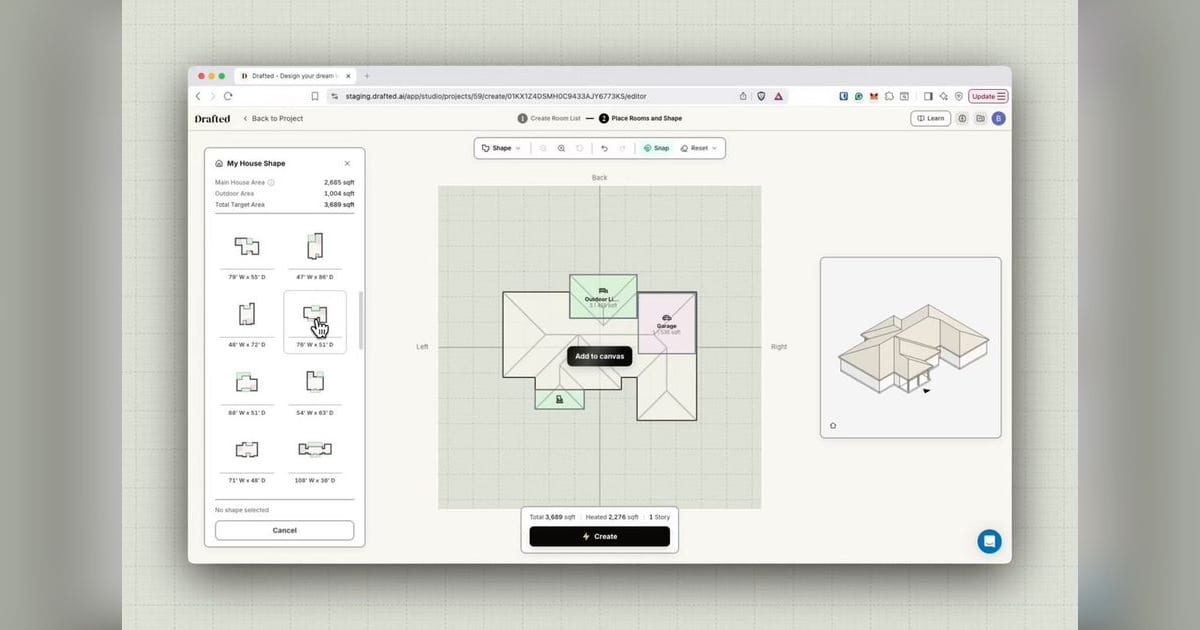
Drafted released Drafted V2 on Friday, July 10th, adding a more directed way for homebuyers, builders, and designers to turn room preferences into editable floor plans, 3D views, and exterior renders.
The San Francisco startup, founded by Nick Donahue (@PrimalNick), said in an 11-post thread on X that the new version lets users choose rooms, position key spaces on a canvas, generate the rest of the house, and then regenerate selected areas without throwing away the whole plan. Drafted called V2 "the fastest AI model and experience for designing your home," a claim the company did not back in the thread with a public benchmark.
Donahue is taking a second run at a problem he has already spent years inside. Business Insider reported in May that he previously ran Atmos, a custom home-design startup that raised about $20 million and shut down in early 2025 after high interest rates made it harder for customers to afford the homes they had spent months planning. Drafted is the AI-native follow-up: less services-heavy, more self-serve, and built around shortening the messy front end of residential design.
That context matters because Drafted V2 is aimed at a specific failure mode in AI design tools. A photorealistic home render is easy to like and hard to build from. A useful schematic plan has to respect adjacency, circulation, lot constraints, exterior massing, and later export into professional workflows. Drafted's pitch is that the AI should generate around explicit spatial inputs rather than a free-form prompt alone.
What V2 changes
Drafted V2 starts with room placement. Users can put key rooms near or away from one another, then ask the model to fill in the rest of the layout. In the example Drafted described, a user could place a garage next to the kitchen or keep laundry away from the primary suite, using rough proximity as the instruction.
The new version also moves from sketch to structured plan. Drafted says V2 can turn an early sketch into a floor plan with walls, doors, and windows in seconds. Users can still manually adjust the result, including moving walls or widening rooms, then regenerate from the changed layout.
The most practical addition is partial regeneration. Instead of rerunning the entire design when one section fails, a user can select a problem area, such as common spaces, a bathroom, or a closet, and ask Drafted to redesign only that part of the plan. For early-stage design, that is a more important workflow change than a prettier render. Home design usually fails in local tradeoffs: a bathroom door swings wrong, a hallway eats too much square footage, a primary closet blocks natural light, or a kitchen adjacency looks good in plan and bad in 3D.
Drafted also added roof and exterior controls. V2 lets users switch between hipped and gable roofs, customize cladding, foundation, roof, windows, trim, and front door, then generate an exterior render. Drafted says those options create more than 2.5 million possible exterior combinations. That number is a company-provided combinatorics claim, not evidence that the output is buildable or architecturally coherent.
The release adds a project structure for saved designs, multiple variations inside the same design, and a design history that records the initial prompt, room changes, manual edits, and later updates. Drafted says every 2D floor-plan change now updates the home in 3D, which pulls the product closer to the feedback loop used in professional design software: plan first, visual consequences immediately after.
The speed claims are self-reported
Drafted said its V2 model is 5x more accurate at creating initial floor plans that match room requirements and produces floor plans 60% faster than before. The company also said it optimized the product for slower internet and lower-cost laptops, claiming up to 78.6% higher FPS on lower-end devices.
Those are meaningful claims if they hold under normal use, but Drafted did not publish the test set, device profile, baseline model, or definition of "accuracy" in the launch thread. For a product that wants to sit between consumer ideation and professional pre-construction workflows, the important question is whether faster plans preserve constraints that builders and architects actually care about: dimensions, circulation, door and window placement, code-sensitive assumptions, structural logic, and export fidelity.
Drafted's own FAQ keeps that boundary clear. The company describes Drafted as an early design and ideation tool, says it is focused on single-level floor plans today, and tells users to work with an architect, structural engineer, or other building professional before building. The FAQ also says Drafted is free to use and can download PDF, CAD, or BIM files, which gives the product a distribution advantage while it tests where users will pay.
Donahue's timing is a fundraising story too
Drafted is not operating like a small side project. Its Y Combinator company page lists Drafted as a Spring 2026 company, founded in 2025, with a team of 9 in San Francisco. YC says the team includes second-time proptech founders, researchers from Stanford, Autodesk, Brown, and Adobe, and architects from WeWork, Atmos, and architecture families.
The same YC page says Drafted has raised $17.5 million from YC, Buckley Ventures, Patrick Collison, Bill Clerico, Ben Silbermann, Jack Altman, Samsung NEXT, Starship Ventures, Charlie Songhurst, Evan Moore, Kevin Mahaffey, and others. Business Insider reported a $16 million seed round in May led by a broader investor group that included Buckley Ventures, Y Combinator, Pinterest cofounder Ben Silbermann, and OneRepublic frontman Ryan Tedder; Donahue did not disclose the valuation to Business Insider.
The usage numbers are also company-reported and differ by timing. YC says that in the month before its listing, Drafted had 120,000 site users and generated more than 325,000 floor plans through social sharing and word of mouth. Business Insider reported in May that Donahue said 250,000 people had visited the website since launch and that users had generated more than 300,000 floor plans in the prior month. Those metrics point to strong top-of-funnel interest, though they do not disclose retention, paid conversion, or how many plans moved into real projects.
V2 is the product Donahue needs if Drafted is going to turn that viral interest into a durable business. A novelty generator can pull traffic from social video. A home-design workflow has to save projects, preserve edit history, regenerate local areas, and produce exports that make sense to the professionals who still control permitting and construction.
The near-term market is crowded with consumer home-design software, CAD incumbents, interior-design tools, and AI rendering products. Drafted's bet is narrower: the earliest phase of custom residential design is full of people who know what they want but cannot translate it into a plan. V2 gives them more control over the AI's first draft, then gives Donahue a cleaner path to charge for plan sets, exports, and collaboration with builders and architects once the design moves beyond exploration.