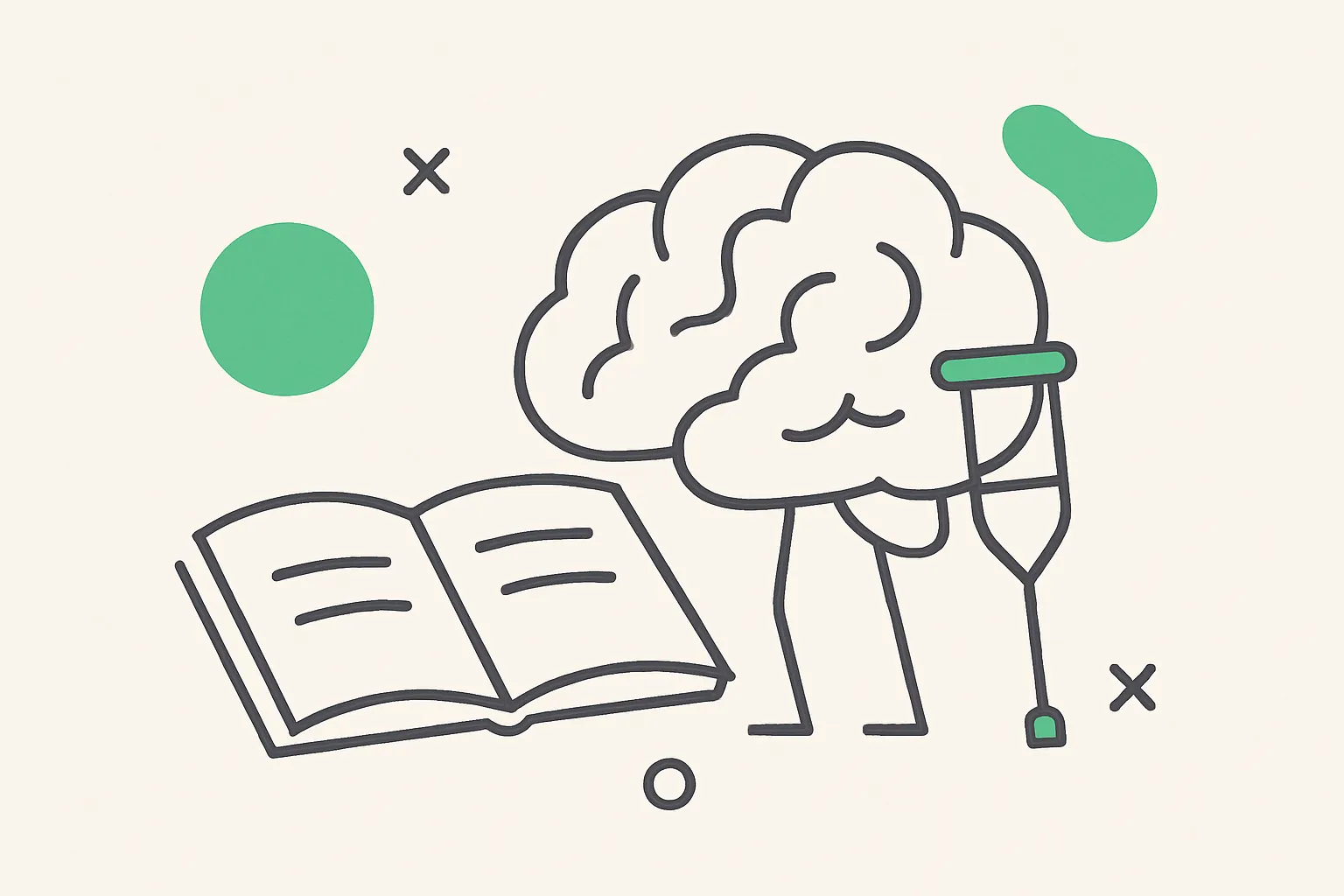
A 2025 paper from Microsoft Research and Carnegie Mellon University is back on the Hacker News front page, and its headline finding is simple: in a survey of 319 knowledge workers, people who trusted generative AI more reported doing less critical thinking, while people who were more confident in their own skills reported doing more. It is a useful result and an easy one to over-read, because it is a survey of what people say about their effort, not a measurement of how well they think.
This post explains what the paper (published at the ACM CHI 2025 conference) actually claims, what it cannot show, how Hacker News readers reacted this weekend, and what the findings suggest for anyone who works with AI daily.
TL;DR: the study at a glance #
| Question | Answer |
|---|---|
| Who ran it? | Microsoft Research and Carnegie Mellon University (lead authors Hao-Ping Lee and Advait Sarkar) |
| Where was it published? | ACM CHI 2025, DOI 10.1145/3706598.3713778 |
| Who was surveyed? | 319 knowledge workers who use generative AI at least weekly |
| What did they provide? | 936 first-hand examples of using AI in work tasks |
| Main finding | More confidence in AI went with less critical thinking; more self-confidence went with more |
| Qualitative finding | Critical thinking shifts toward verification, integration and task stewardship |
| Biggest caveat | Self-reported effort, not measured performance or correctness |
| Does it say use less AI? | No. It recommends better tool design and verification training |
What the researchers did #
According to the Microsoft Research page for the paper, the team asked two questions: when and how do workers perceive themselves using critical thinking while working with generative AI, and when and why does AI change the effort they put in. They surveyed 319 knowledge workers, who described 936 real examples of using AI at work. Respondents used tools such as ChatGPT and Copilot at least weekly.
The paper itself is on the ACM Digital Library and as a PDF on the co-author's site. Our summary relies on the Microsoft Research abstract page and independent coverage, because the full ACM page blocked our fetcher while we were writing.
The finding in one sentence #
The authors report that confidence pulls in opposite directions. Per the Microsoft Research summary, "higher confidence in GenAI is associated with less critical thinking, while higher self-confidence is associated with more critical thinking." Both kinds of confidence predicted whether workers engaged in critical thinking at all and how much effort it took.
In plain language: if you believe the tool is probably right, you check less. If you believe you know the subject well, you check more. That second half is intuitive, because expertise lets you spot a wrong answer, and it gives you the standing to push back.
What changed about "critical thinking" #
The paper's qualitative finding is the more interesting one for practitioners. The Register's summary quotes the authors on the shift: effort moves "from information gathering to information verification." The Microsoft Research page puts the same idea as three activities that grow in importance:
- Information verification: checking claims, facts and code against reliable sources.
- Response integration: merging the AI's output into your own work product, with your own judgment.
- Task stewardship: owning the overall task, deciding what to delegate and what to accept.
This is not a story of people simply stopping thinking. It describes work being reallocated. Time once spent searching and drafting is now spent evaluating and editing. Whether that evaluation actually happens, and with what quality, is exactly what the survey cannot tell us.
What the study cannot tell us #
Four limits matter before you quote this paper in a meeting.
It is self-reported. Workers described their own effort and confidence. People are poor judges of their own cognition, and a worker who feels "I just accepted it" may have been checking more than they realize, or less. As one Hacker News commenter put it, there is often a big gap between self-perception and measured performance.
It measures effort, not outcomes. The paper records how much critical thinking people say they applied, not whether their final work was more or less correct. Less effort on a trivial task may be efficient. More effort on a high-stakes task may be wasted. The study does not score results.
It is a snapshot. A one-time survey cannot show that anyone's skills declined over time. Claims about long-term "atrophy" would need longitudinal data.
There is a conflict-of-interest context. The Register notes that six of the seven authors work at Microsoft, which sells Copilot, and suggests that may explain the paper's emphasis on adapting to AI rather than using it less. We read this as a fair flag, not an accusation: the paper does not recommend reducing AI use, and the authors did not respond to The Register's questions.
What the authors recommend #
The recommendations are about design and training, not abstinence. As relayed by The Register, the authors suggest that AI tools should support long-term skill development, encourage reflective thinking, and offer help when needed, and that workers should "maintain foundational skills in information gathering and problem-solving" while being trained in verification, integration and stewardship. They also point to explainable AI, meaning tools that show how an output was produced, so that checking is easier.
What developers are saying #
The Hacker News thread for the paper (discussion, 55 points and 39 comments when we read it) was a mix of skepticism about the method and personal experience. We paraphrase below and attribute each point to the commenter; these are opinions, not findings.
- Skepticism of the method. Userkenferry argued the study does not seem to discuss correctness at all, only the amount of critical thinking, and that the interesting case is when oversight is inappropriate: too little leads to overconfidence in bad results, too much to wasted effort. Useroceansky wondered whether self-perception would match measured performance, while conceding self-report may be the best available proxy for confidence.
- "That is just Dunning-Kruger." Userneronuser quoted the confidence finding and called it the Dunning-Kruger effect. Whether it is the same phenomenon is arguable: the study ties reported effort to confidence in the tool, not to a gap between ability and self-assessment.
- "My experience is the opposite." UserjMyles asked whether others see people who work closely with LLMs doing some of the most acute critical thinking of their lives, said they are skeptical of the worry, and compared it to Socrates' complaints about books. That thread drew 11 replies. It is an anecdote, but it points at a real limit: the paper's respondents are general knowledge workers, not people who use AI as a sparring partner.
- The learning-by-struggle point. Userzomtorg said the larger issue is skipping the process through which you learn: they learn most when stuck for hours, and an instant AI answer removes that, so you get more done without noticing you are learning less. This is a hypothesis about skill formation that the survey does not test, but it is the most common version of the concern.
- AI as a thinking partner. Userjimnotgym argued chat assistants are good places to practice thinking because they offer counterexamples without ego or concern for your feelings.
- Attribution and links. Userdjoldman noted the paper dates from 2025 and posted a direct PDF link. That matters for framing: this is not a new study, and the thread was a re-discussion.
The disagreement is itself informative. Commenters who use AI as a challenger report more critical thinking; commenters who describe AI as an answer machine report less. That lines up with the paper's own finding that how you relate to the tool, and how confident you are in your own judgment, shapes how hard you think.
How this connects to other recent research #
This paper sits in a growing set of results about reliance on AI, and they do not all measure the same thing.
- A Berkeley and CMU experiment we covered found that AI assistance reduced persistence after only ten minutes . That study measured behavior, which makes it a stronger counterpart to this survey's self-reports.
- Workplace surveys on the cost of checking AI output, which we summarized in the AI verification tax , show the same shift this paper describes: time moves from creating to verifying.
- Our guide to choosing between AI drafts with taste and judgment turns the "task stewardship" idea into a practical filter.
- For the workflow side of the debate, see Lars Faye's argument about AI coding and expertise , and our essayAre we all meat proxies now? on humans reduced to approving machine output.
Taken together, the honest summary is that surveys point to a reallocation of effort, behavioral experiments suggest some short-term drops in persistence, and nobody has shown lasting skill loss in working adults. All three could be true at once without any of them proving the strongest claims in the headlines.
What to do with this #
You do not need to give up AI tools to act on the findings. Four habits follow from them.
- Match checking effort to risk, not to how the answer feels. Fluent output feels trustworthy. The paper's core result is that trust, not evidence, is what lowers scrutiny. Decide in advance which outputs get a real check: anything with numbers, citations, code that runs in production, or legal and medical claims.
- Check hardest when you are least qualified. Self-confidence predicted more critical thinking. When you lack expertise you also lack the instinct to question, so use an outside source or a colleague as a substitute for that missing confidence.
- Keep one thing manual. If you want to retain a foundational skill, such as writing a first draft, debugging a trace, or doing the arithmetic, do it unaided on a regular schedule. The authors' own advice is to maintain foundational skills in information gathering and problem-solving.
- Use the model as an opponent sometimes. Ask it for the strongest counterargument, the cases where your plan fails, or what evidence would change its answer. Several developers describe this as the use that sharpens their thinking rather than dulling it.
If you lead a team, the design implication is yours too: build review steps into the workflow so verification does not depend on individual willpower, and measure error rates, not just output speed. The study suggests people already do this reallocation informally; making it explicit is cheap.
Bottom line #
The Microsoft–CMU survey is credible, peer-reviewed at a top human-computer-interaction venue, and consistent with other research on over-reliance. It is also a survey. It shows that workers who trust AI more say they think less about its answers, and that the thinking they do shifts toward verification and oversight. It does not show that AI makes people worse at thinking, and its authors do not claim it does. Treat it as a reason to design your own checks, not as proof of decline.
Related reading #
Details are as of October 31, 2026. The paper is from 2025; the Hacker News counts will change.