Abstract #
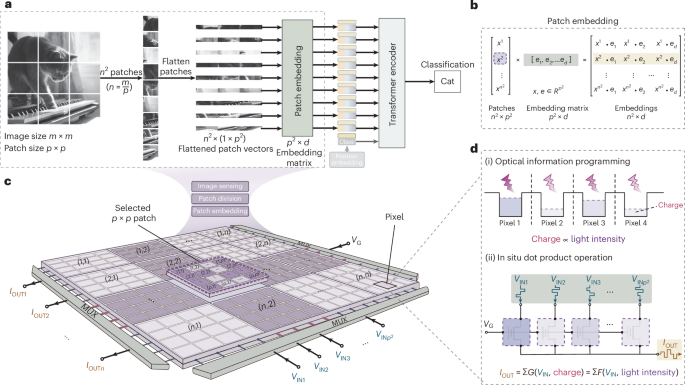
Vision transformers (ViTs) process images as sequences of embedded tokens, yet in existing architectures, tokenization is performed entirely in the digital domain, downstream of image capture. This separation increases energy cost and prevents token formation from occurring where visual information is physically generated. Here we introduce a physical tokenizer that performs analogue light-to-token conversion directly at the sensor level for ViTs. The prototype integrates a 32 × 32 photosensitive memory array of monolayer MoS2 floating-gate phototransistors with peripheral addressing circuitry, enabling optical images to be stored as non-volatile states and selectively combined into patch embeddings in situ, thereby eliminating separate sensing, patch division and patch embedding stages. When deployed in a standard ViT pipeline, the physical tokenizer achieves software-comparable accuracy on CIFAR-10 while reducing energy consumption by 14.3-fold relative to a digital tokenizer. These results establish physical tokenization as an energy-efficient and scalable hardware foundation for edge-intelligent, data-intensive vision systems.
This is a preview of subscription content, access via your institution
Access options #
Subscribe to this journal
Receive 12 digital issues and online access to articles
118,99 € per year
only 9,92 € per issue
Buy this article
- Purchase on SpringerLink
- Instant access to the full article PDF.
39,95 €
Prices may be subject to local taxes which are calculated during checkout
Subjects
Data availability #
The data supporting the findings of this study are available from the corresponding authors upon reasonable request. Source data are provided with this paper.
Code availability #
The code supporting the findings of this study is available from the corresponding authors upon reasonable request.
References #
Dosovitskiy, A. et al. An image is worth 16 × 16 words: transformers for image recognition at scale. In
Proc. International Conference on Learning Representations(ICLR, 2021).Liu, Z. et al. Swin transformer: hierarchical vision transformer using shifted windows. In
Proc. IEEE/CVF International Conference on Computer Vision10012–10022 (IEEE, 2021).Han, K. et al. A survey on vision transformer.
*IEEE Trans. Pattern Anal. Mach. Intell.*45, 87–110 (2023).Wu, B. et al. Visual transformers: token-based image representation and processing for computer vision. Preprint at
https://arxiv.org/abs/2006.03677(2020).Khan, S. et al. Transformers in vision: a survey. *ACM Comput. Surv.*54, 200 (2022).Sun, M. et al. VAQF: fully automatic software–hardware co-design framework for low-bit vision transformer. Preprint at
https://arxiv.org/abs/2201.06618(2022).Wang, T. et al. ViA: a novel vision-transformer accelerator based on FPGA. *IEEE Trans. Comput.-Aided Des. Integr. Circuits Syst.*41, 4088–4099 (2022).Zidan, M. A., Strachan, J. P. & Lu, W. D. The future of electronics based on memristive systems.
*Nat. Electron.*1, 22–29 (2018).Zhou, F. & Chai, Y. Near-sensor and in-sensor computing.
*Nat. Electron.*3, 664–671 (2020).Shi, W., Cao, J., Zhang, Q., Li, Y. & Xu, L. Edge computing: vision and challenges.
*IEEE Internet Things J.*3, 637–646 (2016).Ren, Q. et al. Optoelectronic devices for in-sensor computing.
*Adv. Mater.*37, 2407476 (2025).Wang, S. et al. Nonvolatile van der Waals heterostructure phototransistor for encrypted optoelectronic logic circuit.
ACS Nano16, 4528–4535 (2022).Wang, J. et al. Technology and integration roadmap for optoelectronic memristor.
*Adv. Mater.*36, e2307393 (2024).Zhou, F. et al. Optoelectronic resistive random access memory for neuromorphic vision sensors.
*Nat. Nanotechnol.*14, 776–782 (2019).Zhou, G. et al. Full hardware implementation of neuromorphic visual system based on multimodal optoelectronic resistive memory arrays for versatile image processing.
*Nat. Commun.*14, 8489 (2023).Jang, H. et al. An atomically thin optoelectronic machine vision processor.
*Adv. Mater.*32, e2002431 (2020).Huang, H. et al. Fully integrated multi-mode optoelectronic memristor array for diversified in-sensor computing.
*Nat. Nanotechnol.*20, 93–103 (2025).Zhang, Z. et al. All-in-one two-dimensional retinomorphic hardware device for motion detection and recognition.
*Nat. Nanotechnol.*17, 27–32 (2022).Chen, J. et al. Optoelectronic graded neurons for bioinspired in-sensor motion perception.
*Nat. Nanotechnol.*18, 882–888 (2023).Tan, H. & van Dijken, S. Dynamic machine vision with retinomorphic photomemristor-reservoir computing.
*Nat. Commun.*14, 2169 (2023).Pan, X. et al. Parallel perception of visual motion using light-tunable memory matrix.
*Sci. Adv.*9, eadi4083 (2023).Pang, X. et al. Non-volatile rippled-assisted optoelectronic array for all-day motion detection and recognition.
*Nat. Commun.*15, 1613 (2024).Xu, J. et al. High-order dynamics in an ultra-adaptive neuromorphic vision device.
*Nat. Nanotechnol.*20, 1419–1430 (2025).Wang, S. J. et al. An organic electrochemical transistor for multi-modal sensing, memory and processing.
*Nat. Electron.*6, 281–291 (2023).Liao, F. et al. Bioinspired in-sensor visual adaptation for accurate perception.
*Nat. Electron.*5, 84–91 (2022).Lee, D. et al. In-sensor image memorization and encoding via optical neurons for bio-stimulus domain reduction toward visual cognitive processing.
*Nat. Commun.*13, 5223 (2022).Zhu, Q.-B. et al. A flexible ultrasensitive optoelectronic sensor array for neuromorphic vision systems.
*Nat. Commun.*12, 1798 (2021).Yao, P. et al. Fully hardware-implemented memristor convolutional neural network.
Nature577, 641–646 (2020).Li, C. et al. Analogue signal and image processing with large memristor crossbars.
*Nat. Electron.*1, 52–59 (2017).Cai, F. et al. A fully integrated reprogrammable memristor-CMOS system for efficient multiply-accumulate operations.
*Nat. Electron.*2, 290–299 (2019).Wang, S. et al. Networking retinomorphic sensor with memristive crossbar for brain-inspired visual perception.
*Nat. Sci. Rev.*8, nwaa172 (2020).Li, C. et al. Revisiting the epitaxial growth mechanism of 2D TMDC single crystals.
*Adv. Mater.*36, 2404923 (2024).Ma, S. et al. A 619-pixel machine vision enhancement chip based on two-dimensional semiconductors.
*Sci. Adv.*8, eabn9328 (2022).Dodda, A. et al. Active pixel sensor matrix based on monolayer MoS
2phototransistor array.*Nat. Mater.*21, 1379–1387 (2022).Migliato Marega, G. et al. A large-scale integrated vector-matrix multiplication processor based on monolayer molybdenum disulfide memories.
*Nat. Electron.*6, 991–998 (2023).Wang, H. et al. Recent advances in two-dimensional photovoltaic devices.
*J. Semicond.*45, 051701 (2024).Yang, X., Yan, B., Li, H. & Chen, Y. ReTransformer: ReRAM-based processing-in-memory architecture for transformer acceleration. In
Proc. 39th International Conference on Computer-Aided Design1–9 (ACM, 2020).Kachris, C. A survey on hardware accelerators for large language models.
*Appl. Sci.*15, 586 (2025).Nag, S., Datta, G., Kundu, S., Chandrachoodan, N. & Beerel, P. A. ViTA: a vision transformer inference accelerator for edge applications. In
*2023 IEEE International Symposium on Circuits and Systems (ISCAS)*1–5 (IEEE, 2023).Leroux, N. et al. Analog in-memory computing attention mechanism for fast and energy-efficient large language models.
*Nat. Comput. Sci.*5, 813–824 (2025).Fu, J.-H. et al. Oriented lateral growth of two-dimensional materials on c-plane sapphire.
*Nat. Nanotechnol.*18, 1289–1294 (2023).Zou, X. et al. Robust epitaxy of single-crystal transition-metal dichalcogenides on lanthanum-passivated sapphire.
Science390, eaea0849 (2025).Hinton, H. et al. A 200 x 256 image sensor heterogeneously integrating a 2D nanomaterial-based photo-FET array and CMOS time-to-digital converters. In
*2022 IEEE International Solid- State Circuits Conference (ISSCC)*1–3 (IEEE, 2022).Zhu, K. et al. Hybrid 2D-CMOS microchips for memristive applications.
Nature618, 57–62 (2023).Liu, C. et al. A full-featured 2D flash chip enabled by system integration.
Nature646, 1081–1088 (2025).Liu, Y., Huang, Y. & Duan, X. Van der Waals integration before and beyond two-dimensional materials.
Nature567, 323–333 (2019).Jayachandran, D. et al. Three-dimensional integration of two-dimensional field-effect transistors.
Nature625, 276–281 (2024).
Acknowledgements #
We thank Nexstrom Pte. Ltd., Singapore, for providing single-crystal monolayer MoS2 films.
Funding #
This work was supported in part by the National Key R&D Program of China under grant 2023YFF1203600 (S.-J.L.), the National Natural Science Foundation of China (62034004 (F.M.)), the Leading-edge Technology Program of Jiangsu Natural Science Foundation (BK20232004 (F.M.)), the Natural Science Foundation of Jiangsu Province (BK20233001 (F.M.)), the AI & AI for Science Project of Nanjing University (14380240 (S.-J.L.) and 14380242 (F.M.)). F.M. and S.-J.L. would like to acknowledge support from AIQ Foundation and the e-Science Center of Collaborative Innovation Center of Advanced Microstructures. L.-J.L. acknowledges support from the National University of Singapore and NRF Professorship (NRF-P2025-002).
Author information #
Authors and Affiliations
Contributions
S.W., S.-J.L. and F.M. conceived the idea and designed the experiments. F.M. and S.-J.L. supervised the whole project. S.W., N.Y., X.S. and X.-J.Y. contributed to the device and array fabrication. S.W., X.-J.Y., J.S. and D.W. performed all the measurements and analysed the experimental data. X.-J.Y. contributed to the FPGA-controlled peripheral circuitry. J.S. carried out the simulation of the ViT model. L.-J.L., C.L. and H.L. contributed to the material growth. X.X. provided help in the array fabrication. W.Y., Y.Z., L.Y., Y.Y. and P.W. assisted in the design of the optoelectronic measurement set-up. C.P., Y.C. and Y.W. provided help in the data analysis. S.W., S.-J.L. and F.M. co-wrote the paper with input from all other authors.
Corresponding authors
Ethics declarations #
Competing interests
The authors declare no competing interests.
Peer review #
Peer review information
Nature Sensors thanks Junseok Heo, Ming Liang Jin and Dmitry Polyushkin for their contribution to the peer review of this work.
Additional information #
Publisher’s note Springer Nature remains neutral with regard to jurisdictional claims in published maps and institutional affiliations.
Supplementary information #
Supplementary Information (download PDF ) Supplementary Figs. 1–25 and Notes 1–6.
Source data #
Source Data Fig. 2 (download ZIP ) Source data for Fig. 2e–g.
Source Data Fig. 3 (download ZIP ) Source data for Fig. 3g,j.
Source Data Fig. 4 (download ZIP ) Source data for Fig. 4b–d,f.
Rights and permissions #
Springer Nature or its licensor (e.g. a society or other partner) holds exclusive rights to this article under a publishing agreement with the author(s) or other rightsholder(s); author self-archiving of the accepted manuscript version of this article is solely governed by the terms of such publishing agreement and applicable law.
About this article #
Cite this article
Wang, S., Yang, N., Yangdong, XJ. et al. Direct light-to-token conversion with integrated 2D photosensitive memory.
Nat. Sens. (2026). https://doi.org/10.1038/s44460-026-00122-3 Received:
Accepted:
Published:
Version of record:
DOI: https://doi.org/10.1038/s44460-026-00122-3