Diátaxis — a documentation framework created in 2020 — hit the top of Hacker News on August 2, 2026 with 407 points. A six-year-old framework trending at the top of HN is not nostalgia. Developers building AI-powered tools are independently arriving at the same conclusion: their AI agents give wrong answers because their documentation is structurally broken. According to API platform Fern’s 2026 analysis, nearly half of traffic to documentation sites now comes from AI agents — Cursor, Claude, GitHub Copilot — rather than human browsers. The structure of your docs now determines the quality of those agents’ answers.
AI Agents Retrieve Fragments, Not Pages #
Human readers scan documentation pages and apply judgment. They skip irrelevant sections, follow links when confused, and infer context from surrounding text. AI coding agents do none of this. They retrieve the smallest useful document chunk that fits their current context window, slot it in, and act on what they find.
This retrieval behavior has a direct consequence: when a documentation page mixes a tutorial walkthrough, a reference table, a design explanation, and usage caveats into a single undifferentiated block, an agent retrieves a noisy chunk it cannot interpret cleanly. It must infer which sentence is a factual specification and which is a teaching example. It often gets this wrong. Production post-mortems in 2026 document the pattern repeatedly — an agent hallucinated API field values because the reference spec and a tutorial curl example lived on the same page. Another sent an automated welcome email before offer acceptance, having retrieved an onboarding flow doc that mixed candidate status field definitions with step-by-step processing instructions. These are not model failures. They are documentation failures at machine speed.
Research on context window retrieval confirms the mechanism: LLM accuracy drops significantly when relevant information is buried mid-context in a dense mixed-content block. Structured retrieval — where an agent grabs a focused reference chunk rather than a mixed-type page — produces dramatically better accuracy on factual queries.
Why Diátaxis Maps to AI Agent Reasoning #
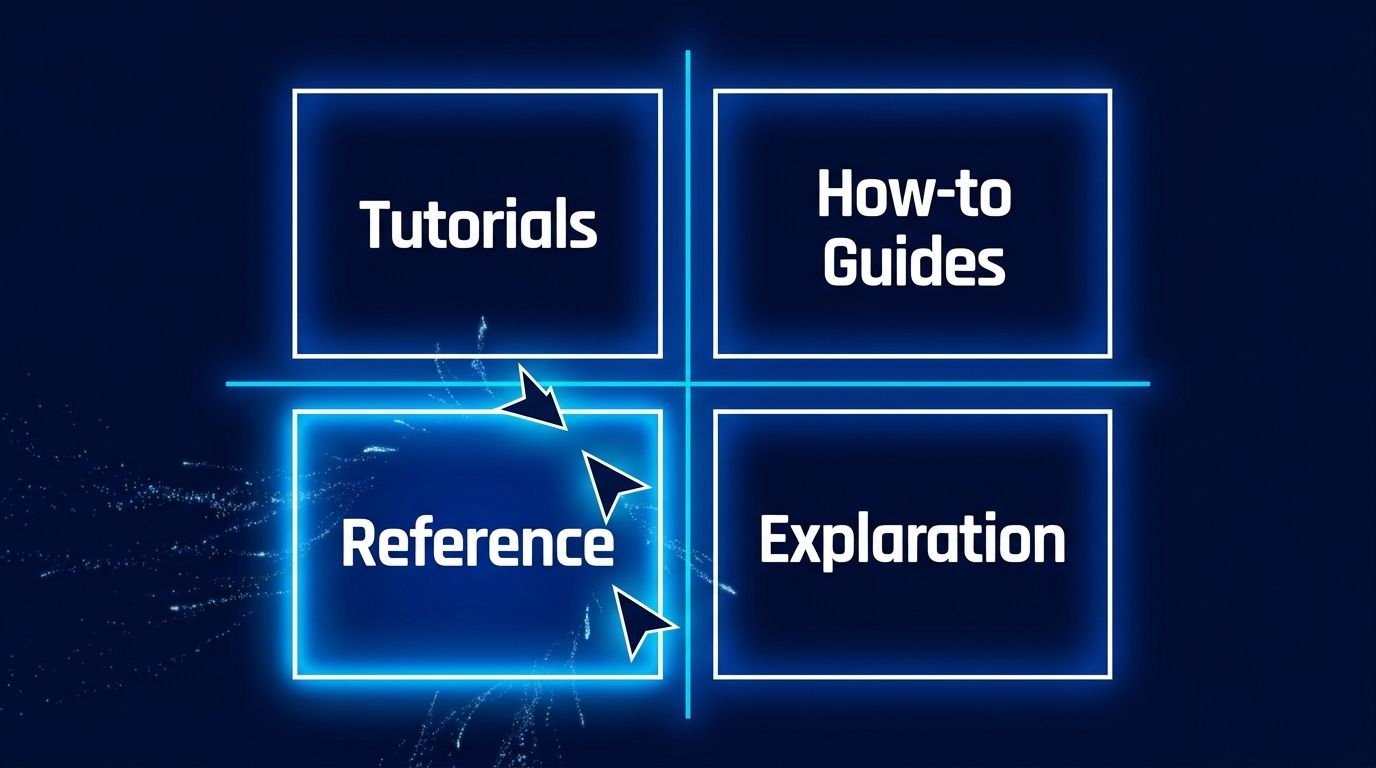
The Diátaxis framework, created by Daniele Procida, separates all technical documentation into four types: Tutorials (learning by doing), How-to guides (task execution steps), Reference (accurate technical facts), and Explanation (conceptual understanding). The boundary rules are strict. Reference contains no teaching narrative. Tutorials contain no reference tables. How-to guides assume competence and skip explanation.
This separation maps almost exactly to how AI agent reasoning works. An agent executing a task — authenticating with OAuth 2.0, say — does not need a lesson on why OAuth exists. It needs the how-to guide: the precise sequence of steps. When it needs to verify a field value, it needs the reference section: unambiguous facts, no narrative noise. When it is building a plan and needs architectural context, it reaches for the explanation. Diátaxis was designed around human reader intent, and AI agent reasoning is intent-driven in precisely the same way.
The companies that adopted Diátaxis early are not surprised by this alignment. Cloudflare credited it as the “north star” for their developer documentation redesign — “our documentation is now clearer than it’s ever been, both for readers and contributors.” Canonical implemented it across all Ubuntu and cloud product documentation, one of the largest open-source documentation restructurings in recent memory. Django and the Python community adopted it for official docs. These organizations serve millions of API consumers — many of them AI agents running in production.
Related:[GitHub Copilot Code Review: Agent Skills and MCP Are Now GA]
Clean Reference Documentation Reduces Hallucinations #
The highest-value change you can make for AI agent accuracy is simple: keep your reference documentation free of narrative. Reference should contain neutral, well-bounded facts — endpoint parameters, field types, valid values, error codes. No curl examples. No “here’s why we designed it this way.” No usage tips.
When an agent retrieves a clean reference chunk, it has facts to act on. When it retrieves a mixed-type page, it has facts embedded in narrative, and it must separate them. It does not always succeed. The hallucination is not the model inventing something from nothing — it is the model misreading narrative context as factual specification. A tutorial that says “for most use cases, set the timeout to 30 seconds” becomes, in a poorly retrieved chunk, “the timeout value is 30 seconds.” The separation Diátaxis enforces is not a stylistic preference. It is a reliability mechanism.
This is why the 2026 Hacker News discussion around Diátaxis is qualitatively different from previous years. The developers in the comments are not tech writers arguing about documentation theory. They are backend engineers who discovered their AI coding assistant keeps suggesting deprecated API calls — because tutorial examples using old syntax were not separated from the current reference spec. The problem-owner has shifted from documentation teams to engineering teams. That shift is the signal.
What to Apply Today #
You do not need to rebuild your documentation site. The minimum viable change is consistent labeling: add section headers that signal document type. A README that splits into “Tutorial: Getting Started,” “How-to: Configure Authentication,” “Reference: Environment Variables,” and “Explanation: Why We Use Stateless Tokens” immediately gives agents reliable structural cues. They can skip the tutorial and go straight to the reference. Retrieval quality improves without any infrastructure change.
The structural complement in 2026 is llms.txt — a plain-text, markdown-formatted file that works like a sitemap for AI agents. It lists your documentation sections with their types, stripping CSS and navigation to deliver structured text within token budgets. Fern’s analysis found that llms.txt adoption is accelerating across developer tools platforms precisely because agents need a map before they retrieve. Diátaxis gives you the structure; llms.txt tells agents where each structure type lives. Apply both, and you have given AI coding tools the same navigational clarity that sitemap.xml gave search engines two decades ago.
Key Takeaways #
- AI coding agents retrieve documentation fragments, not full pages — mixed-type documentation produces hallucinations and wrong API calls at machine speed
- Diátaxis separates documentation into four types (Tutorials, How-to guides, Reference, Explanation) that map directly to AI agent reasoning modes — clean separation improves retrieval accuracy without any AI-specific tooling
- Pure reference documentation — no narrative, no examples, no teaching moments — is the single highest-value change for reducing AI agent hallucinations on factual lookups
- The minimum change is labeling: consistent section headers signaling document type give agents structural cues immediately
- Add llms.txt as a complement: Diátaxis is the structural layer, llms.txt is the delivery layer — together they give agents a sitemap to the right document type
The 407 HN points for a 2020 framework in August 2026 are not a documentation trend. They are engineering teams discovering that documentation structure is now a first-class AI infrastructure concern — and that the right framework has existed for six years.