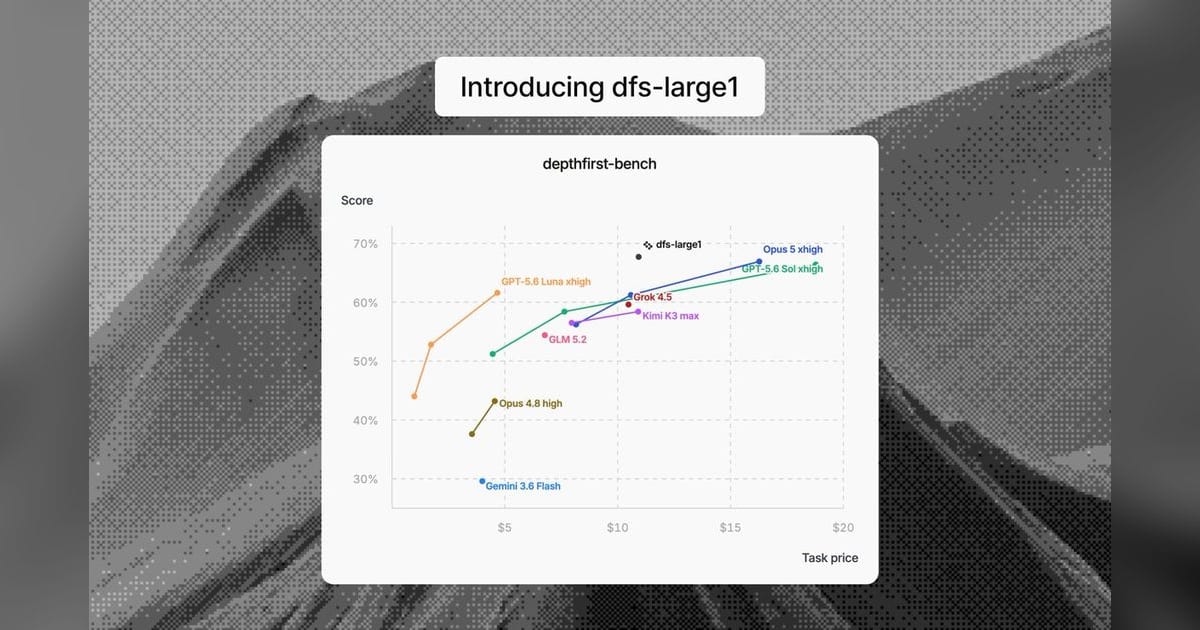
Andrea Michi (@andreamichi), Depthfirst's co-founder and CTO, launched dfs-large1 on July 30th, putting a reinforcement learning-trained model into preview for customers hunting vulnerabilities across large enterprise code repositories.
The San Francisco AI security developer built dfs-large1 on GLM 5.2, then post-trained it inside Depthfirst's security-agent harness with support from Fireworks AI for training and inference. Depthfirst says the new model is its most capable release and outperformed a group of general-purpose models on depthfirst-bench, an internal evaluation based on vulnerabilities in large repositories. (depthfirst.com)
That performance claim has a clear limitation: Depthfirst has not published enough information for outsiders to reproduce the benchmark. Its report says a future post will explain the benchmark's construction and methodology in greater detail. The company says it manually reviewed every passing trajectory and blocked benchmark agents from internet access and future commits containing vulnerability fixes.
Michi previously led research engineering at Google DeepMind, where he worked on reinforcement learning for Gemini and co-authored the AlphaDev project, which used reinforcement learning to discover faster sorting algorithms. Depthfirst's other co-founders bring infrastructure and security experience: Qasim Mithani built developer and security products at AWS before leading infrastructure and enterprise-platform work at Databricks, while Daniele Perito co-founded Faire after working on security and fraud prevention at Cash App. (depthfirst.com)
That mix explains Depthfirst's central technical bet. General-purpose models can inspect code, but Depthfirst is training models around the narrower work of finding a potential vulnerability, tracing whether attacker-controlled data can reach it and producing executable evidence that the flaw is real.
Training agents to prove a bug
Depthfirst's production harness divides a large repository into smaller audit scopes and assigns each agent a defined set of files and a threat model. The agent can still inspect shared libraries, dependencies and related repositories when it needs broader context to establish reachability or exploitability.
dfs-large1 was jointly trained on vulnerability detection in application code, vulnerability detection in lower-level systems code and validation of candidate findings. Depthfirst also penalized the model for excessive tool use and speculative reports, an attempt to curb two costly failure modes in automated security analysis: agents that investigate indefinitely and scanners that swamp engineers with plausible-looking false positives.
According to Depthfirst, later training checkpoints increasingly tested specific hypotheses and used executable harnesses instead of broadly searching repositories. The company presented examples in which dfs-large1 reproduced memory-safety failures under AddressSanitizer after tracing defects across multiple pieces of code.
The model's reported results should still be read as vendor-run testing. depthfirst-bench places dfs-large1 at roughly 68% while comparing score with estimated task price, ahead of the other tested systems at a similar cost. Depthfirst omitted two cybersecurity-focused models, Mythos and GPT-5.6 Cyber, because it did not have access to them during evaluation. (depthfirst.com)
Depthfirst says an earlier model checkpoint also supported a research campaign that validated 105 vulnerabilities across 34 Ruby projects, with about 61% involving memory-safety problems. The new release is intended for the company's broader commercial workflow, where customers connect repositories to the Depthfirst platform for vulnerability discovery, validation and proposed fixes. (depthfirst.com)
A heavily funded specialized-model bet
Depthfirst has raised $120 million since its October 2024 founding. Accel led a $40 million Series A announced in January, with participation from SV Angel, Mantis VC and Alt Capital. Meritech Capital led an $80 million Series B announced on March 31st, joined by Forerunner Ventures, The House Fund and existing investors including Accel, BoxGroup, Liquid 2 Ventures, Alt Capital and Mantis VC. (techcrunch.com)
The Series B arrived alongside dfs-mini1, an earlier domain-specific model initially focused on smart-contract vulnerabilities. Four months later, dfs-large1 expands the approach to application and systems code across enterprise repositories. That progression puts model training, rather than a general model wrapped in security workflows, at the center of Depthfirst's product strategy.
Depthfirst names AngelList, Lovable, Persona and Moveworks among its customers. Accel said in January that the company's agents found eight times as many true-positive vulnerabilities as traditional static-analysis tools while reducing false positives by 85%, figures supplied around the investment and not independently audited. dfs-large1 gives Depthfirst a new technical basis for those commercial claims, but adoption will depend on performance inside customer repositories where false positives, audit cost and time to a reproducible exploit determine whether a finding reaches an engineer. (accel.com)