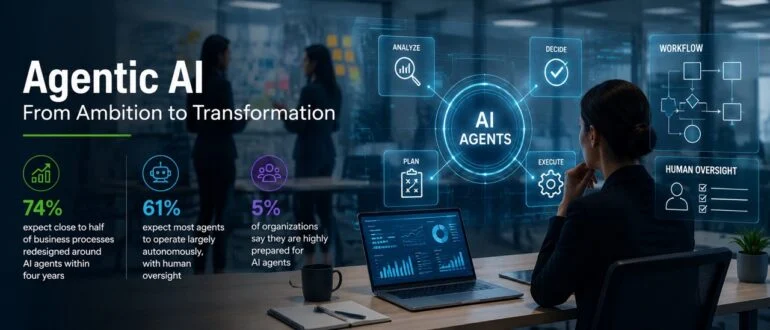
Businesses have ambitious plans for agentic AI, but most lack the processes and workforce preparation needed to put those plans into practice, according to new Deloitte research entitled AI agents are only the beginning: The path to agentic transformation.
Within four years, 74% of surveyed business and IT leaders expect close to half of their business processes to be redesigned around AI agents. Another 61% expect most agents to operate largely autonomously, with humans providing oversight.
Yet current enterprise readiness is far below those expectations. A mere 5% of organizations said their businesses are highly prepared for AI agents, while 15% have reached scaled adoption of multi-agent systems. Even among companies that have scaled agentic AI, just 46% consider their businesses prepared for broader adoption.
Rethinking How Work Gets Done
The findings suggest that deploying the technology may be the easier part of the agentic AI transition. Companies will also need to rethink how work gets done, how employees interact with autonomous systems and who remains accountable for AI-driven decisions.
Adoption is moving beyond the experimentation phase. Forty-two percent of respondents said their companies have tested or deployed AI agents, while 43% have introduced agents across multiple business functions.
Scaling those projects is proving more difficult. Data is a major obstacle, with 72% citing a lack of unified and accessible data. Another 70% reported concerns about their ability to govern and trust agents, while 67% pointed to the cost and complexity of integration.
Business processes ranked as the weakest area of readiness. Just 21% described their organizations as prepared or highly prepared in this area. By comparison, 52% reported readiness in vision and strategy, 48% in technology infrastructure, 42% in data and 39% in risk, security and governance. Workforce readiness stood at only 25%.
**Using Existing Workflows **
Many companies are being pragmatic by placing agents into current workflows rather than rebuilding the workflows themselves. That approach can generate earlier returns and provide experience with the technology, but Deloitte argues that it should be a transitional strategy rather than the end goal.
Workforce management presents another major challenge. Forty-three percent of leaders expect AI agents to cause significant workforce disruption during the next 12 to 18 months. Looking two to three years ahead, that figure climbs to 72%.
Companies expect job requirements to change, new roles to emerge and employees to take on different responsibilities as they work alongside AI systems. Yet half of respondents said their organizations are not investing enough in AI-related workforce transformation.
Human oversight will remain important even as agents gain greater autonomy. Three-quarters of surveyed leaders believe collaboration between employees and AI agents will create more value than automation alone, although fewer than half have defined real systems for this collaboration.
Long-Term Planning
Deloitte recommends that businesses develop long-term agentic AI road maps and redesign workflows around desired business results. Companies also need clear rules defining what agents can decide independently, when people must intervene and who is responsible for results.
Bottom line, the challenge for enterprises is rebuilding business workflows so those agents can perform useful work at scale without sacrificing human judgment or accountability.
Deloitte surveyed 501 US respondents ranging from senior managers to C-suite executives between April and June 2026. All respondents were directly involved in agentic AI strategy or implementation, and their organizations were at least piloting the technology. Deloitte supplemented the survey with interviews of 20 executives and AI and data science leaders.