DeepSeek V4 Flash Vision, listed on the API as deepseek-v4-flash-vision-exp
, went live on August 21, 2026. It is the week’s only confirmed new-model launch from a major lab, and DeepSeek’s framing is narrow on purpose: an experimental multimodal variant that matches the text-only V4-Flash on agents, reasoning and world knowledge, takes images alongside text, and bills those images at the same per-token rate as everything else.
That last clause is where the coverage goes wrong. Search for this model’s price and you will find two answers, $0.22 in and $0.66 out per million tokens, or $0.44 and $1.32. Both are right. DeepSeek publishes peak and off-peak rates for the V4-Flash line, the peak rate is exactly double, and the vision model inherits that clock unchanged. A write-up that quotes one number without saying which clock it sampled is incomplete, and a budget built on it is off by a factor of two in one direction or the other.
This post covers what shipped and on which surfaces, the two-price table and what OpenRouter shows you, how DeepSeek tokenizes an image and the limits it published, a per-image cost table we computed from the vendor’s own figures, the self-reported benchmark table that sits inside an image in the announcement, what the model does not do, and where it fits in a multi-model stack. The numbers here are sourced to DeepSeek’s own documentation as published at launch, plus the same-day listings on OpenRouter and Vercel’s AI Gateway and the same-day trade coverage of the launch.
- 01One real launch, same day everywhere.DeepSeek announced deepseek-v4-flash-vision-exp on August 21, 2026. OpenRouter listed it at 11:26 UTC the same day and Vercel’s AI Gateway added it as Experimental. Text and image in, text out. No video, PDF or OCR mode appears anywhere in DeepSeek’s docs.
- 02Vision costs nothing extra per token.The rate card is identical to text-only deepseek-v4-flash. Images are tokenized for billing at up to 384 tokens each and charged at the input rate, so a 5000×5000 image costs the same as a 2000×2000 one.
- 03Two prices are both correct, because of the clock.Off-peak: $0.22 per M input (cache miss), $0.007 (cache hit), $0.66 output. Peak hours, 01:00–04:00 and 06:00–10:00 UTC, are exactly double: $0.44, $0.014, $1.32. OpenRouter’s displayed price appears to track the same clock.
- 04The benchmarks exist, inside a PNG, and they are self-reported.DeepSeek’s announcement embeds an 11-benchmark table against Opus 4.8, with the DeepSeek text-agent scores run on DeepSeek’s own Harness Minimal Mode. The vision model trails on 8 rows, including Terminal Bench 2.1 at 83.9 versus 85.0, and leads narrowly on 3. No independent reproduction was found.
- 05No weights, no licence, a published limit sheet.There is no Hugging Face repo for this model; the webbrain-one repos with Vision in the name are third-party splices that predate it. DeepSeek’s Vision guide does publish limits: 600 images per request, 8,192 px per side (4,096 at 15 or more images), 64 MiB payload without the Files API or 200 MiB with it.
01 — What ShippedAn experimental multimodal V4-Flash, live on three surfaces at once. #
DeepSeek’s release note describes the model in one sentence: an experimental multimodal model that matches DeepSeek-V4-Flash on text capabilities, including agents, reasoning and world knowledge. The benchmark image attached to that note names the text baseline explicitly as DeepSeek-V4-Flash-0731
, the July snapshot we covered in the V4-Flash-0731 release post. Read it as that model plus an image pathway, not as a new generation.
The spec sheet is the V4-Flash spec sheet. Context is 1,048,576 tokens, maximum completion is 384,000 tokens, thinking mode is supported and is the default, and the model is served through both of DeepSeek’s API formats: the OpenAI-compatible endpoint at api.deepseek.com
and the Anthropic-format endpoint at api.deepseek.com/anthropic
. The release note adds that it supports Chat Completions, Messages and Responses. If you already route V4-Flash through either format, the vision model is a model-ID change; the format convergence itself is covered in our post on DeepSeek’s Responses and Anthropic-format endpoints.
DeepSeek API Platform · day one
Announced August 21 via news post, changelog and X. Concurrency limit 2,500, the same as text-only V4-Flash and five times the 500 on V4-Pro. A new Files API shipped alongside it, which DeepSeek states is free to use, so an image can be uploaded once and referenced by file_id.
OpenRouter · listed 11:26 UTC
The listing timestamp converts to 2026-08-21 11:26:03 UTC, the same day as the vendor announcement. That is unusual: the other new listings we checked in the same window, GLM-5.3, Muse Spark’s contributor tier and Tencent’s Hy-MT2 sizes, each traced back to a vendor launch days or months earlier. hugging_face_id is null, which matches the absence of open weights.
Vercel AI Gateway · Experimental
Vercel added the model to AI Gateway the same day and tagged it Experimental. Its changelog is also the only place a supported-format list appears; DeepSeek’s own docs do not enumerate formats, so attribute that list to Vercel.
deepseek-v4-flash-vision-exp
is live on the DeepSeek API with text and image inputand text output. Shipped alongside it: a Files API for image reuse that DeepSeek states is free, and
DeepSeek Harness 0.1.1, a same-day point release of the agent runtime that launched as v0.1 on August 13, with out-of-the-box support for the new model (our
Harness write-upcovers the runtime itself). Bloomberg ran the launch the same day under the headline “DeepSeek Unveils Test Model to Rival Anthropic’s Opus 4.8”; the Opus comparison is examined in section 05.
One naming note. The -Exp
suffix is not new: DeepSeek has used it before, on DeepSeek-V3.2-Exp
, and it was read at the time as marking a model still under evaluation ahead of a stable release. That is a reported pattern rather than anything DeepSeek documents, and DeepSeek has published no formal definition of what Exp guarantees about stability, evaluation length or deprecation, so treat the suffix as a signal that the model ID may be superseded, not as a policy you can plan against.
02 — PricingTwo correct prices, one model, one clock. #
DeepSeek’s [pricing page](https://api-docs.deepseek.com/quick_start/pricing) lists the vision model in the same model-details table as `deepseek-v4-flash`

and `deepseek-v4-pro`
, and its three line items are identical to text-only V4-Flash on every row. The page’s own footnote defines the clock: peak hours are 01:00 to 04:00 and 06:00 to 10:00 UTC, and all other hours are off-peak. That leaves seven peak hours and seventeen off-peak hours in each day.
| Line item · per 1M tokens | Off-peak | Peak (01–04, 06–10 UTC) | Peak ÷ off-peak |
|---|---|---|---|
| deepseek-v4-flash-vision-exp · identical to deepseek-v4-flash | |||
| Input, cache miss | $0.22 | $0.44 | 2.0× | | Input, cache hit | $0.007 | $0.014 | 2.0× | | Output | $0.66 | $1.32 | 2.0× | | Image tokens | Up to 384 tokens per image, billed at the input rate above (cache miss or hit, whichever applies). No separate per-image fee. |
Rate columns are DeepSeek’s published figures at launch; the ratio column is our division. The practical reading is that a pipeline running between 10:00 UTC and 01:00 UTC the next day pays the left-hand column, and anything that lands in the two peak windows pays double. We are not going to restate the scheduling mechanics here, because our off-peak pricing post already walks through the clock, the cache-hit arithmetic and the batching playbook for DeepSeek’s off-peak windows. What is new is that the vision model joined that clock on its first day with no vision-specific surcharge.
What OpenRouter shows you
OpenRouter’s listing for this model displays one price pair, and a single pair cannot describe a two-column rate card. The two figures OpenRouter can show for it, $0.22 in and $0.66 out, and $0.44 and $1.32, are exactly DeepSeek’s off-peak and peak rows. Neither figure is a markup and neither is wrong. The straightforward reading is that the listing passes DeepSeek’s live rate through rather than freezing a number when the model was added, which is the same pass-through behaviour Vercel states outright for its gateway: AI Gateway reflects provider pricing with no markup and does not charge a platform fee on inference. OpenRouter does not document how or when the figure refreshes, so treat any single quoted price as a sample rather than the model’s price, and check which of DeepSeek’s two columns a comparison site is quoting before you budget from it. The broader point, that a catalog listing is a snapshot with a timestamp rather than a fact about the model, is the subject of our model-catalog literacy guide.
"Images are tokenized for billing: up to 384 tokens each, at V4-Flash pricing."— DeepSeek, V4-Flash-Vision-Exp release note, August 21, 2026
03 — Image BillingUp to 384 tokens per image, and the limits DeepSeek did publish. #
The billing rule is a ceiling, not a formula you need to reproduce. Each image is tokenized at up to 384 tokens, and those tokens are charged at whatever input rate applies at that moment, cache miss or cache hit, peak or off-peak. DeepSeek’s own worked example makes the consequence explicit: a 2000×2000 image and a 5000×5000 image consume identical tokens. Shrinking a 5000-pixel image to 2000 pixels saves nothing on the bill; whether very small images tokenize below the ceiling is not something DeepSeek has documented. Shrinking images to stay inside the payload limits below is a different matter.
Images can be supplied three ways: inline as base64, as an external URL, or by file_id
through the new Files API. DeepSeek states the Files API is free, and its stated purpose for it is bandwidth: upload an image once, then reference it across requests without re-sending the bytes. DeepSeek does not say that reusing a file produces a cache hit on the image tokens; the cache-hit rate is a property of DeepSeek’s context cache, so do not assume the two are the same thing when you budget.
The per-request limits are published, but not on the pricing page. They live in the Vision guide, which is the page to bookmark if you are building anything that batches images.
Per image, at most
Billed at the input rate in force at the time of the call. DeepSeek’s example: a 2000×2000 and a 5000×5000 image consume identical tokens. Output tokens and any text in the prompt are charged separately at the normal rates.
Maximum count
The Vision guide caps a single request at 600 images. At 600 images the image tokens alone can reach 230,400, which still leaves most of the 1,048,576-token window for text and reasoning.
Per side, with a step-down
Maximum 8,192 pixels per side for requests with fewer than 15 images; from 15 images per request the per-side cap drops to 4,096 pixels. Tokens do not scale with resolution, only the limit does.
Total image payload
64 MiB of images per request without the Files API, rising to 200 MiB when images are referenced by file_id. That, not the token ceiling, is the reason to use the Files API for large or repeated image sets.
Two things are absent from every DeepSeek surface we read: a published tokenization formula for images below the 384-token ceiling, and any statement of supported file formats. The only format list in circulation is in Vercel’s changelog, for its own gateway: JPEG, PNG, GIF or WebP. That is a format list, not a modality list. Still images are the whole of the input surface; nothing in DeepSeek’s documentation describes video, PDF or document ingestion, and the OpenRouter record agrees, listing input modalities as text and image only.
04 — Cost ModelWhat an image actually costs, by clock and cache state. #
The coverage we read stops at “up to 384 tokens each.” The multiplication is trivial, so we did it. The table below is our own calculation from two vendor inputs: the 384-token ceiling and the six published per-million rates. Formula for every cell: images × 384 ÷ 1,000,000 × the per-M input rate. These are ceiling costs for the image tokens alone, at the 384-token maximum; smaller images may tokenize below the ceiling, and the text in your prompt plus every output token is extra at the rates in section 02.
| Images | Off-peak · cache miss ($0.22/M) | Off-peak · cache hit ($0.007/M) | Peak · cache miss ($0.44/M) | Peak · cache hit ($0.014/M) |
|---|---|---|---|---|
| Image tokens only · 384 tokens per image · output not included | |||| | 1 image | $0.0000845 | $0.0000027 | $0.000169 | $0.0000054 | | 1,000 images | $0.0845 | $0.0027 | $0.169 | $0.0054 | | 100,000 images | $8.45 | $0.27 | $16.90 | $0.54 | | 1,000,000 images | $84.48 | $2.69 | $168.96 | $5.38 |
Image-token cost per 1,000 images · four billing states
Source: Digital Applied arithmetic on DeepSeek’s published launch rates and 384-token image ceilingThe shape of the table matters more than any cell. The clock moves cost by 2×; the cache state moves it by roughly 31×, because $0.22 divided by $0.007 is about 31.4. For a screenshot-driven agent loop that re-sends the same page state across turns, whether the image tokens land in DeepSeek’s context cache is a bigger lever than what hour it is, and DeepSeek has not documented how image tokens interact with the cache. Measure it on your own traffic before you assume the cache-hit column.
The other reading is that at these rates, image input is close to free relative to the text around it. A million images at the off-peak cache-miss ceiling is $84.48 of image tokens; a single thinking-mode response of a few thousand tokens per image would dwarf that. For bulk visual classification, the output side is where the budget goes, which is the same conclusion our V4-Flash bulk-workload playbook reached for text.
05 — BenchmarksThe table is in the announcement, inside a PNG, and it is self-reported. #
DeepSeek’s text says that on multimodal agent benchmarks the vision model makes a major leap over V4-Flash, bringing multimodal agent performance close to Opus-4.8. The numbers behind that sentence are not in the page text. They are in an image the release note embeds, v4_260821_benchmark_en.png, which any text-only fetch of the announcement will miss. We downloaded it and transcribed it. It is an 11-benchmark table in two sections, text-based agent evaluation and multimodal agent evaluation, comparing the vision model, text-only V4-Flash-0731 and Opus 4.8. The final column below is our subtraction.
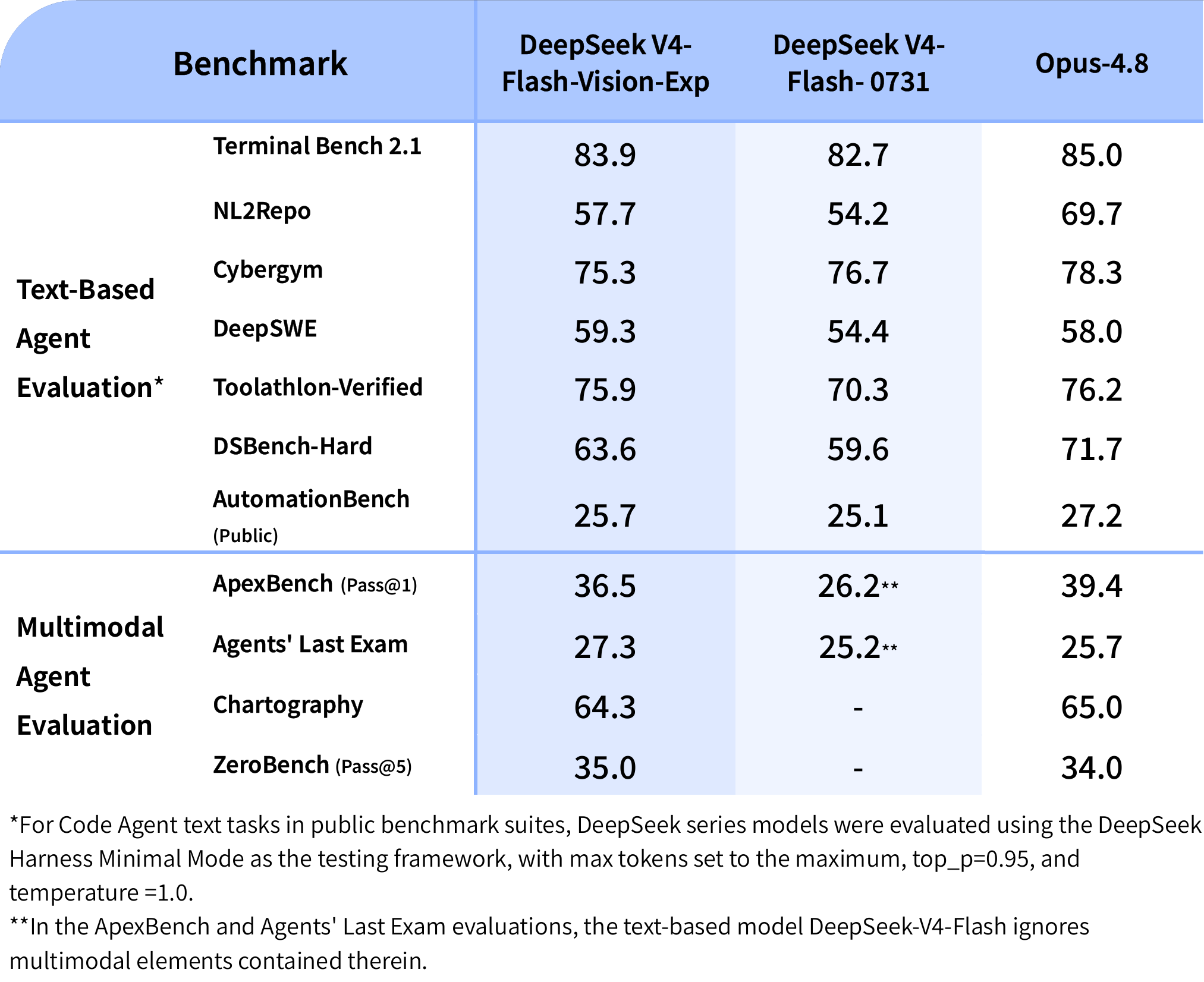
| Benchmark | V4-Flash-Vision-Exp | V4-Flash-0731 (text) | Opus 4.8 | Vision vs Opus 4.8 |
|---|---|---|---|---|
| Text-based agent evaluation · DeepSeek models on Harness Minimal Mode | |||| | Terminal Bench 2.1 | 83.9 | 82.7 | 85.0 | −1.1 | | NL2Repo | 57.7 | 54.2 | 69.7 | −12.0 | | Cybergym | 75.3 | 76.7 | 78.3 | −3.0 | | DeepSWE | 59.3 | 54.4 | 58.0 | +1.3 | | Toolathlon-Verified | 75.9 | 70.3 | 76.2 | −0.3 | | DSBench-Hard | 63.6 | 59.6 | 71.7 | −8.1 | | AutomationBench (Public) | 25.7 | 25.1 | 27.2 | −1.5 | | Multimodal agent evaluation · text-only model ignores multimodal elements where marked | |||| | ApexBench (Pass@1) | 36.5 | 26.2 * | 39.4 | −2.9 | | Agents’ Last Exam | 27.3 | 25.2 * | 25.7 | +1.6 | | Chartography | 64.3 | — | 65.0 | −0.7 | | ZeroBench (Pass@5) | 35.0 | — | 34.0 | +1.0 |
Scores are DeepSeek’s own, transcribed from the image; the asterisk marks the two rows where DeepSeek’s footnote says the text-only model ignores the multimodal elements, so its score there is not a fair comparison. Counting the final column: the vision model trails Opus 4.8 on 8 of the 11 rows and leads on 3 (DeepSWE by 1.3, Agents’ Last Exam by 1.6, ZeroBench by 1.0). The largest gaps run the other way: 12.0 points on NL2Repo and 8.1 on DSBench-Hard. On Terminal Bench 2.1, the figure that circulated most widely, it scores 83.9 against 85.0. Against its own text baseline the picture is better: it leads V4-Flash-0731 on 8 of the 9 rows where both have scores, trailing only on Cybergym. DeepSeek’s “major leap” phrase is narrower than that spread, though. It is made about the multimodal agent benchmarks specifically, which is the second block of the table, and the only two rows there with a text-only score are the two the footnote asterisks.
self-reported, unaudited result on a benchmark set the vendor chose. We found no independent entry for this model on the Terminal-Bench leaderboard at tbench.ai, and no independent re-run of any of the 11 scores in the launch coverage we read.
Dataconomy’s same-day coveragereports the same ApexBench, Agents’ Last Exam and ZeroBench figures and likewise notes they are not independently verified. “Close to Opus 4.8” is a fair summary of the vendor’s table; “matches Opus 4.8” is not.
Our interpretation: the table is more honest than the headline it generated. A lab that wanted to claim parity would have shown a narrower benchmark set. Showing NL2Repo at a 12-point deficit alongside three narrow wins reads as a team reporting what it measured, and the right response is to treat the multimodal rows as the interesting ones. ApexBench and ZeroBench are built differently from text-agent suites, and our guide to multimodal benchmarks explains what a Pass@5 on ZeroBench does and does not tell you before you weight it.
06 — BoundariesWhat is not in the box. #
A launch note is as useful for what it omits as for what it says, and several of the things people will assume about this model are absent from every DeepSeek surface. Each of the absences below is stated narrowly: not found in the release note, the changelog, the pricing page or the Vision guide as published at launch, and not claimed by the OpenRouter record either.
No video, PDF, OCR or grounding mode
Input is text and image; output is text. There is no video modality, no PDF or document-ingestion path, and no named OCR, grounding or bounding-box mode anywhere in DeepSeek’s documentation for this model. If your pipeline needs page-level document understanding, you rasterize the pages yourself, pay up to 384 tokens per page image, and stay inside the 600-image and 64 MiB (200 MiB with the Files API) limits per request.
No open weights, no licence, no Hugging Face repo
The V4 family has open-weight siblings on Hugging Face, which is why the assumption is natural. It is wrong here. The deepseek-ai organisation carries V4-Flash-0731, V4-Flash, V4-Flash-DSpark, V4-Flash-Base and the V4-Pro line, and no vision-exp entry. OpenRouter’s record has a null hugging_face_id
. With no weights there is nothing to attach a licence to, and DeepSeek has published none.
The repos that look official are not
Search results surface third-party Hugging Face repos such as webbrain-one/DeepSeek-V4-Flash-Vision-NVFP4
. Per their own model cards these graft a MoonViT vision encoder taken from Kimi K2.6 onto the frozen, text-only V4-Flash backbone through a custom-trained projector. They are independent research splices that predate DeepSeek’s release. They say nothing about how DeepSeek built its vision pathway, and they are not a route to self-hosting this model.
API-only, served from DeepSeek’s platform or through an aggregator that proxies to it. The open-weight path is still the text-only V4-Flash checkpoints; a vision checkpoint may follow the Exp period, but DeepSeek has not said so, and nothing in this post should be read as a prediction that it will.
07 — Where It FitsFour workloads, and which clock to run them on. #
The model is cheap enough that the interesting question is not whether to try it but what to try it on, and when. Our starting positions are below; every one of them should be checked against your own prompts before it becomes a routing rule.
Browser and UI loops that look at state
The multimodal rows are where the model moved most versus its text baseline, and per-screenshot cost is measured in hundredths of a cent. Run evaluations off-peak, measure whether repeated screenshots hit the context cache, and keep Opus 4.8 as the comparison arm rather than the assumption.
Catalog images, moderation, tagging at volume
Image tokens for a million images cost $84.48 at the off-peak cache-miss ceiling. Output dominates, so pair the model with short structured outputs and schedule batches outside 01:00–04:00 and 06:00–10:00 UTC. Thinking mode is the default; turn it off where a label is all you need.
PDFs, scans, multi-page forms
No PDF or OCR mode exists. You can rasterize pages and send them as images inside the 600-image and payload limits, but you are building the document layer yourself, and there is no published accuracy figure for that use. Keep your current document stack until you have measured it.
Weights-required deployments
No weights, no licence, no Hugging Face repo. The model is API-only for the Exp period and DeepSeek has announced nothing beyond that. For on-prem vision today, this is not the candidate.
Looking past the launch window, the likely direction is that the Exp suffix comes off, the model ID changes, and teams that hard-coded deepseek-v4-flash-vision-exp
find out through an error. Build the model ID as configuration, log which clock each batch ran on so your cost reports explain themselves, and re-check the pricing page before each budget cycle, because an experimental model’s terms can move without a new announcement. Teams deciding where a cheap multimodal model belongs in a stack that already includes closed frontier models are exactly the conversations our AI transformation engagements start with, and for retail catalogs specifically, the bulk-tagging workload above is one our ecommerce team already costs out for clients.
08 — ConclusionSame price, two clocks, one honest table. #
Vision is free at the margin; the clock is not.
DeepSeek V4 Flash Vision is a narrow release done cleanly. One model, three surfaces on the same day, a spec sheet copied from V4-Flash, and a billing rule simple enough to fit in a sentence: images are tokenized at up to 384 tokens each and charged at the input rate. The only number a buyer has to hold in their head is which hour their calls land in, because every rate on the card doubles between 01:00 and 04:00 and between 06:00 and 10:00 UTC.
The benchmark story is better told from the image than from the headline. Self-reported, on the vendor’s own harness, the model trails Opus 4.8 on most rows and wins a few by a point or so, while clearly improving on its own text-only baseline on the multimodal suites. That is a credible experimental release, not a frontier claim, and DeepSeek’s own wording, close to Opus-4.8, is the accurate one.
What to do with it: put it in an evaluation harness against the vision model you use today, run the evaluation off-peak, budget from the cost table in section 04 rather than from a single quoted price, and keep the model ID in configuration. When the Exp comes off, you will want to be the team that changes one line.