Chinese models continue to make impressive progress to compete with their US counterparts.
DeepSeek has released V4.1-Flash, an update to its efficiency-focused model line, and the company is making a pointed case that “flash”-tier models no longer need to trail flagship models from OpenAI and Anthropic by much — while costing a fraction as much to run.
DeepSeek positioned V4.1-Flash as the smallest model in a new architecture family, one built for cheaper inference and designed to scale up to larger models later. On several agentic and coding benchmarks, the company’s own numbers show V4.1-Flash landing ahead of or within striking distance of GPT-5.6 Sol and Claude Opus 5, two models that cost considerably more to run per million tokens.
DeepSeek v4.1 Architecture #
V4.1-Flash uses what DeepSeek calls an “asymmetric” Causal Encoder–Decoder architecture. The model has 552 billion parameters in total, but only 8 billion are active for processing input and 16 billion for generating output — a split designed to keep inference cheap without gutting capability. DeepSeek says this, combined with new pre-training methods and larger-scale reinforcement learning in post-training, is what lets the model beat its own larger sibling, DeepSeek-V4-Pro, on several benchmarks despite being far cheaper to run.
The model also ships with native visual understanding, folding in multimodal support that was previously handled by a separate, now-retired “V4-Flash-Vision-Exp” model.
DeepSeek v4.1 Benchmarks #
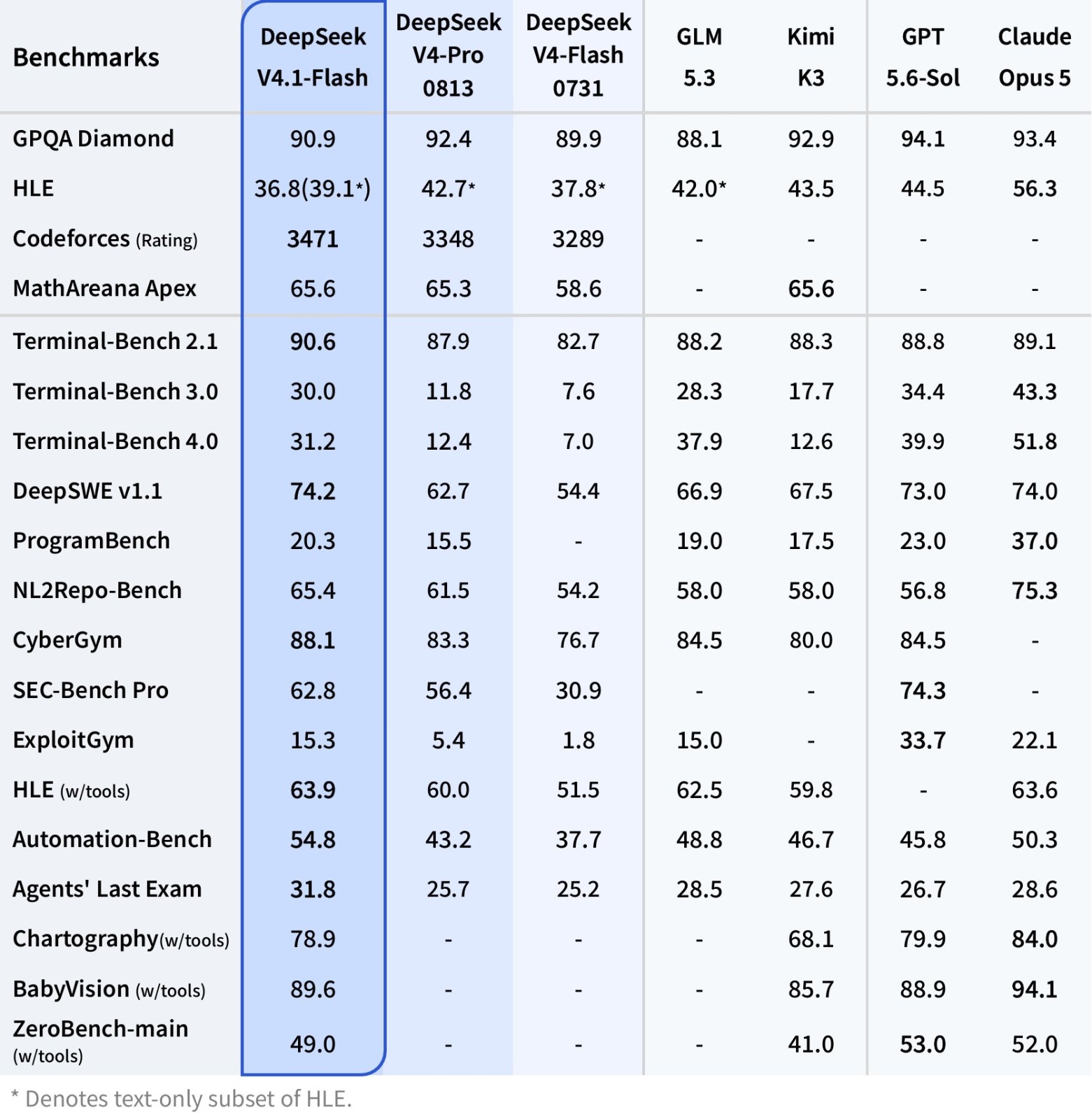
DeepSeek published a comparison table stacking V4.1-Flash against DeepSeek-V4-Pro, the previous V4-Flash, GLM 5.3, Kimi K3, GPT 5.6 Sol, and Claude Opus 5 across more than a dozen benchmarks. A few numbers stand out:
- On CyberGym , a cybersecurity-focused benchmark, V4.1-Flash scored 88.1, ahead of GPT 5.6 Sol and GLM 5.3 (both 84.5) and Kimi K3 (80.0).
- On DeepSWE v1.1 , a software engineering benchmark, V4.1-Flash scored 74.2, edging out Claude Opus 5 (74.0) and GPT 5.6 Sol (73.0).
- On Automation-Bench , V4.1-Flash posted 54.8, ahead of Claude Opus 5 (50.3), GLM 5.3 (48.8), Kimi K3 (46.7), and GPT 5.6 Sol (45.8).
- On Terminal-Bench 3.0 , however, Claude Opus 5 still leads comfortably at 43.3, with GPT 5.6 Sol at 34.4 and V4.1-Flash at 30.0.
The pattern holds across the rest of the table: V4.1-Flash is consistently the strongest of the “efficient” tier of models (comfortably ahead of GLM 5.3 and Kimi K3 on most tasks, and well ahead of its own predecessor, V4-Flash 0731), while trading blows with the much pricier Claude Opus 5 and GPT 5.6 Sol rather than trailing them outright. On raw knowledge benchmarks like HLE and GPQA Diamond, though, Claude Opus 5 still holds a clear lead — 56.3 versus V4.1-Flash’s 36.8, for instance, on HLE.
Why The Cache Size Matters #
Alongside the benchmark comparisons, DeepSeek highlighted a steep cut to its KV cache size — the memory a model needs to hold per token during inference. The company’s own chart shows this figure falling from 389,120 bytes per token in DeepSeek-V1, down to 48,068 in V3.2, to 3,514 in V4-Flash, and now to just 890 bytes in V4.1-Flash — a reduction the company says makes this generation roughly 3.9 times smaller than its immediate predecessor, and over 400 times smaller than DeepSeek’s original model.
This matters commercially because, as DeepSeek notes, cache-hit charges make up a large share of the cost of running AI agents that repeatedly reuse context. A smaller cache directly lowers what developers pay to keep long conversations or agent sessions running.
DeepSeek v4.1 Flash Pricing: The Real Differentiator #
This is where V4.1-Flash’s pitch gets sharper. DeepSeek’s new pricing, effective from September 10, 2026, is split between off-peak and peak hours:
|  | Input (cache hit) | Input (cache miss) | Output |
|---|---|---|---|
| Off-Peak | $0.003 | $0.15 | $0.6 | | Peak hours | $0.006 | $0.3 | $1.2 |
Peak hours are defined as 01:00–04:00 and 06:00–10:00 UTC on weekdays; everything else, including weekends and holidays, is billed at the cheaper off-peak rate. For context, Claude Opus 5 is priced at $5 per million input tokens and $25 per million output tokens — meaning V4.1-Flash’s peak output rate is still roughly 20 times cheaper, and its off-peak rate more than 40 times cheaper, than Opus 5’s output pricing. A similar gap holds against GPT 5.6 Sol, which is positioned by OpenAI as a premium flagship model.
DeepSeek is also using the new model to retire its more expensive V4-Pro tier. Starting September 14, 2026, all deepseek-v4-pro API requests will be automatically routed to V4.1-Flash — at V4.1-Flash’s lower rates — with DeepSeek saying multiple independent testers have found V4.1-Flash ahead of V4-Pro on performance, cost, speed, and total runtime combined. The routing will stay in place until a V4.1-Pro model arrives.
The Bigger Picture #
None of this means V4.1-Flash is simply “better” than Claude Opus 5 or GPT 5.6 Sol across the board — on knowledge-heavy evaluations like HLE, and on some terminal and coding benchmarks, both Western flagship models still lead by a clear margin. What DeepSeek is claiming instead is competitiveness on a specific, commercially important slice of agentic and coding benchmarks, at a small fraction of the price — the same pitch that made DeepSeek’s earlier releases, like V3 and R1, disruptive when they first landed.
DeepSeek says it’s also working with the open-source community on inference support for V4.1-Flash, and is open to large-scale deployment partnerships involving thousands of GPUs. The model and its accompanying technical report are both available on Hugging Face.