Last month, DeepSeek shipped a model that outperformed its own flagship on software engineering benchmarks, then quietly tried to retire that flagship by rerouting its entire API traffic. Developers noticed the behavior change, complained, and forced a reversal. The Western tech press was busy covering OpenAI DevDay. A Hacker News thread asking “why isn’t the industry freaking out about this?” hit 500 points today — and honestly, it’s a fair question.
What V4.1 Flash Actually Is #
DeepSeek-V4.1-Flash is a 552-billion-parameter mixture-of-experts model that activates just 8 billion parameters on input and 16 billion on output. That distinction matters: the model’s total size is a measure of its routing pool, not its computational footprint. At inference time, you’re running something closer to a 16B model while drawing on the knowledge of a 552B one. The result is fast — around 300–400 tokens per second in production — with a 1 million-token context window and a KV cache that consumes roughly a quarter of the memory its predecessor required.
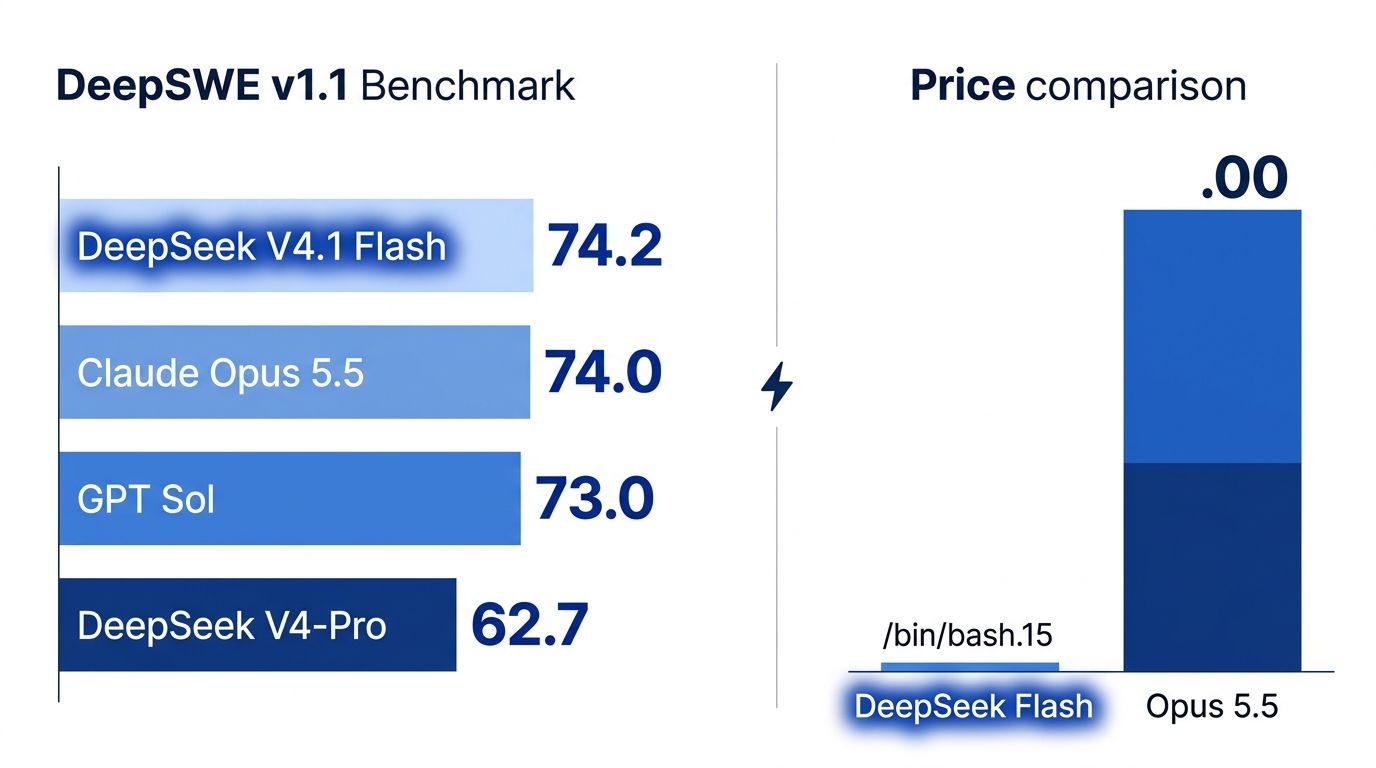
The benchmark that drew attention is DeepSWE v1.1, a software-engineering evaluation focused on long-horizon coding tasks. V4.1 Flash scores 74.2 — beating DeepSeek’s own V4-Pro (62.7), matching Claude Opus 5.5 (74.0), and edging out GPT-5.6 Sol (73.0). That’s a 19.8-point jump over the previous V4-Flash release — the largest single-generation improvement tracked in any open-weight model this year. It carries an MIT license. Weights are on HuggingFace.
The Silent Reroute #
Here is the part that should have made headlines. On September 14, DeepSeek began routing every API call to deepseek-v4-pro silently to V4.1 Flash, billing at Flash rates. No warning. No flag in the response. Prompts sent to the premium model started being answered by the cheaper one, and developers noticed because their workflows changed — not because anyone told them. Four days later, under enough pressure, DeepSeek reversed the decision and kept V4-Pro available. Their explanation: “in response to user demand.”
Read that charitably and it says V4-Pro still has legitimate use cases that V4.1 Flash doesn’t cover. Read it less charitably and it says DeepSeek thought Flash was good enough to replace Pro, tried it quietly, and backed down when users pushed back. Either way, it’s the most revealing thing they’ve done with this model: they trusted Flash enough to pull the trigger on their flagship. That’s a signal worth more than any press release.
What It Costs #
DeepSeek V4.1 Flash runs at $0.15 per million input tokens off-peak, $0.60 on output. Here’s how it stacks up against the models it’s competing with on benchmarks:
| Model | DeepSWE v1.1 | Input ($/M) | License |
|---|---|---|---|
| DeepSeek V4.1 Flash | 74.2 | $0.15 | MIT |
| Claude Opus 5.5 | 74.0 | $4.00 | Closed |
| GPT-5.6 Sol | 73.0 | $5.00 | Closed |
| DeepSeek V4-Pro | 62.7 | $0.27 | Closed |
If those benchmark numbers translate to your workload, there is no economic argument for using a closed frontier model for most agent loops. The MIT license means you can also self-host if the API’s peak pricing ($0.30/M input) or data-residency concerns you.
Why Nobody Noticed #
DeepSeek published V4.1 Flash with no keynote, no teaser campaign, and no documentation fanfare — just an X post and a line in the API changelog. Three weeks later, OpenAI held DevDay 2026 and announced more than 20 new features in a single afternoon. GPT-6.1 Sol, the Agents API public beta, Codex Cloud, the Decisions API — the developer media covered every announcement in detail for two weeks straight. The DeepSeek story simply wasn’t competing for attention on the same calendar.
There’s a broader number worth sitting with: the performance gap between the US and China’s best AI models is now estimated at 3%, down from 9% in May and roughly 15% at the start of the year. That compression happened largely because of V4.1 Flash. It’s not front-page news in the West because the release strategy doesn’t generate front-page news. That’s the actual story.
The Honest Caveat #
V4.1 Flash isn’t a drop-in replacement for everything. Its Automation-Bench score of 54.8 means it fails roughly half of complex multi-step workflows. Real developer reports are split: some call it excellent for daily coding agent tasks; others report frustrating failures on first contact. Peak pricing doubles the input cost. The silent reroute reversal confirmed that V4-Pro still has a user base that needed it.
But framing this as a “Flash” model — small, fast, cheap, a tier below the real thing — is increasingly inaccurate. When your cheap tier matches frontier closed models on software engineering benchmarks at 26x lower cost, the tier names stop meaning what they used to. The industry will catch up to that eventually. It’s just taking longer than it should.