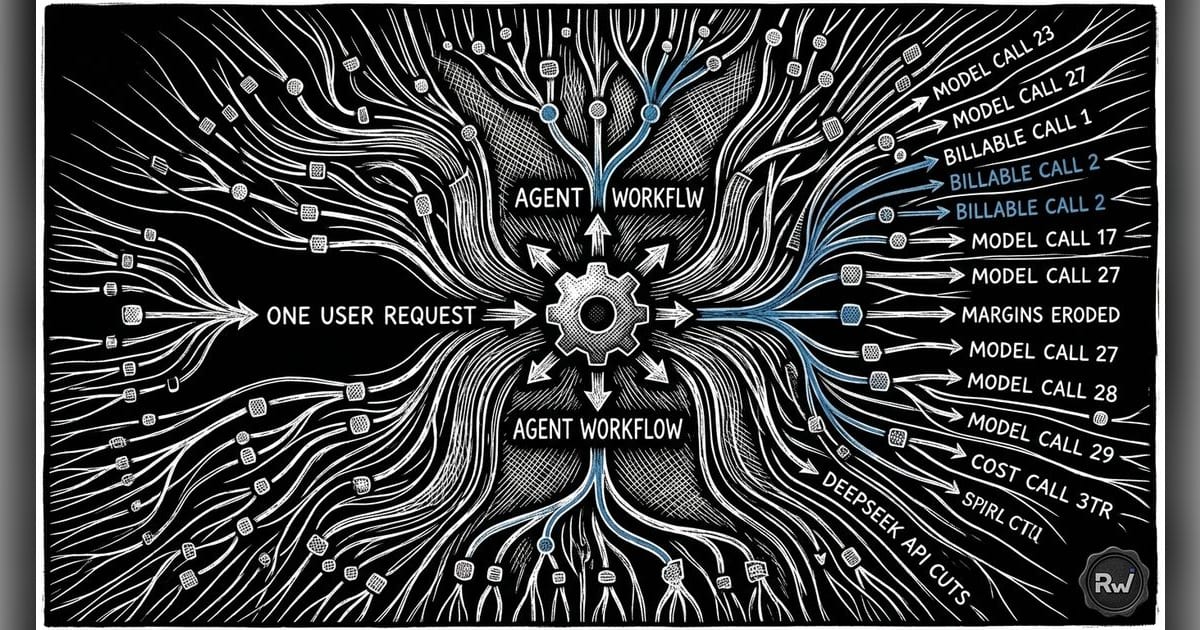
Liang Wenfeng's DeepSeek (@deepseek) has turned its V4-Pro price cut into a standing challenge to the frontier-model business, and a VentureBeat analysis published July 12, 2026 argues that the cheaper-token story still misses the operating problem facing AI founders: agents spend tokens much faster than model vendors cut prices.
DeepSeek's discount itself is older than the VentureBeat piece. In May, InfoWorld reported a 75% reduction on V4-Pro. DeepSeek's API pricing page now lists sharply lower rates and a large spread between cache-hit and cache-miss input pricing.
That is the kind of price move Liang has used to pressure better-funded U.S. labs since DeepSeek broke into the global AI conversation. DeepSeek was founded in July 2023 in Hangzhou by Liang, who also runs High-Flyer, the hedge fund that funded the lab. The origin matters because DeepSeek's market posture has always looked less like a SaaS company chasing near-term subscription revenue and more like a compute-efficiency lab using price as distribution. Its V4-Pro cut extends that playbook.
The hard part for application founders is that DeepSeek can lower the meter without changing how often the product hits the meter.
VentureBeat calls this "token amplification." A chatbot generally maps one user question to one model call. An agentic product often turns the same visible request into planning, retrieval, tool selection, tool execution, summarization, verification, and follow-up decisions. The user sees one answer. The vendor pays for the loop.
The example in VentureBeat is plain enough to be useful for pricing teams. A user asks, "What did our top customer ask about last week?" VentureBeat's hypothetical workflow includes a 50-token user prompt, roughly 3,000 tokens of system prompt and tool definitions repeated across calls, 5,000 tokens of retrieved context, an 8,000-token input call for tool selection, a 4,000-token tool result, then 12,000-token and 12,400-token follow-up calls for summarization and decisioning. The result is about 35,000 input tokens billed for one short question, according to the analysis.
On a frontier model, VentureBeat estimates that kind of query can cost $0.10 to $0.40. At 1M queries a month, that becomes a six-figure monthly infrastructure line before the company pays for hosting, observability, customer support, sales, compliance, and the rest of the operating stack. A 75% model discount helps. It does not save a product that lets a single user action fan out into dozens of model operations.
The pricing model is lagging the product architecture
The pressure lands first on founders selling AI agents through familiar SaaS packaging. A $40-per-seat plan works when cost per user stays bounded and usage variance stays manageable. Agents make the heaviest users the most expensive users. VentureBeat's example of a power user running 50 to 100 agent requests a day shows how a product can cross from healthy gross margin into negative contribution margin while customer engagement improves. That is an uncomfortable inversion for software operators. In classic SaaS, power users usually deepen retention and expand seats. In agentic SaaS, power users can become the accounts that force pricing redesign, usage caps, model routing, or margin reviews. The most honest AI founders already price with some combination of seats, credits, metered usage, workflow limits, or outcome-based fees. The laggards are still selling unlimited-sounding agents against finite inference budgets.
OpenAI's May offer to Y Combinator (@ycombinator) startups shows the same pressure from the other side of the market. TechCrunch reported that OpenAI (@OpenAI) offered $2M worth of API tokens to every startup in the current YC class in exchange for equity. That is developer acquisition, but it is also a recognition that compute has become a financing instrument for AI-native companies.
For founders, the equity-for-compute structure changes the old cloud-credit bargain. AWS or Google Cloud credits helped a startup avoid early infrastructure spend. AI credits can become the raw material of the product itself. If a startup's core workflows depend on a single model provider's credits, the funding decision becomes a platform-dependence decision.
DeepSeek's advantage is real, and incomplete
DeepSeek's lower V4-Pro prices still matter. InfoWorld's May report framed the 75% cut as a pricing challenge to OpenAI, Anthropic, and Google, and DeepSeek's current docs show a cost profile that will be attractive to developers building long-context workflows. Lower output-token prices are especially relevant for agent products that generate drafts, reports, code, or customer-facing responses.
The practical question for AI founders is where the savings get captured. If the product keeps every tool result and reasoning trace in the context window, repeats large tool definitions on every call, and uses a premium model for every subtask, DeepSeek's discount gets consumed quickly. If the product routes simpler steps to cheaper models, compresses context aggressively, caches repeated inputs, limits loops, and prices usage transparently, cheaper models widen the margin cushion.
DeepSeek's own pricing page points to that architecture problem. The cache-hit price on V4-Pro input tokens is orders of magnitude lower than the cache-miss price. That gap rewards builders who make repeated context reusable and punishes systems that treat every step as a fresh, bloated call. Agent orchestration is starting to look less like an engineering detail and more like the gross-margin center of the product.
Security remains part of the same operating decision for customer-facing or enterprise workflows. Founders using third-party models should pair the model decision with policy controls, evals, logging, and fallback behavior.
The founder lesson is margin discipline
Liang's DeepSeek can keep forcing the market price of model intelligence down. That is good for founders. It also removes an excuse. If a startup still cannot make its agent product work economically after a steep model-price cut, the problem is likely in workflow design, pricing, or customer promises.
The winners in enterprise AI will have to know their unit economics at the level of individual agent steps. They will need to know which calls require a frontier model, which calls can run on cheaper models, where context can be cached, where retrieval can be narrowed, and where a human-in-the-loop path is cheaper than another automated loop. Founders who cannot answer those questions are selling a demo with an invoice attached.
DeepSeek's price cut pressures the model labs. VentureBeat's 100x problem pressures everyone building on top of them.