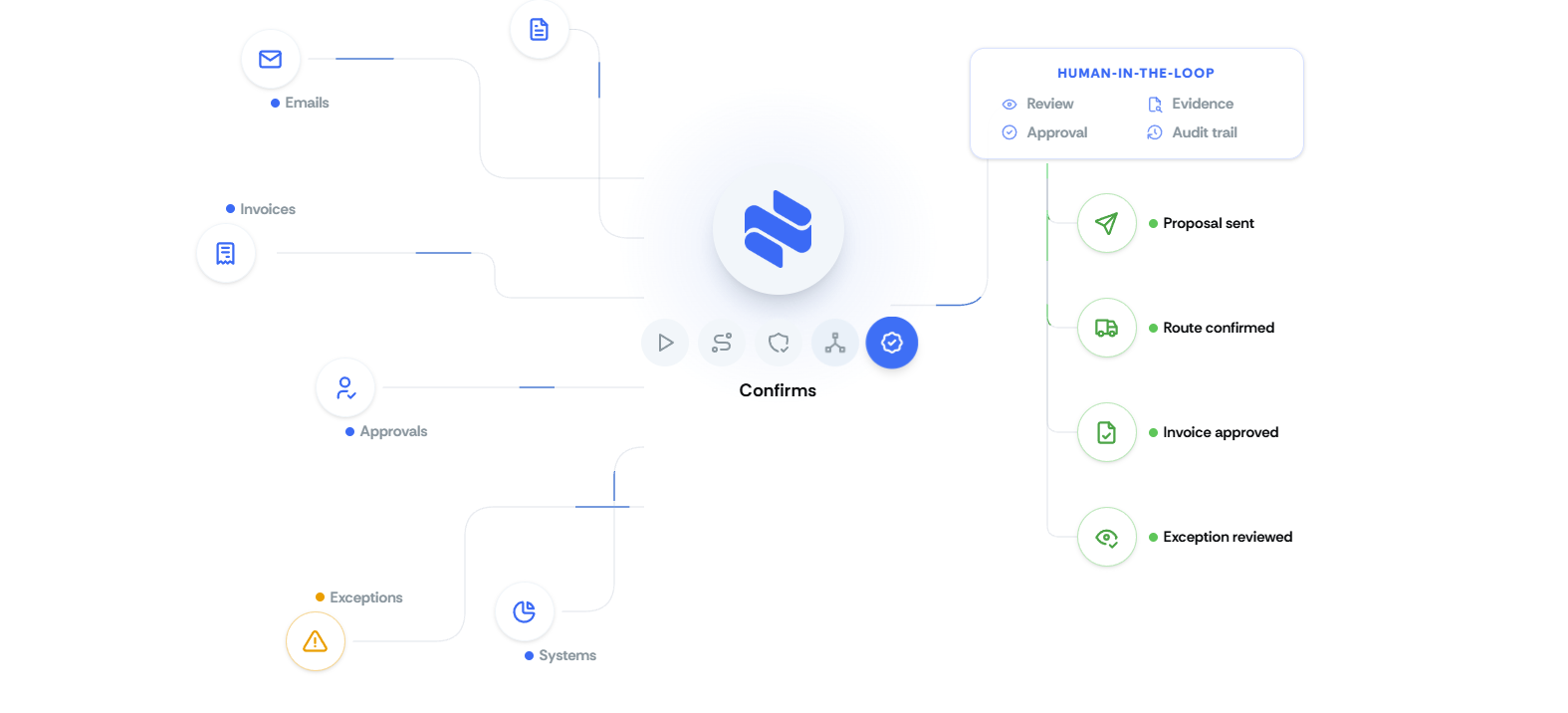
DeepFabric announced general availability of a supply-chain AI agent platform with more than 50 packaged agents across operations, finance, assurance, and growth workflows. The PRNewswire release and SiliconANGLE coverage name production customers including HelloFresh, Kenco, NFI Industries, TwinMed, Merchants Fleet, and Weber, while the company reports outcomes such as 10x ROI on freight audit and faster RFP responses. Because those performance claims are vendor-reported, buyers should treat the launch as a useful signal for domain-specific agent platforms, then validate integrations, audit trails, human review paths, and financial metrics on their own supply-chain data.
DeepFabric's launch is most useful as a case study in where enterprise-agent products are getting narrow: not general chatbots, but role-specific workflow agents tied to documents, exceptions, approvals, and measurable operations KPIs. The buyer question is less whether agents can automate supply-chain work in principle, and more whether the platform can prove provenance, controls, and ROI inside a messy enterprise data environment.
What happened
In a PRNewswire release, DeepFabric announced general availability of its AI agent platform for end-to-end supply-chain operations. The company says the platform includes more than 50 agents across operations, financial control, assurance, and growth, and lists frequently deployed agents such as Freight Auditor, Proposal Manager, and Inventory Manager. SiliconANGLE also covered the launch and described the product as a set of supply-chain agents already used in production.
Industry context
The named customer list, including HelloFresh, Kenco, NFI Industries, TwinMed, Merchants Fleet, and Weber, points to a domain-specific enterprise AI market where buyers want packaged workflows rather than generic model access. DeepFabric's reported outcomes, including up to 10x ROI on freight audit, 45% lower audit spend, and 30% faster RFP response times, remain vendor-reported and should be treated as proof points to test, not settled benchmarks.
For practitioners
Supply-chain teams evaluating products like this should inspect the integration layer first. The hard parts are usually document extraction, entity matching across ERP/TMS/WMS systems, exception routing, auditability, and finance reconciliation. Useful agent outputs should carry evidence, confidence, approval history, and clear escalation paths when the system cannot resolve an exception.
What to watch
Watch for independent case studies, customer-reported before-and-after metrics, data residency details, access-control documentation, and evidence that agent decisions can be audited after the fact. Those signals will matter more than agent counts when procurement and operations teams decide whether the platform is production-grade.
Key Points #
- 1DeepFabric launched more than 50 supply-chain agents spanning freight audit, proposal workflows, inventory, finance, and operational assurance.
- 2The strongest claims are vendor-reported customer outcomes, so buyers should validate ROI, data quality, and exception handling themselves.
- 3Production value will depend on connectors, provenance, human review controls, and auditable decisions across ERP and logistics systems.
Scoring Rationale #
This is a notable enterprise AI product launch with named production customers and concrete but vendor-reported ROI claims in a high-friction operations domain. It is useful for practitioners evaluating packaged agent platforms, while the lack of independent outcome validation keeps it below major platform or research news.
Sources #
Public references used for this report. Practice with real Ad Tech data
90 SQL & Python problems · 15 industry datasets
[Active Search Campaigns by BudgetEasy](https://letsdatascience.com/problems/sql/active-search-campaigns-by-budget)

[High CPC Clicks & Poor Landing PagesMedium](https://letsdatascience.com/problems/sql/high-cpc-clicks-poor-landing-page)

[Campaign ROAS by Attribution ModelHard](https://letsdatascience.com/problems/sql/campaign-roas-by-attribution-model)
250 free problems · No credit card