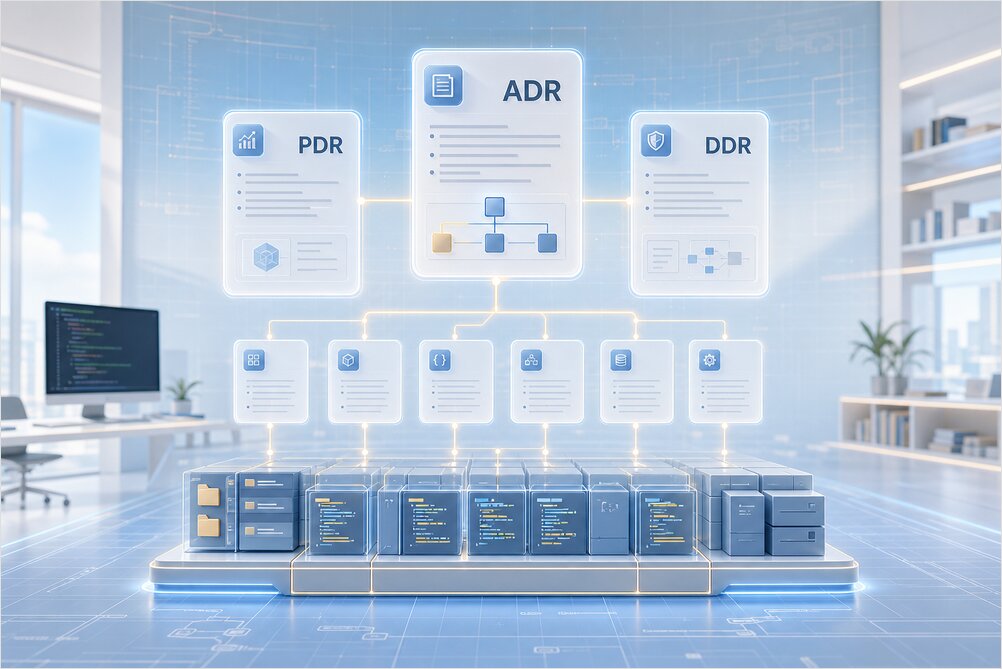
Keep intent close to the code.
Decision records are the missing memory layer in AI-assisted software development. They capture not just what was built, but why — and that distinction becomes critical when AI tools are writing your code.
Decision records are the missing memory layer #
AI-driven programming changes the economics of software development by making code cheaper to generate, easier to refactor, and faster to throw away. That is useful. It is also dangerous, because when code becomes easier to produce, the scarce resource is no longer typing — the scarce resource is judgment.
Why did the team choose PostgreSQL instead of DynamoDB? Why does the product require human review before sending AI-generated emails? Why does the interface show suggestions in a side panel instead of applying them directly? Why was a simpler approach rejected six months ago? The code may show what exists, but it rarely explains why it exists.
Decision records solve this problem by providing a short, version-controlled document that captures an important choice, the context behind it, the alternatives considered, and the consequences the team accepted. In an AI-assisted codebase, these records become more than documentation — they become durable project memory that both humans and AI coding agents can read before making future changes. The practical operating rule is simple: keep decision records as Markdown files in the repository, review them like code, and let future AI tools read them before proposing or implementing changes.
What are decision records? #
A decision record is a written record of a meaningful decision, structured to answer four basic questions: what did we decide, why did we decide it, what alternatives did we consider, and what consequences did we accept? The most common form is the Architecture Decision Record, shortened to ADR. ADRs are widely used to document technical decisions, and the same pattern can be extended beyond architecture into product and design work.
For AI-driven programming, three types are especially useful:
| Record type | Captures | Example |
|---|---|---|
| ADR | Architecture and technical decisions | Use PostgreSQL as the primary database |
| PDR | Product behavior and scope decisions | AI-generated emails must remain drafts |
| DDR | Design and interaction decisions | Show AI suggestions in a side panel |
Together, ADRs, PDRs, and DDRs describe not only the structure of the system but also the intent of the product and the reasoning behind the user experience. That combination matters because AI agents can read code, but code alone does not contain enough context to make good decisions. Decision records give AI systems a reviewed, durable, human-approved source of project intent.
Architecture Decision Records #
Architecture Decision Records capture technical and structural decisions. Use an ADR when a decision affects the shape of the system — its boundaries, dependencies, operational model, or long-term maintainability.
Examples of decisions worth recording as ADRs include:
- Choosing PostgreSQL as the primary database
- Using an event-driven architecture for background processing
- Keeping the application as a modular monolith
- Introducing a message queue
- Choosing REST instead of GraphQL
- Using server-side rendering for the web application
- Requiring all background jobs to be idempotent
- Adopting a specific authentication and authorization model
An ADR is not a full architecture document — it is intentionally small, recording one important decision at a specific moment in time. A good ADR prevents architectural amnesia: without it, future contributors may rediscover the same tradeoffs, reopen old debates, or accidentally undo important constraints.
In AI-driven programming, ADRs carry even more weight. AI tools are often skilled at local optimization, and they may propose a technically plausible change that violates a larger architectural constraint. An ADR gives the AI a clear boundary: “This is how this system is supposed to be shaped.”
Product Decision Records #
Product Decision Records capture product behavior, scope, and user-facing intent. This is less common than ADRs, but it is often just as valuable — product decisions are frequently scattered across tickets, roadmap tools, chat threads, meeting notes, and people’s memories, making them easy for humans to forget and almost impossible for AI tools to infer reliably.
Use a PDR when a decision affects what the product does, who it serves, what is intentionally out of scope, or how a user-facing feature should behave. Examples include:
- AI-generated messages must remain drafts until reviewed by a human
- Free-tier users can create up to three projects
- Deleted workspaces are recoverable for 30 days
- Team billing is out of scope for version 1
- Users can export their data without contacting support
- Low-confidence AI summaries show a warning instead of being hidden
A PDR is especially useful when a product choice looks arbitrary from the code. The code might contain a limit of three projects for free users, and without a PDR an AI tool may treat that number as a magic constant and suggest changing it. With a PDR, the AI can see that the limit is tied to pricing strategy, onboarding cost, or support load — and that changing it requires a deliberate product decision, not a quick edit.
Design Decision Records #
Design Decision Records capture user experience, interaction, visual, and content-design decisions. Use a DDR when a decision affects how users interact with the product, how information is presented, or how a design principle should be applied across future work.
Examples of design decisions worth recording include:
- Use inline validation instead of validation only on submit
- Put AI suggestions in a side panel instead of directly in the editor
- Use progressive disclosure for advanced settings
- Require confirmation before destructive actions
- Use “Draft” and “Published” instead of “Inactive” and “Active”
- Keep primary actions visible on mobile screens
Design intent is easy to lose during implementation. A developer may simplify a flow, or an AI agent may generate a component that technically works but breaks the intended interaction model. For example, a DDR might record: “We show AI writing suggestions beside the document, not inside it, because users need to compare generated text with their own draft before accepting changes.” That record gives future contributors a principle to preserve, not just a layout to copy.
Why decision records matter more with AI #
AI coding tools are powerful, but they are often stateless or only partially aware of project history. They can inspect files, infer patterns, and generate changes — but they do not automatically know which decisions are intentional, which are accidental, and which were already debated and resolved. This creates several distinct risks.
AI may reopen settled debates
If the team already decided to use a modular monolith, an AI agent may still propose extracting a service because that looks clean in isolation. Without an ADR, the AI has no durable way to know that the team already considered and rejected that path, and the result is wasted effort or a subtle regression in system coherence.
AI may optimize locally and damage globally
A generated refactor may make one file cleaner while violating system boundaries. A UI change may reduce component complexity while weakening the intended user experience. A product change may simplify the implementation while breaking pricing or compliance assumptions. Decision records give the AI a larger frame of reference before it acts on narrowly scoped signals.
AI may preserve code but lose intent
A model can follow existing patterns in the codebase, but patterns are not the same as principles. Sometimes existing code is a compromise. Sometimes it is transitional. Sometimes it exists because of an external constraint that is not visible in the file. Decision records explain the difference between “this is how it works” and “this is why it was built this way.”
AI may generate plausible but wrong rationale
AI can draft decision records, but it can also invent confident-sounding explanations that do not match the real decision. This is why human review is non-negotiable: AI may generate the first draft of a record, but a human must verify that it accurately describes the actual decision, alternatives, and consequences before the record is merged.
Decision records as part of a broader methodology #
Decision records are not just documentation — they are part of a broader way of working that sits at the intersection of lightweight architecture governance, docs as code, AI-augmented knowledge management workflows, product discovery, design rationale, AI governance, and code review. A useful way to describe the larger process is Decision-Oriented Development.
Most AI-driven programming workflows focus narrowly on the generate-review-commit loop:
That cycle is too thin for serious systems work. A stronger workflow treats the repository as a store of both code and intent — the diagrams here use Mermaid, a lightweight format that works well inside Markdown decision records too:
This process turns the repository into more than a code store. It becomes the source of truth for implementation, intent, and reasoning — a durable artifact that accumulates value with every decision made.
Decision records and docs as code #
Decision records work best when they follow docs-as-code principles, which means they should be stored in the same repository as the code, written in plain Markdown, reviewed in pull requests, versioned with Git, linked to related issues and pull requests, and searchable by both humans and AI tools. This is far more reliable than storing important decisions in chat, wiki pages, slide decks, or meeting notes — those tools may still be useful for discussion, but the accepted decision should always live close to the code.
A well-organized repository structure for decision records might look like this:
docs/
  decisions/
    architecture/
      0001-use-postgresql-for-primary-storage.md
      0002-keep-billing-inside-the-core-app.md
    product/
      0001-ai-generated-email-requires-human-review.md
      0002-free-tier-project-limit.md
    design/
      0001-use-inline-validation.md
      0002-place-ai-suggestions-in-side-panel.md
For smaller projects, a flatter structure works equally well. The exact folder organization matters less than consistency — the records must be easy to find, easy to review, and easy for AI tools to load as context before acting on the codebase. For Go teams, this docs/decisions/
structure fits naturally alongside the cmd/
, internal/
, and api/
layout described in Go Project Structure: Practices & Patterns, which recommends docs/
as the home for architecture decisions and API references.
A practical decision record template #
A useful decision record template should be short enough that people actually use it. Here is a practical Markdown template that includes an optional but valuable AI guidance section:
Status: Proposed | Accepted | Superseded | Deprecated
Date: YYYY-MM-DD
Type: Architecture | Product | Design
Owners: Team or names

## Context

Describe the problem, constraints, goals, user needs, technical facts,
and business factors that led to this decision.

## Decision

State the decision clearly.

## Alternatives considered

### Option 1

Pros:
- ...

Cons:
- ...

## Consequences

Describe what becomes easier, what becomes harder, and what risks
or follow-up work this creates.

## AI guidance

When an AI assistant works in this area, it should:
- Preserve ...
- Avoid ...
- Prefer ...
- Ask for review when ...

## Links

- Related issues:
- Related pull requests:
- Related files:
- Supersedes:
- Superseded by:
The “AI guidance” section is optional, but for AI-driven programming it is extremely valuable — it turns the decision record into a durable instruction for future agents working in the same area of the codebase.
What belongs in a decision record? #
Not every choice deserves a record, and if every small implementation detail becomes a decision record the process collapses into noise. Create a decision record when a choice is meaningful and likely to matter later.
Good candidates are decisions that:
- Affect multiple parts of the system
- Encode a product promise
- Resolve a real debate
- Introduce a long-term tradeoff
- Depend on business, compliance, or operational constraints
- Would be expensive to rediscover later
- Future AI tools might plausibly get wrong
- Future contributors might be tempted to reverse casually
Poor candidates include tiny refactor choices, obvious bug fixes, temporary experiments, local naming decisions, and implementation details with no lasting consequence. A good rule of thumb is straightforward: if reversing the decision would require discussion, record the decision.
Status values and lifecycle #
Decision records should have a lifecycle to signal their current standing. The simplest status values are sufficient.
Proposed — The decision is being considered but not yet accepted. Use this when the team wants to discuss a decision in a pull request before committing to it.
Accepted — The decision is active and should guide future work. Most useful decision records will spend most of their life in this state.
Superseded — The decision has been replaced by a newer record. Do not delete old records; keep them for history and link to the newer decision so the evolution of thinking stays visible.
Deprecated — The decision is no longer recommended but may still describe existing parts of the system. This is particularly useful during migrations, when old patterns exist in the codebase alongside newer approaches.
The important principle is that decision records should be append-friendly. When the team changes direction, create a new record and link the old one rather than rewriting history to make the past look cleaner.
How AI should generate decision records #
AI can help create decision records, and this is one of the better uses of AI in software development — it is fast at drafting structured documents from context. After a discussion, architecture review, or pull request, you can ask an AI assistant to draft a record:
Draft an Architecture Decision Record for the decision in this pull request.
Include context, alternatives, consequences, and AI guidance.
Save it as Markdown under docs/decisions/architecture.
For product work:
Draft a Product Decision Record explaining why AI-generated messages
must remain drafts until reviewed by the user.
Include user impact, out-of-scope behavior, tradeoffs, and AI guidance.
The AI-generated record should not be trusted automatically, however. Human review should verify that the context is accurate, that the AI has not invented rationale, that the alternatives listed are real, that the consequences are honest, and that the AI guidance matches the team’s actual intent. AI is a drafting assistant — it is not the owner of the decision.
How AI should read decision records #
The other half of the practice is instructing AI to read the records before acting. Before asking an AI assistant to implement a change, include an instruction like this:
Before modifying this feature, read docs/decisions.
Identify any Architecture, Product, or Design Decision Records that apply.
Follow accepted decisions. If your proposed change conflicts with a decision
record, explain the conflict before changing code.
For larger tasks, reinforce the role of the records as project memory:
Use the decision records as project memory.
Do not reverse accepted decisions without proposing a new superseding decision.
When you generate code, explain which decision records influenced the implementation.
This changes the AI’s role from “predict plausible code” to “operate inside a documented system of constraints” — a significant improvement in reliability for complex or long-lived projects.
Decision records in pull requests #
Decision records should be part of normal pull request review rather than a separate process. A simple PR checklist entry makes the habit visible:
## Decision record checklist

- [ ] This PR does not introduce a significant architecture, product, or design decision.
- [ ] This PR introduces a significant decision and includes a new decision record.
- [ ] This PR changes a previous decision and includes a superseding record.
- [ ] Relevant existing decision records were considered.
- [ ] AI-generated code follows the accepted decision records.
- [ ] AI-generated decision records were reviewed by a human.
This checklist is simple, but it changes behavior by reminding the team that code is not the only artifact that matters in a pull request. It also makes it natural to catch when an AI-generated change silently violates a prior decision.
Decision records and architecture governance #
Traditional architecture governance often fails because it is too heavy, too slow, or too disconnected from implementation — central approval boards, large upfront documents, and gatekeeping processes that block rather than guide. Decision records offer a lighter alternative that integrates directly into the development workflow.
They do not require a central architecture board for every change, nor do they block teams from learning and adapting. Instead, they create a trail of decisions that can be reviewed, referenced, and built on over time. This supports evolutionary architecture: the architecture can change, but it changes with memory rather than in spite of it. The team can revisit old decisions without having to rediscover why they were made, which is a healthier and more honest form of governance:
- Small records instead of giant documents
- Review near the code instead of separate approval theater
- Historical context instead of tribal knowledge
- Explicit tradeoffs instead of hidden assumptions
Decision records and product management #
Product work also needs decision memory, and this is an area where the value of decision records is often underestimated. A roadmap says what might happen. A ticket says what to build next. Analytics say what users did. None of those fully explain why a product behavior exists.
Product Decision Records fill that gap and are especially useful for pricing and packaging decisions, permission models, limits and quotas, AI safety and review flows, onboarding choices, user role definitions, collaboration rules, data retention policies, and feature scope boundaries. Once implemented, product decisions become invisible in the code — later, someone sees only the code and asks, “Why does it work this way?” A PDR gives the answer in a form that both humans and AI tools can find and use.
Decision records and design systems #
Design systems often document components, tokens, and usage rules, but they rarely document why the system works that way. Design Decision Records fill this gap. A component library might say “use the confirmation dialog for destructive actions,” while a DDR explains the rationale: “We require confirmation for destructive actions because users often work with shared team data, and accidental deletion has a high recovery cost.”
That rationale matters beyond the specific component. It helps future designers, developers, and AI tools apply the principle correctly in new situations. Without the DDR, an AI agent may generate a faster interaction that skips confirmation because it appears more efficient. With the DDR, the agent can recognize that preserving the safety property is intentional and non-negotiable.
How decision records support spec-driven development #
Spec-driven development explains what the system should do. Decision records explain why the team chose that direction, and the distinction matters significantly for AI-assisted work.
A feature specification may say that AI-generated emails must be saved as drafts. A Product Decision Record explains why automatic sending was rejected, what risks were considered, and which future changes would require a new decision. A design specification may describe a side-panel interaction, while the corresponding DDR explains why inline AI edits were explicitly rejected and why preserving user control was weighted more heavily than workflow speed. An architecture specification may define a service boundary, and its ADR explains why the team chose that boundary over a simpler or more distributed alternative.
The spec guides implementation. The decision record preserves judgment. Together, they give AI coding agents both instructions and context — the “what” and the “why” — which is what makes the combination so effective for complex, long-lived systems.
Decision records are not specifications #
Decision records are related to specifications, but they serve a different purpose. A specification says “the system shall do X,” while a decision record says “we chose X instead of Y because of these constraints and tradeoffs.” That “instead of Y” is the valuable part. AI tools often generate solutions by finding a plausible path to the requested outcome, but decision records tell them which plausible paths have already been explored, evaluated, and rejected — reducing churn and improving the quality of AI-assisted work.
Decision records are not a replacement for tests #
Tests verify behavior; decision records explain intent. Both are necessary and they work together. A test can enforce that AI-generated emails must be saved as drafts, while a Product Decision Record explains that this is required because users must review AI-generated communication before it leaves the system. The test protects behavior. The decision record protects meaning. Together, they make future changes safer and more predictable.
Decision records are not a replacement for code comments #
Code comments explain local implementation details, while decision records explain broader decisions. Use comments for surprising lines, edge cases, workarounds, and functions that cannot be simplified. Use decision records for why an architecture exists, why a product behavior exists, why an interaction pattern exists, and why the team chose one direction over another. If the explanation affects only a few lines, a comment is the right tool. If it affects the system’s direction, a decision record is the right tool.
Common mistakes #
Writing records too late
A decision record should be written when the decision is made, not months later when everyone has forgotten the tradeoffs. It is fine to draft one during a pull request. It is better still to draft it before implementation, while the decision is still being actively discussed and the alternatives are fresh.
Making records too long
A decision record is not an essay. It should be detailed enough to preserve judgment but short enough that people will actually read it. Prefer clarity over completeness — a concise record that gets read is far more valuable than a comprehensive one that gets skipped.
Recording decisions without consequences
The consequences section is the heart of the record. A decision without stated consequences is often just a preference rather than a real decision. Good records admit tradeoffs honestly, including what becomes harder or riskier as a result of the choice.
Editing old records as if history changed
When a decision changes, create a new record and mark the old one as superseded. Silently rewriting an old decision to match the current state destroys the historical context that makes decision records valuable. History is useful precisely because it shows how thinking evolved.
Letting AI-generated records merge without review
AI can produce a polished, well-structured record that is subtly wrong. Treat AI-generated decision records exactly like AI-generated code — review them carefully, verify the rationale is accurate, and ensure the consequences section reflects what the team actually accepted.
Hiding records outside the repository
If decision records live in a separate wiki or documentation system, they are less likely to be updated alongside code changes and far less likely to be read by AI coding tools context for a task. Keeping them in the repository is not just a convenience — it is what makes the practice work for AI-assisted development.
A lightweight operating model #
A practical team process that adds minimal overhead looks like this:
- During planning or implementation, identify whether a meaningful decision is being made.
- Ask an AI assistant to draft an ADR, PDR, or DDR based on the discussion.
- Review the draft as a team, verifying context, alternatives, and consequences.
- Commit the record as Markdown in the repository.
- Link it from the related issue or pull request.
- Instruct AI coding tools to read relevant records before making future changes in the area.
- Supersede records when decisions change, preserving the old record for history.
This does not require a new bureaucracy or a dedicated documentation role. It requires a small habit: preserving important judgment at the moment it is created, close to the code where it will be needed.
Example ADR #
Status: Accepted
Date: 2026-06-25
Type: Architecture
Owners: Platform team

## Context

The application needs durable relational storage for accounts, projects,
permissions, and audit events. The team expects frequent reporting queries
and strong consistency requirements for permission checks.

## Decision

We will use PostgreSQL as the primary application database.

## Alternatives considered

### DynamoDB

Pros:
- Operationally scalable
- Good fit for predictable key-value access patterns

Cons:
- More complex for relational queries
- Harder for ad hoc reporting
- Less familiar to the current team

### MySQL

Pros:
- Mature relational database
- Familiar operational model

Cons:
- PostgreSQL better matches the team's needs for JSON support,
  indexing options, and existing expertise

## Consequences

PostgreSQL becomes a core operational dependency. The team must manage
migrations carefully and monitor query performance. In return, the
application gets strong relational modeling, mature indexing, and
flexible reporting support.

## AI guidance

When modifying persistence code, prefer relational modeling in PostgreSQL.
Do not introduce a second primary database without a superseding ADR.
Example PDR #
Status: Accepted
Date: 2026-06-25
Type: Product
Owners: Product team

## Context

The product can generate email replies using AI. Sending email is a
high-trust action because mistakes may reach customers, partners, or
internal teams.

## Decision

AI-generated emails must be created as drafts. A human user must
review and send them.

## Alternatives considered

### Send automatically

Pros:
- Faster workflow
- Less user effort

Cons:
- Higher risk of incorrect or inappropriate messages
- Lower user trust
- Harder to recover from mistakes

### Ask for confirmation only after generation

Pros:
- Keeps the workflow simple
- Provides some user control

Cons:
- Still encourages shallow review
- Does not fit existing email client behavior as well as drafts

## Consequences

The workflow is slightly slower, but safer and more trustworthy.
Future automation can improve review speed, but must not bypass
human approval without a superseding PDR.

## AI guidance

When building email-generation features, create drafts by default.
Do not add automatic sending unless a new accepted PDR explicitly allows it.
Example DDR #
Status: Accepted
Date: 2026-06-25
Type: Design
Owners: Design team

## Context

Users need help improving written content, but they also need to stay
in control of the final text. Inline AI edits can make it hard to
distinguish user-written content from generated suggestions.

## Decision

AI writing suggestions will appear in a side panel. Users can accept,
reject, or copy suggestions into the main editor.

## Alternatives considered

### Apply suggestions inline

Pros:
- Fast
- Feels integrated

Cons:
- Blurs authorship
- Makes review harder
- Can surprise users

### Show suggestions in a modal

Pros:
- Focused experience
- Easy to implement

Cons:
- Interrupts writing flow
- Harder to compare suggestion and original text

## Consequences

The side panel takes more screen space, especially on small screens.
However, it preserves user control and makes review clearer.

## AI guidance

When adding writing-assistance features, preserve separation between
user text and AI suggestions. Do not apply generated text directly
into the document without explicit user action.
Suggested prompt library #
Use these prompts to make decision records part of daily AI-assisted development.
Find relevant records before working on a feature:
Read docs/decisions and identify any accepted decision records that apply
to this task. Summarize the constraints before proposing code changes.
Draft a new ADR:
Draft an Architecture Decision Record for this technical decision.
Include context, decision, alternatives, consequences, and AI guidance.
Keep it concise and specific.
Draft a new PDR:
Draft a Product Decision Record for this product behavior.
Include user impact, scope, alternatives, consequences, and AI guidance.
Draft a new DDR:
Draft a Design Decision Record for this interaction pattern.
Include user problem, alternatives, tradeoffs, consequences, and AI guidance.
Review a pull request against existing decisions:
Review this pull request against the accepted decision records in docs/decisions.
Identify any conflicts, missing decision records, or decisions that should
be superseded.
Supersede a decision:
Create a new decision record that supersedes the existing one.
Preserve the historical rationale, explain what changed, and link both records.
Related reading #
Michael Nygard’s original ADR format— the foundational post that started the ADR movementADR GitHub organization— tooling, templates, and community resources for managing decision recordsApp Architecture in Production: Integration Patterns, Code Design, and Data Access— the cluster home covering integration, testing, data access, and software documentation patternsAI for Knowledge Management: Real Workflows That Hold Up— practical AI-augmented knowledge workflows that complement the decision-record practice