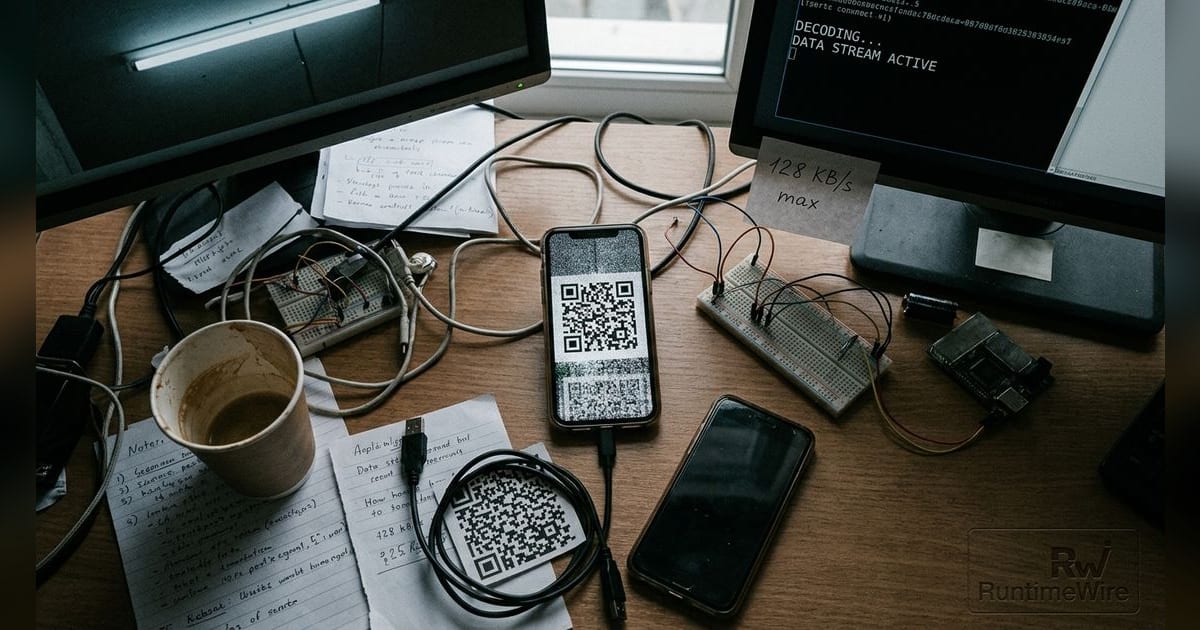
A pseudonymous software engineer using the name Alstroph released Decimen Optical Transfer on July 31st, turning a screen and camera into a one-way file link built from rapidly changing QR codes. In a demonstration post, Alstroph said the proof of concept was built with Claude Code in one night.
The project grew out of a cached web music player. Alstroph wrote that frustration with streaming audio quality and advertising led to an attempt at phone-to-phone music sharing that would not depend on Apple AirDrop or require both devices to use the same transfer service. The creator later described the concept as a "sneaker net for music sharing" and acknowledged that the result sits closer to a technical experiment than a finished consumer feature.
Alstroph says they have worked as a professional software engineer for over a decade and have used Claude Code for both work and personal projects since the coding agent's early release. The creator also said the optical-transfer concept preceded the Claude session, with the AI tool used to implement the proof of concept.
How Decimen handles missed frames
Decimen divides a file into blocks and displays an endless sequence of QR frames. A second device points its camera at the screen, decodes enough frames and reconstructs the original file. The receiver can start watching after the transmission has begun because every frame includes a 20-byte header containing a session identifier, sequence number, block information, file length and hash.
The important component is Luby-transform fountain coding. Each displayed frame combines a pseudorandom subset of the original file blocks. The receiver does not need every frame or a specific sequence. Decimen's documentation says it can rebuild the file after collecting about 1.15 times the original number of blocks, absorbing frames lost to blur, autofocus, mismatched refresh rates or slow decoding.
That design eliminates the need for a return channel asking the sender to repeat a missing frame. It also allows the sender and receiver to run at different frame rates. Decimen uses TypeScript and Vite, generates codes with node-qrcode and performs camera-side decoding through zxing-wasm, which packages ZXing-C++ for WebAssembly.
The repository also addresses browser-specific failures that a typical QR demo can ignore. It uses a deterministic logarithm implementation so V8 and JavaScriptCore calculate identical fountain-code distributions, accounts for iOS camera frame-rate behavior and runs decoding workers around dropped frames. The code was published under the MIT license.
The speed claim comes with a setup caveat
Alstroph's original demonstration claimed about 120 KB/s. The repository documentation says the broader experiment reached about 128 KB/s while handheld and about 186 KB/s when the receiving phone was propped up. It also describes a 2 MB image transfer measured at 129 KB/s. Those figures are creator-reported benchmarks rather than independent measurements.
The stripped-down public version sends a selectable 512 KB or 2 MB image. Its default configuration displays 1,465 bytes per frame at 24 frames per second, while the higher-throughput experiment used denser QR codes, stacked codes, a 120 Hz display and an error-corrected color channel.
Decimen's claim of moving the payload without a network is accurate once the browser pages are running, but the current setup is not a turnkey workflow for two completely isolated devices. The instructions have the sender run a local Vite server and tell the receiving phone to load an HTTPS page from the server's local-network address before activating its camera. The file bytes then cross the gap through light rather than the LAN.
A deployable air-gapped version would need the sender and receiver software installed or loaded on each device in advance. The present repository proves the optical channel and recovery method, rather than packaging the full operating procedure for locked-down environments.
Animated QR transfer already has a history
Decimen is a new implementation of an established idea. TXQR, first published in 2018, also combines animated QR codes with fountain coding. Qrs streams data through QR-code series using Luby-transform encoding. Airgapped QR Code Transfer provides a browser implementation built with Vue.js, compression and WebAssembly scanning.
Libcimbar abandons standard QR codes for custom color-icon-matrix barcodes. Its maintainers claim roughly 106 KB/s between a monitor and smartphone camera, using fountain codes, compression and a barcode format designed specifically for optical transfer. Decimen's README acknowledges these predecessors and says its creator arrived at the approach independently.
The fresh contribution is the speed at which a solo developer turned the idea into a browser-based, inspectable systems demo. The repository contains decisions about error recovery, camera behavior, cross-engine numerical consistency and worker scheduling that go beyond generating a sequence of QR images.
The same channel has a security edge. A one-way optical link can move information where Bluetooth, Wi-Fi and conventional network traffic are blocked or monitored. That could support device provisioning and controlled transfers in isolated environments. It could also create an exfiltration route through an approved screen and camera. Alstroph explicitly acknowledged malicious uses in the discussion.
The QR stream is visible broadcast data. Any compatible receiver with line of sight could collect the frames, which makes physical access and screen visibility part of the threat model. Decimen packages that trade-off in a small proof of concept: network controls disappear from the payload path, while control of the room and the camera becomes decisive.