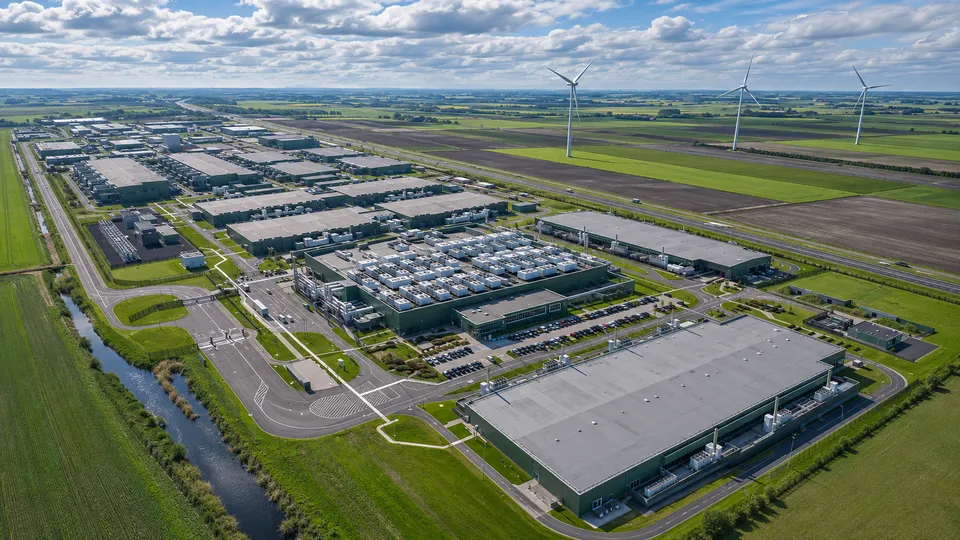
Since May, a supercomputer in Sønderborg, Denmark, has sent the heat from its chips into the town’s heating pipes, and that makes it unusual: across the European Union, data centers put about 1.8 percent of the heat they generate to use, the European Commission said in a report published on Sept. 21.
The machine is named Bitten, after Bitten Clausen, who played a major part in the early years of the Danish engineering company Danfoss, and it is Denmark’s main A.I. resource for academic research. Nick Clark reported for Al Jazeera on Nov. 8 that liquid cooling designed by Danfoss recovers all of its waste heat, pumping coolant directly over the processors so that no air conditioning vents it outdoors. The heat can then flow into a municipal network that, by Al Jazeera’s count, serves 75,000 residents. By industry standards Bitten is small: 128 Nvidia B200 chips, running at launch at about 30 percent of the capacity of the new data center built for it, according to the University of Southern Denmark. Neither the university nor Danfoss has said how much heat it delivers.
The E.U. data, drawn from 770 sites, and projects going back to 2010 point to the same reasons Sønderborg is the exception, and most of them have little to do with computers. Most server heat leaves the building too cool for an older city network. Demand for heat disappears in summer, and servers run all year. Somebody has to pay for the heat pumps and pipes that close the gap, and they outlast the hardware by decades. In much of the world, the United States included, there are no pipes.
The A.I. buildout changes part of that. Liquid-cooled chips run hot enough to feed some networks directly, and the International Energy Agency estimates that data center heat could supply up to 300 terawatt-hours of space heating to European buildings by 2030 if it were fully connected. The rules meant to move that heat are weaker than they look. E.U. law asks larger sites to reuse heat only where doing so is technically and economically feasible. The Commission’s new rating scheme is mostly about disclosure. And Germany, which wrote a reuse quota into law in 2023, is moving to loosen it.
A tap of hot water #
Kristian Strand, the president of Danfoss Climate Solutions, started with ordinary acts. Taking a picture or up a document, he told Al Jazeera, sets off processing somewhere in a data center.
Sune Tornbo Baastrup, Danfoss’s chief information officer, described the plumbing to the Danish trade site IT Watch. The computing racks are liquid-cooled, so their heat stays concentrated in a stream of fluid warm enough to enter a modern district heating network without a heat pump. The storage and network equipment is still cooled by air, and that heat is too cool to use directly, so a heat pump raises its temperature first. Together, he said, the two systems reuse all of the heat. “We haven’t seen many large data centers be liquid-cooled yet,” he told the site in Danish. “The solutions and technology are available today.”
District heating in Sønderborg is a modest business. Sønderborg Varme, the town’s district heating company, has about 18,000 customers and charges 11,878 kroner a year, tax included, to heat a standard 125-square-meter house, according to Dansk Fjernvarme, the Danish district heating association. It wants to be carbon neutral by 2029 using electric boilers, biomass and waste energy. The association’s account of that plan doesn’t mention the supercomputer.
Danfoss has done the same at Sønderborg Hospital, where it replaced two gas boilers with heat pumps that collect heat from MRI scanners and from the climate systems of operating theaters, wards and corridors. That heat used to leave through cooling towers. The hospital is now energy independent for nine months of the year and feeds heat back into the network. “The project will pay for itself inside two years,” Lasse Bo Madsen, the hospital’s head of technical services, told Al Jazeera.
DatacenterDynamics, a trade publication, posted the plan in January, when the university first announced an Nvidia-based supercomputer for Sønderborg built with Danfoss and HPE.
The temperature problem #
Almost all the electricity a server draws ends up as heat. For a heating utility, what matters is the temperature. Air-cooled data centers typically release heat at 25 to 35 degrees Celsius, or 77 to 95 degrees Fahrenheit, according to a 2024 study in the journal Energy and Buildings. The older district networks still common in Europe send water out at about 90 degrees and take it back at about 70, according to a survey of carbon-neutral data center research. Server heat has to be raised before anyone can use it.
Odense shows what that takes. Water leaves Meta’s data center there at about 27 degrees, and large electric ammonia heat pumps owned and run by the local utility, Fjernvarme Fyn, raise it to 70 to 75 degrees for the city network, Meta wrote in 2020. Those heat pumps run on electricity of their own, and the utility had to buy them.
A.I. hardware narrows the gap. The chips that train and run large models are increasingly cooled with liquid, which raises waste heat to 50 to 60 degrees, the authors of a 2026 paper in Energy Conversion and Management wrote. That’s why Danfoss can send most of Bitten’s heat straight into the pipes. It is still short of what older networks run at, and the paper was written about exactly that: how to fit liquid-cooled sites into those networks.
The Uptime Institute, an industry research group, put it bluntly in a 2023 primer on heat reuse: “thermodynamics and economics weigh down the business case.” It counted nearly 60 documented projects in Northern Europe, where a cold climate and widespread district heating help, and found that operators often give the heat away rather than sell it.
The record since 2010 #
The idea is older than the A.I. boom. In 2010, the Finnish IT company Academica and the utility Helsingin Energia ran a pilot data center in a cavern 30 meters beneath Helsinki’s Uspenski Cathedral, sending server heat into the city’s district heating, and it won an Uptime Institute green IT award that year, Data Center Knowledge reported in 2011. The partners then fitted out a former electric substation about 10 times the size, whose waste heat, once the hall filled, could warm “up to 2,000 single-family houses in Helsinki,” the publication wrote.
A few years later, DatacenterDynamics filmed a report at the CeBIT trade fair on Yandex’s facility in Mäntsälä, Finland, which reclaimed server heat for the local district heating system.
Stockholm turned the idea into a market. The city’s utility, Stockholm Exergi, opened its network to outside heat suppliers in 2014 under a program called Open District Heating and later teamed up with the city to attract data centers through Stockholm Data Parks. The volumes have stayed small. In 2023, heat recovered through the two programs came to 117 gigawatt-hours, out of 1,050 gigawatt-hours of recovered heat of all kinds, according to the company’s annual report. Stockholm Exergi’s goal is for data center heat to cover 10 percent of the city’s heating needs.
Odense grew faster. Fjernvarme Fyn signed with Facebook in 2017, and Meta estimated in 2018 that the project would recover 100,000 megawatt-hours a year, enough for about 6,900 homes. That is the figure Jan Rosenow, a professor of energy and climate policy at the University of Oxford, gave Al Jazeera. An expansion announced in 2020 raised the target to 165,000 megawatt-hours, or 11,000 homes. Ramboll, the engineering firm that designed the plant for the utility, says it can inject about 45 megawatts of heat into the city’s network.
Finland is trying projects of a different size. Google expects its data center in Hamina to meet 80 percent of the local network’s annual heat demand. The I.E.A. puts the figure at 70 to 75 percent in its report on integrating data centers into power systems. In Espoo, Fortum expects heat from Microsoft’s data centers to cover about 40 percent of the heat used by 250,000 district heating customers in Espoo, Kauniainen and Kirkkonummi, according to the utility. Fortum’s new heat plants started up this year, running for now on outdoor air and electric boilers. Heat from the server halls is due to phase in from 2027, the trade site DataCenterSweden reported.
Ireland had no district heating at all until local government created Heat Works in 2020 as the country’s first not-for-profit energy utility, built around an Amazon Web Services data center in Tallaght, outside Dublin. Since 2023 the network has met 92 percent of the heating demand at the Technological University Dublin campus there, CNBC reported. AWS supplies the heat free.
Who pays for the pipes #
Denmark capped the price of surplus heat until July 1, 2025. Jørn Thorgaard, a special adviser at the government agency Invest in Denmark, said the cap “discouraged businesses, particularly data centres, Power-to-X facilities, and industrial plants” from investing in heat recovery, and the agency wrote that only about 13 percent of the country’s surplus heat was being used, though it could cover up to a quarter of all district heating demand. Prices are now negotiated, but the overall district heating price still can’t exceed the cheapest alternative.
Germany shows the other side of the deal. As the government drafted its energy efficiency law in 2023, Bloomberg News reported, in an article republished by Data Center Knowledge, that about 200 data centers open in the country each year and that the Economy Ministry put the cost of the upgrades needed to use their heat at more than 680 million euros. Ralph Hintemann, a researcher at the Borderstep Institute, said operators were “mostly ready and willing to give away their waste heat.”
Béla Waldhauser, the chief executive of the operator Telehouse, said, “The gap in the temperatures is way too great,” and that feeding the heat into district networks “doesn’t make ecological or economical sense.” Germany’s association of local utilities said low-temperature heat was more complex and more expensive to use. As Bloomberg described it, the law’s flaw was that no one who might use the heat had to take it.
Brendan Reidenbach of the I.E.A. pointed to a mismatch in lifetimes. Heat networks are built to last about 30 years and data center equipment seven to 10, which, he told CNBC, “does leave a very large risk of stranded assets.” Supplying heat still earns operators “additional social license,” he said.
Adam Nethersole, a vice president at the British operator Kao Data, wrote in June that the model fails in the middle. Small edge sites can heat a pool, and giant Nordic campuses can plug into mature networks. Midsize colocation halls of roughly 5 to 40 megawatts make too much heat for a side project, take years to fill with tenants and have nowhere to send it, because “district heating networks require a stable, predictable baseload.” Heat networks supply about 3 percent of British heat demand.
The summer objection #
Michael Liebreich raised the sharpest objection with Dr. Rosenow on an episode of his Cleaning Up podcast released Sept. 23. Dr. Rosenow had said there was “a huge opportunity I think to use that waste heat for district heating.” Mr. Liebreich called that a truism and pointed to the calendar.
Mr. Liebreich said the heat should first drive the data center’s own chillers and then go to industries like food processing that need heat “all year round.” Dr. Rosenow agreed about industry and suggested storing summer heat for winter, citing a Finnish project of about 90 gigawatt-hours, the cavern store under construction in Vantaa. Mr. Liebreich did the math: that would hold about three days of heat from a 1.2-gigawatt data center in Sines, Portugal. The numbers hold up. A 1.2-gigawatt site turning all its power into heat produces about 86 gigawatt-hours in 72 hours.
The record bears out parts of both arguments. The projects that work are in places with long heating seasons, from Odense to Hamina, and they depend on utilities willing to buy heat pumps, which supports Mr. Liebreich’s point about the calendar. Dr. Rosenow’s answer works where industry or storage can take the summer surplus, but the largest store being built would absorb only a few days of output from one big A.I. campus. Liquid cooling answers the temperature complaint Telehouse made in 2023. It does nothing about July.
The 1.8 percent figure comes with caveats. It is drawn from the first reporting round, May to September 2024, when 770 data centers filed returns, about 36 percent of those required to, and the numbers are self-reported, as the environmental site Reset noted. Among sites that reuse any heat, the average reuse factor is 0.205, about a fifth of their energy, according to the Borderstep Institute, which helped analyze the data. Across all sites it is 0.018.
How much heat is coming #
There will soon be far more heat. The I.E.A. estimated that data centers used about 415 terawatt-hours of electricity worldwide in 2024 and expects that to more than double, to around 945 terawatt-hours by 2030, with A.I. the main driver, according to its Energy and AI report. Al Jazeera, citing the agency, gave a higher 2024 figure of 485 terawatt-hours. In the E.U., data centers used 68 terawatt-hours in 2024, and the Commission projects 114 terawatt-hours by 2030, or 3.2 percent of the bloc’s electricity demand.
If that heat were fully integrated into district heating, the I.E.A. wrote, it could provide up to 300 terawatt-hours of space heating to buildings within five kilometers, about three miles, by 2030. That is more than 2,500 times what Stockholm’s data center programs recovered in 2023. The Commission estimates that reusing about half of Europe’s data center heat would meet the heating demand of four million households. Writing in his newsletter in September, Dr. Rosenow cited a projection that Europe’s data center waste heat will nearly triple by 2050 and said that “may be a conservative estimate.” Dr. Rosenow promoted the newsletter piece on X, where he posts regularly about heat pumps and heat networks.
The United States has the most data centers of any country, about 4,000, drawing 5 percent of the nation’s electricity, and recovers very little of their heat, Al Jazeera reported. Dr. Rosenow wrote that this is partly because the country has little district heating, though he pointed to exceptions such as the Westin Building Exchange in Seattle, which heats Amazon’s headquarters. Virginia passed a law this year directing its Department of Energy to find uses for data center heat, naming district heating among them, with a report due Sept. 1. It was not clear whether the report had been published.
“We should be building data centres where their heat can be used, not just where land is cheapest,” Dr. Rosenow told Al Jazeera. In the American market the big contracts are for cooling: LG has signed on to cool 5 gigawatts of American A.I. Opposition to the buildings themselves is growing. Dutch police arrested protesters opposing a new Microsoft data center near Amsterdam on Nov. 6, according to Al Jazeera, and some American regions have turned against new halls, as the Bay Area’s fight with its own A.I. boom shows.
What the rules require #
E.U. law already calls for reuse, with an exit. Under Article 26 of the 2023 Energy Efficiency Directive, data centers with more than one megawatt of rated energy input must use their waste heat unless it can be shown that doing so is not technically or economically feasible, and new or substantially refurbished sites above that size must run a cost-benefit analysis, according to the law firm Bird & Bird. A 2024 Commission recommendation says the duty also covers operating sites that don’t yet reuse heat. Denmark requires the analysis for data centers above one megawatt, according to the Danish Energy Agency.
The Sept. 21 package adds a label. The proposed rating scheme would cover data centers with at least 500 kilowatts of installed IT power, grade energy and water efficiency from A to G and show whether a site reuses waste heat, according to the Commission, which wants to triple the bloc’s data center capacity in five to seven years. Teresa Ribera, the Commission’s executive vice president, tied the two together, Reset reported.
Only the label becomes public. The site-level data behind it stays confidential, which Bram Vranken of Corporate Europe Observatory, a group that tracks lobbying in Brussels, said would let a company “consume an undisclosed gigawatt of power,” according to Reset. The Commission has also opened a consultation on minimum performance standards for data centers, the first step toward requirements rather than disclosure.
Germany went further and is now pulling back. Its 2023 Energy Efficiency Act requires new data centers starting operation from July 1, 2026, to reuse at least 10 percent of their energy, rising to 15 percent for those starting from July 2027 and 20 percent from July 2028, according to the law firm White & Case. Amendments approved by the cabinet on June 24 keep those quotas but would let sites connected to a heat network deviate from them, exempt sites where a connection is not technically or economically viable, count heat used in an operator’s own offices and drop the duty to provide a heat transfer station, the law firm CMS wrote. The Bundestag held a first reading on Sept. 24 and a committee hearing on Oct. 5, and its records list no date for a final vote.
What comes next #
Several deadlines are already set. The European Parliament and the Council have two months from Sept. 21, until about Nov. 21, to object to the rating scheme. The Commission’s consultation on minimum performance standards closes Dec. 14. Heat from Microsoft’s halls is scheduled to start reaching Fortum’s network in Espoo in 2027. In Sønderborg, Bitten runs at about 30 percent of its data center’s capacity, and the university says it is built to expand as newer, more efficient chips become available.
The first labels are due by Aug. 15, 2027. Under the proposal, each will say whether a data center reuses its heat, and the figures behind the grade will stay confidential.