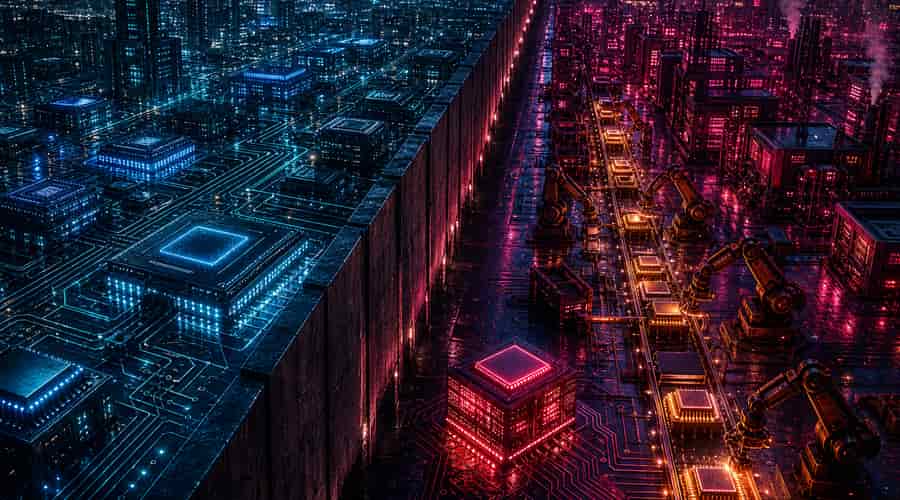
Dario Amodei spent this week asking Washington to tighten the screws on China: harder chip export controls, a crackdown on model distillation, and mandatory safety tests. Read it charitably and it is a safety argument. Read it the way the rest of the industry is reading it, and it is the sound of a company that has started to look over its shoulder. Anthropic is not winning this race as comfortably as it once assumed, and its policy wish list is starting to look like fear dressed up as principle.
On July 27, Amodei clarified that Anthropic does not want open-weight models banned. Good. But he drew his line exactly where it hurts China most. He wants tighter enforcement of chip export controls and a crackdown on the smuggling that gets advanced silicon into Chinese data centers. He wants a crackdown on distillation, the practice of training a smaller model on a bigger model's outputs. And he wants mandatory safety testing for every sufficiently capable model, wherever it is built. The trigger, by his own framing, was what China keeps shipping for free, including Moonshot's Kimi K3.
Notice what that list has in common. Every item is a way to slow down the competition rather than out-build it. When the fastest path you can find to staying ahead runs through the US government's export desk, you are not describing confidence. You are describing a lead you are not sure you can hold on the merits.
The ban he wants will build the thing he fears #
Here is the part Amodei's argument keeps skating past. Cutting China off from American chips does not freeze China in place. It sets a deadline. Beijing has spent years pouring money into domestic silicon precisely so that a moment like this cannot strangle it, and the effort is no longer theoretical. Huawei's Ascend accelerators and SMIC's manufacturing are not at parity with Nvidia's best, but they do not have to be. They have to be good enough, made at home, and improving every quarter. Export controls hand that program the one thing money cannot buy on its own: urgency, and a guaranteed domestic customer base with nowhere else to shop.
The scaling-law logic Amodei leans on assumes China stays dependent on chips it can be denied. Remove the dependency and the logic inverts. A harder ban does not keep the United States ahead on hardware. It gives China every reason to win the hardware frontier too, and to do it faster. The likeliest outcome of trying to protect an American lead in both software and silicon is losing the lead in both, because you spent the runway teaching your rival to make its own engines.
The distillation complaint from a company that just paid for piracy #
Then there is the distillation line, and this is where the argument stops being merely shaky and starts being hard to say with a straight face. Amodei wants Washington to treat training on another model's outputs as something close to theft. This is the same Anthropic that, one week ago, watched a federal judge give final approval to a 1.5 billion dollar settlement for training Claude on roughly half a million pirated books it pulled from piracy sites. The court was blunt about it: the training itself was one question, but acquiring the material through pirate websites was wrongful. It is the largest copyright settlement in history, and Anthropic wrote the check.
So the position, stated plainly, is that when a Chinese lab learns from model outputs floating on the open internet, it is a national security threat that requires federal intervention. When Anthropic builds its flagship product on stolen books, it is a line item that gets settled and moved past. You cannot spend the summer paying 3,000 dollars a book for other people's work and then spend the same summer lecturing the world about who is allowed to learn from whom. Pick one.
What this actually signals #
None of this means Anthropic is finished. It has a great model, real enterprise revenue, and more capital than almost anyone. But great companies that are confident about the next five years do not spend their political capital trying to get the referee to slow the other runners down. They ship. The fact that Anthropic's most public policy push is about restricting rivals, rather than about anything it is building, tells you how the view looks from inside the building.
The Chinese labs are not waiting for permission. They are releasing capable models, often open, and moving toward chips they control end to end. Washington can make that harder for a while. It cannot make it stop, and every wall it builds doubles as a subsidy for the exact self-sufficiency Amodei says he is afraid of. Anthropic is not losing because its models are bad. It is losing the argument, and the argument was the part it was supposed to be good at. This looks less like the top of the market and more like the beginning of a long defense.
Also read: Dario Amodei says he doesn't want open-weight AI banned but fears what China just released for free • Anthropic's $1.5 billion copyright settlement gets final approval but authors aren't cheering • Nearly 200 startups tell Washington that banning Chinese AI models would hand OpenAI and Anthropic a monopoly