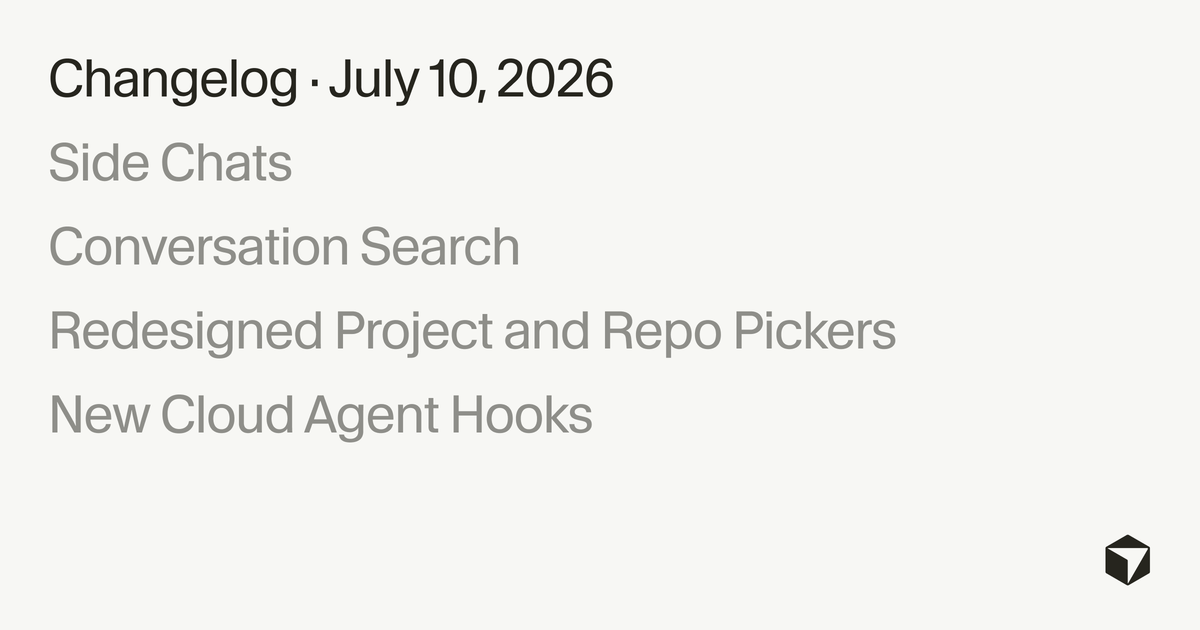
Cursor has released version 3.11, introducing Side Chats, a new feature that allows developers to open parallel agent conversations without interrupting or redirecting their primary coding tasks. Developers can initiate a side chat using commands like /side
, /btw
, or by clicking the plus button in the chat panel. Each side chat receives context from the main thread, remains accessible for future follow-ups, and can be referenced with an @-mention to integrate its findings back into the original conversation.
Side chats are designed to read, search, and answer queries, enabling developers to explore alternatives, clarify implementation details, or review decisions while the main agent continues its work. Unlike starting an unrelated chat, this new system maintains the connection between the primary task and each tangent, transforming Cursor’s agent interface into a workspace for multiple concurrent reasoning paths.
Cursor 3.11 also introduces a full conversation search feature. The Agents Window now allows users to search transcript content using Cmd+K, rather than relying solely on conversation names and pull request numbers. According to Cursor, this feature uses a local index that can handle thousands of conversations. Additionally, Cmd+F enables searches within the current transcript, complete with match navigation and counters for lengthy sessions.
The release reorganizes project and repository selection around three execution locations: This Computer, Cloud, and Remote Machines. Users can create projects, connect to GitHub, GitLab, or Azure DevOps, select multiple repositories, and choose branches without leaving the picker. Cloud agents also gain hooks for prompts, responses, thoughts, subagents, compaction, stopping, and turn completion. These controls can be used to inspect agent activity, apply policies, or create self-correcting workflows.
Cursor is developed by Anysphere, an applied research lab focused on the future of programming. Version 3.11 advances Cursor from being a single coding assistant to a coordinated agent workspace. This allows developers to run a primary task, investigate related questions in parallel, retrieve prior work, and control cloud agent behavior through programmable lifecycle hooks.