Crusoe today revealed it is providing organizations with an ability to fine-tune artificial intelligence (AI) models that they can also now opt to deploy themselves.
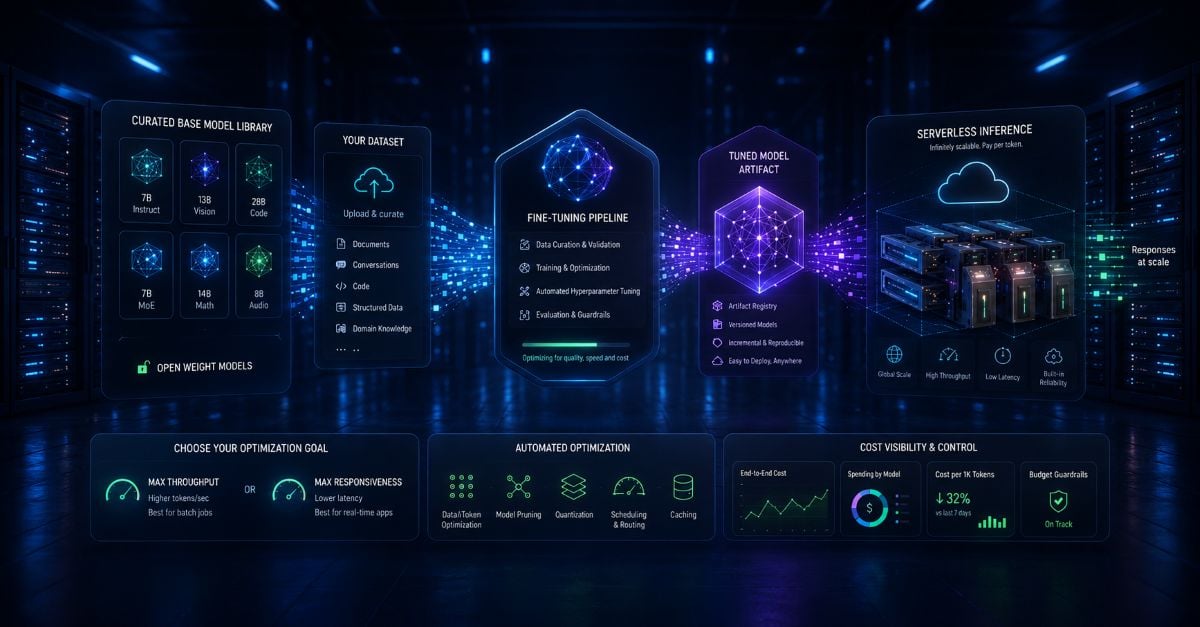
The Serverless Fine-Tuning and Self-Serve Deployments capabilities being added to the Crusoe Intelligence Foundry will make it simpler for organizations to deploy, for example, an open source AI model that they can optimize for specific use cases, says Erwan Menard, senior vice president of product for Crusoe Cloud.
That approach ultimately provides organizations with more control over their AI model in a way that also serves to reduce costs, he adds.
The IT teams in charge of AI projects can now select a base model from a curated library of open-weight models and then upload a custom data set to create a custom AI inference model that can be deployed on the serverless computing infrastructure provided by Crusoe that provides access to an OpenAI-compatible application programming interface (API).
Jobs run with automated recovery and restart if hardware issues are detected. As soon as the model stops improving, teams stop paying. When tuning is complete, model weights are returned in portable .safetensors format that can be deployed anywhere. Every tuned artifact traces back to the exact data and configuration that produced it. Pricing for Serverless Fine-Tuning is based on per one million tokens processed.
The Self-Serve Deployments option, meanwhile, enables organizations to select a base model, choose an inference profile optimized either for throughput or responsiveness, and deploy it on NVIDIA H100 or H200 graphics processing units (GPUs) without having to manually configure IT infrastructure. Organizations are then billed by consumption of GPU resources per hour to provide a more predictable method of tracking total costs.
Crusoe already provides access to AI models such as Qwen, DeepSeek, Gemma and gpt-oss, all of which are gaining traction as more organizations embrace open AI models, says Menard. In fact, there is much less concern about where an AI model originated as organizations focus more on control and costs, he adds. “There’s been a huge uptake,” says Menard.
In general, Crusoe intends to continue to invest in optimizing the AI model development lifecycle by making it simpler to use reinforcement techniques to train and update models, notes Menard. Additionally, Crusoe will be adding context primitives to reduce the amount of memory that AI agents would otherwise need to consume, he adds.
It’s not clear to what degree organizations are opting to use so-called neocloud, such as the services provided by Crusoe, but a recent Futurum Group report estimates they currently account for a little more than 10% of the total market. However, as GPU capacity continues to be scarce, many organizations are now relying on multiple sources.
Of course, there may come a day when organizations opt to rely less on GPUs to train and run AI models as other classes of processors become more able to run these types of workloads. In the meantime, however, the focus now is clearly on maximizing the utilization of GPUs anywhere they can be found.