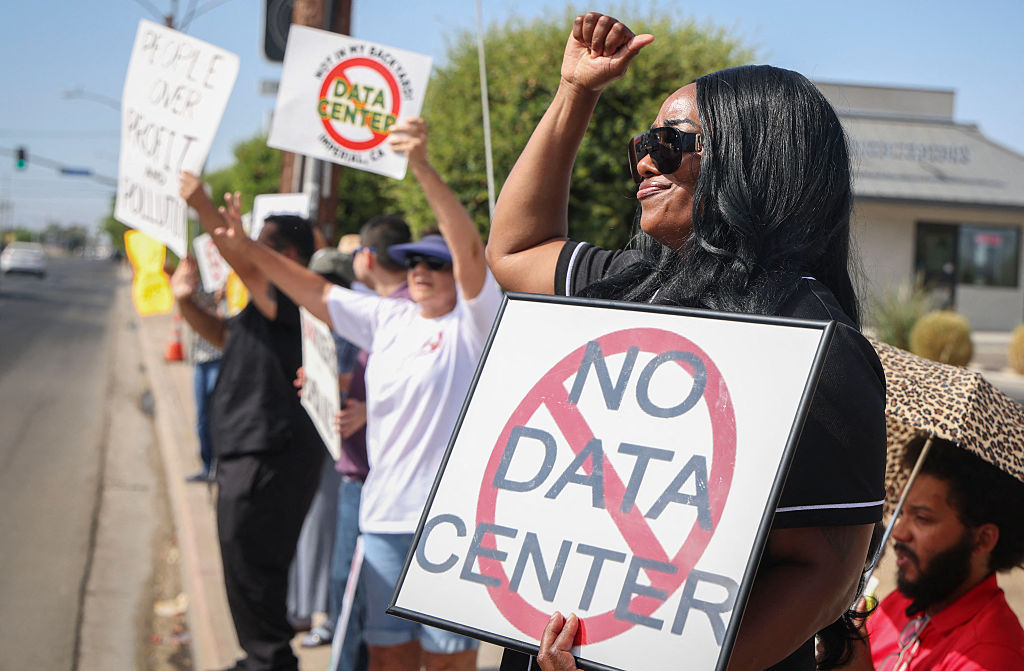
Recent US intelligence documents hype up the threat of “anti-tech violent extremist activity” against data centers. Casting protests as ideologically extreme is a shortcut to silencing critics of AI and removing democratic constraints on Big Tech.
The politics of artificial intelligence are entering a new phase. In the United States and beyond, communities are protesting data centers that are projected to triple water and electricity consumption by 2030, drive up utility costs, and harm the environment. Artists, journalists, and writers are suing AI companies for using their work without permission. Teachers are questioning whether generative AI is improving education. And workers in many fields are growing worried about automation, surveillance, and job loss or displacement.
These aren’t fringe concerns. In 2025 alone, 1,416 data centers were either already built or approved for construction across forty-five American states, triggering a wave of opposition over environmental impacts, quality-of-life concerns, and the growing concentration of corporate power. Similar battles are now emerging everywhere from Ireland to Mexico. Opposition to AI infrastructure is no longer a local dispute but an international phenomenon.
As resistance grows, however, so does the effort to label it. Different concerns — from water scarcity and job insecurity to surveillance and concentration of corporate power — are treated as a single obstacle to technological advancement. This absurdly broad category already has a name: “anti-tech extremism.”
The phrase itself deserves scrutiny. The people protesting the effects of AI infrastructure aren’t part of a single coordinated movement. They don’t necessarily share the same politics or interests, or even criticisms. A teacher questioning AI’s impact on learning outcomes has little specific in common with a novelist suing over copyright infringement, just as a community fighting against a data center that’s causing water and electricity outages isn’t making the same argument as a worker worried about the automation of her job.
However, treating them as though they belong to the same camp does two things at once.
First, it pushes the actual underlying grievance out of view and replaces it with a political identity. Questions about water shortages, automation, copyright, workers’ rights, or corporate concentration cease to stand on their own merits. Instead they are absorbed into a much larger political story about growth, competitiveness, and the AI race. Britain’s AI Growth Zones program, for example, promises to remove “barriers” to the construction of AI data centers so the country can become “an AI maker, not an AI taker.” A recent trade secretary described the same program as one that will “attract AI start-ups and scale-ups” and “start a ripple effect of good, future-proofed jobs.” Within that political story, objections over water use, electricity demand, or democratic accountability become obstacles to prosperity.
Second, this changes the terms on which criticism is received. The problem is no longer whether a concern is valid and needs attention, but whether the person raising it belongs to a category that can safely be ignored — or should even be feared. The term is already acquiring institutional force. Internal US intelligence bulletins warn of “anti-tech violent extremist activity” and describe “environmental extremists” as potential threats to data centers, recasting peaceful opposition to AI infrastructure within the elastic political category of “national security.”
The recent US counterterrorism strategy offers a useful example. Under broad classifications of extremism sit a diverse collection of actors and beliefs — from “anarchists and anti-fascists” to “violent left-wing extremists” and other movements that share little beyond their placement within a common category.
In Britain, concerns about environmental costs, democratic accountability, and digital dependency have collided with appeals to growth, competitiveness and national AI leadership. Calls for stronger public oversight of technology companies are routinely framed as threats to innovation, entrepreneurship, or economic dynamism.
This framing is particularly useful to those with the greatest stake in AI’s continued expansion — the companies building it, the investors financing it, and the institutions betting heavily on its success. For them, opposition is rarely presented as a legitimate disagreement over resources, power, societal needs, or democratic accountability — or even how we, as societies, define intelligence or knowledge!
The logic behind this is sometimes stated with remarkable bluntness. In his 2023 ”Techno-Optimist Manifesto,” venture capitalist Marc Andreessen argued that any attempt to slow the development of AI amounts to “a form of murder.” The claim is extraordinary, but its underlying argument is clear.
If AI is able to cure all diseases, transform societies “for the better” and solve humanity’s greatest challenges, then opposition to data centers because of rising electricity bills can easily be cast as parochial, even selfish. The sheer scale of the promise, we are told, overwhelms the specific grievance, however justified. Here is the point at which dissenting voices are swiftly drowned out.
Engineering Consent #
Nearly a century ago, the public relations pioneer Edward Bernays argued that democratic societies increasingly depended upon what he called the “engineering of consent.” As more citizens became politically organized and capable of influencing public life, the challenge was no longer simply governing people but shaping the assumptions through which they understood the world. The struggle shifted toward managing public opinion itself.
Today, the engineering of labels like “anti-tech,” “anti-growth,” and “anti-innovation” helps to organize public debate by determining which concerns appear serious and worthy of attention.
Edward S. Herman and Noam Chomsky identified a similar mechanism during the Cold War. In their propaganda model, “anti-communism” functioned as a powerful filter through which legitimacy was distributed. The label reached far beyond members of communist parties, frequently encompassing antiwar activists, critics of US foreign policy, and other dissenting voices. Some ideas appeared responsible and realistic, while others became suspect before they could even be seriously debated.
The crusade against so-called anti-tech movements is today’s equivalent.
All of this matters because many of the central questions surrounding AI remain unresolved. The environmental costs are real. Labor displacement is already occurring. Educational benefits remain fiercely disputed. Market power is unstoppably concentrating. Public oversight remains weak and fragmented. Trillions of dollars are now flowing into AI infrastructure, automatically creating powerful incentives to sustain narratives of inevitability and ever more digital expansion. And everywhere, society’s understandings of knowledge and expertise are being redefined. Yet almost nowhere is the debate happening about how society should define intelligence, knowledge, and expertise. The impacts of doing so, by accident or default, are potentially huge for society’s basic institutional structure. The more all this becomes clear, the more new unifying narratives of resistance may emerge — and rightly so — as initiatives such as the recent launch of the AI Resist List may already suggest.
Crudely simplified portrayals of resistance to AI sidestep all of these essential democratic questions. However, democratic debate depends on more than the formal right to disagree. It also hangs on the ability to question dominant assumptions without being cast as an enemy of progress.
The most important political struggle surrounding AI may therefore not concern the technology itself, but who gets to define which futures — and which forms of resistance — are legitimate. Big Tech knows this all too well, which is why, with the help of its media allies, it is determined to close down this struggle prematurely.
Any society that still claims to be democratic should refuse to let that happen.