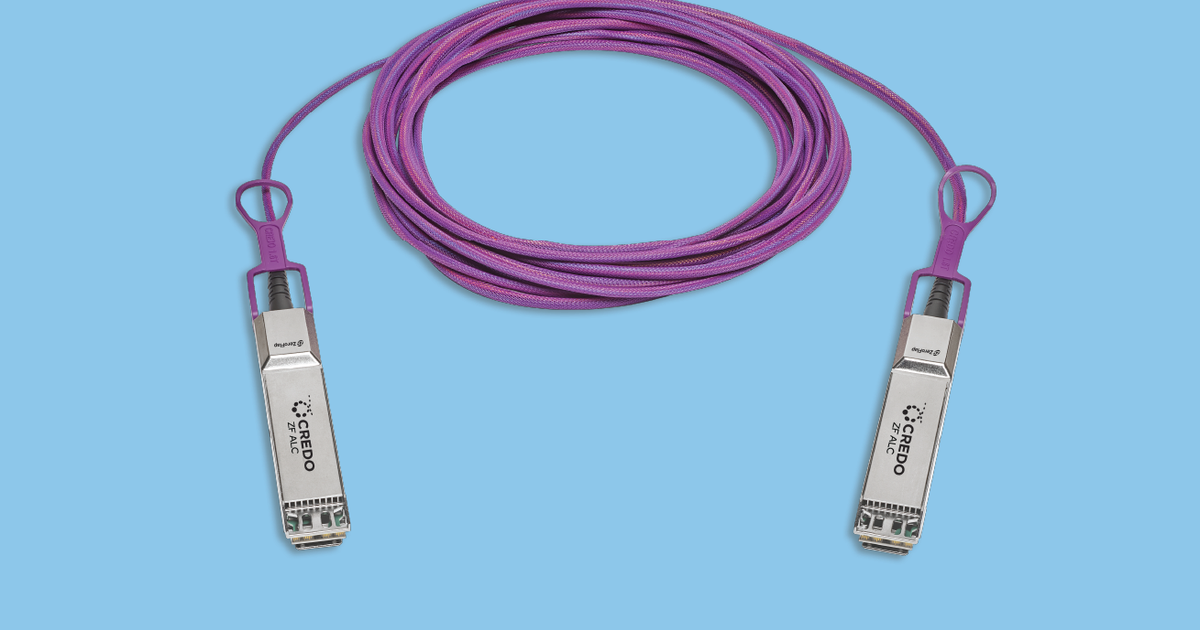
Credo unveiled an optical interconnect active light cable (ALC) capable of supporting 1.6-terabit (1.6T) connectivity.
The ZeroFlag ALC was unveiled at this week's OCP event in San Jose, California, and is designed for AI scale-out and front-end networks. Credo claims a targeted reach up to 164 feet (50 meters) and power draw of 12 watts per cable end, with shipping set to start sometime next year.
Credo’s optical ALC looks to push past copper's distance limits by placing wide-parallel, micro-emitter optics at the end of cables in a pluggable style form factor. These optics use arrays of micron-scale sources – sub-millimeter components that control and transmit light – to process information. Multiple emitters can be used in tandem to push data at optimal individual speeds rather than forcing extreme data rates down just a few optical channels. In practice, the cable splits 200 Gb/s (200G) lanes into many low-rate optical channels, which improves flow and reliability.
The product boast 100 million hours mean time between failures, while offering improved power and cost overhead compared to traditional pluggable optics. Credo goes as far as to claim it draws roughly 30% less power than comparable active electrical cables (AECs) while also being 10-times lighter.
“For decades, optical transceivers have prioritized data rate per fiber. Our 1.6T ZeroFlap ALCs are engineered with reliability as the first-order concern,” L.K. Bhupathi, associate VP of product at Credo, explained. “The scale-up and scale-out links that form the densest connections in AI data centers demand higher reliability than traditional optics were designed to provide. Credo’s ALCs bring copper-class reliability to these links, enabling larger GPU clusters and higher-throughput connectivity for massive-scale AI deployments.”
The ZeroFlag reveal comes as Credo looks to push deeper into optical connectivity. In June it acquired silicon photonics firm DustPhotonics for around $750 million with its high-speed optical to feed into the ZeroFlap portfolio.
In addition to active light cables, Credo is developing optical-based digital signal processors for AI clusters with a 1.6T offering launching back in March.