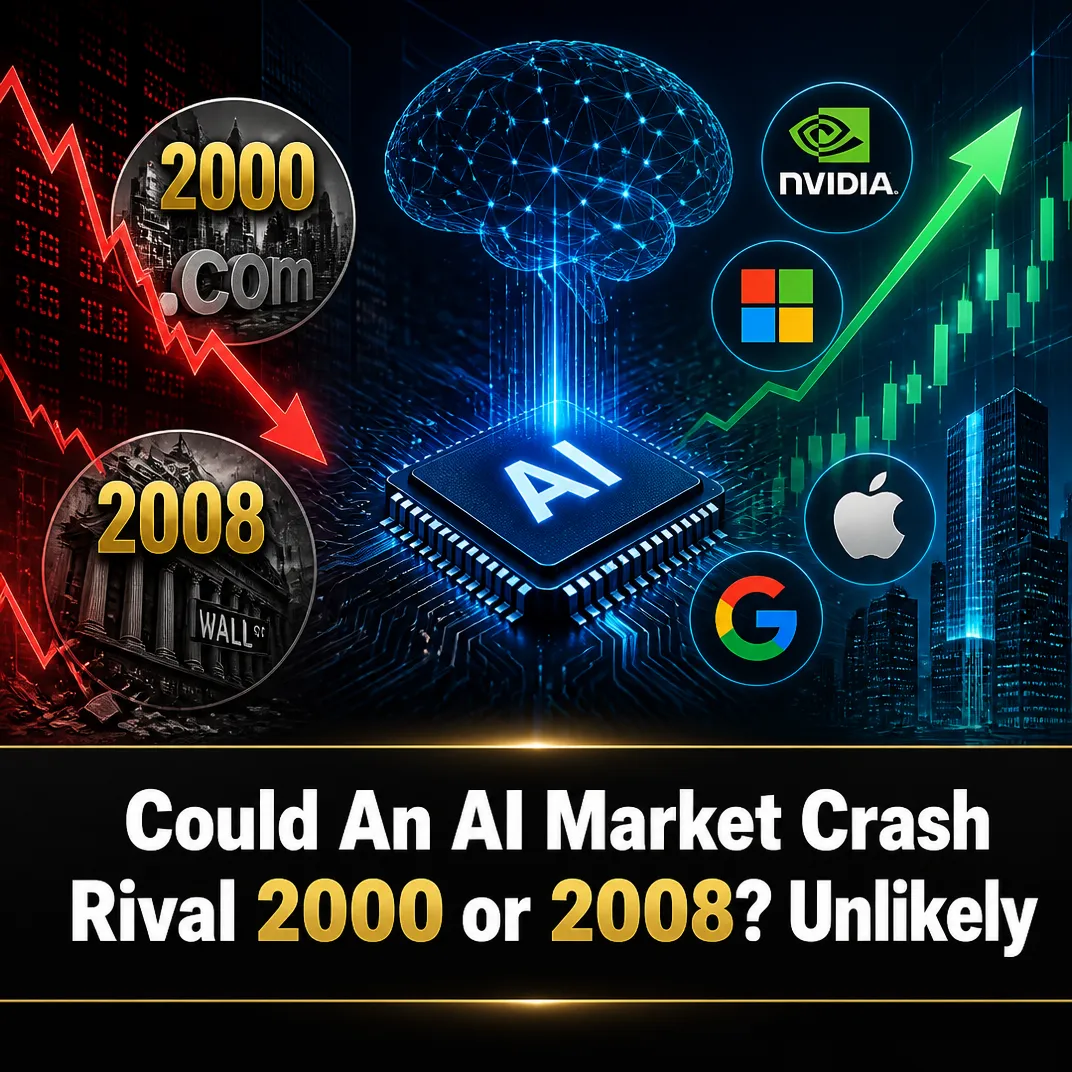
July 29, 2026, (Inside AI) — Chip stocks are tumbling and AI bubble fears are spiraling, prompting urgent questions about how far market volatility could spread. The Nasdaq is flirting with a 10% correction, and the Philadelphia Semiconductor Index has slipped into a technical bear market, even while remaining up 55% on the year.
Yet the broader market appears resilient. The Dow and S&P 500 sit just 1% and 2% below record highs, and the Russell 2000 small cap index has surged 20% in 2026. This disconnect between tech turmoil and overall market health is stoking debate about whether an AI-driven crash could rival the dotcom bust or the 2008 Global Financial Crisis.
Some bearish voices on financial social media warn that the AI buildout’s so-called “circular financing” mirrors the complex leverage that fueled the subprime mortgage meltdown. They argue that if one pillar of the trillion-dollar AI infrastructure falls, the entire market could cascade. This view is reinforced by record concentration: semiconductor companies now account for 19% of the S&P 500, more than double their weight in 2000.
But a closer look at valuations and systemic risk suggests such comparisons are overblown. The Nasdaq’s 12-month forward price/earnings ratio hovers around 30, a fraction of the 70 multiple seen in March 2000. Today’s tech giants are highly profitable, established firms, unlike the unprofitable startups that defined the dotcom era.
“I think we have the ability as an industry to double each year,” Nvidia CEO Jensen Huang told Bloomberg last week.
Such optimism fuels speculative excess, but the underlying financial system has hardened since 2008. The GFC was rooted in housing, a sector representing 16% of U.S. GDP and touching every household. A 25% retreat in chip stocks or a 50% downturn in private credit would not carry the same catastrophic economic weight. Post-crisis regulation, stronger capital rules, and tighter supervision make a banking system freeze extremely remote.
Valuation Reality Check #
Historical data underscores the valuation gap. Research on technology bubbles shows that the dotcom crash was preceded by extreme price-to-sales ratios and negative earnings for most companies. A study from the National Bureau of Economic Research found that only 14% of tech IPOs in 1999–2000 were profitable, versus over 80% of today’s leading AI firms. This profitability provides a buffer absent in 2000.
Moreover, the GFC’s systemic risk stemmed from opaque, interconnected derivatives tied to housing. The Federal Reserve’s post-mortem highlighted that housing wealth effects amplified the downturn as home equity evaporated. AI infrastructure financing, while complex, lacks the same direct consumer balance sheet exposure. Even if hyperscaler credit default swap costs are at record highs, the transmission mechanism to Main Street is weaker.
Concentration Without Contagion #
The S&P 500’s 19% semiconductor weighting is historically extreme, but concentration alone does not guarantee a systemic crisis. In 2000, the tech sector’s collapse dragged down the broader market because it was accompanied by accounting fraud and a recession. Today, AI demand is underpinned by real corporate investment and revenue growth. Nvidia’s data center revenue, for instance, is projected to exceed $100 billion in fiscal 2026, driven by cloud providers and enterprises.
Private credit, a **$3 trillion** market, is indeed opaque and sensitive to rising bond yields. But its links to AI are indirect, and regulators have been monitoring leverage buildup since the 2020 COVID shock. The risk of a “nuclear” financial event remains low because central banks now have playbooks for liquidity crises, as demonstrated in March 2020 and March 2023.

If the AI bubble pops, history suggests a sharp but contained correction, not a lost decade. The Nasdaq took **15** years to recover from its 2000 peak, but that was an anomaly driven by a historic overvaluation unwind. A more likely scenario is a reset akin to the 2022 tech selloff, where the index fell **33%** but rebounded within **18** months. Not every bear market is a crisis, and the AI story still has room to run.