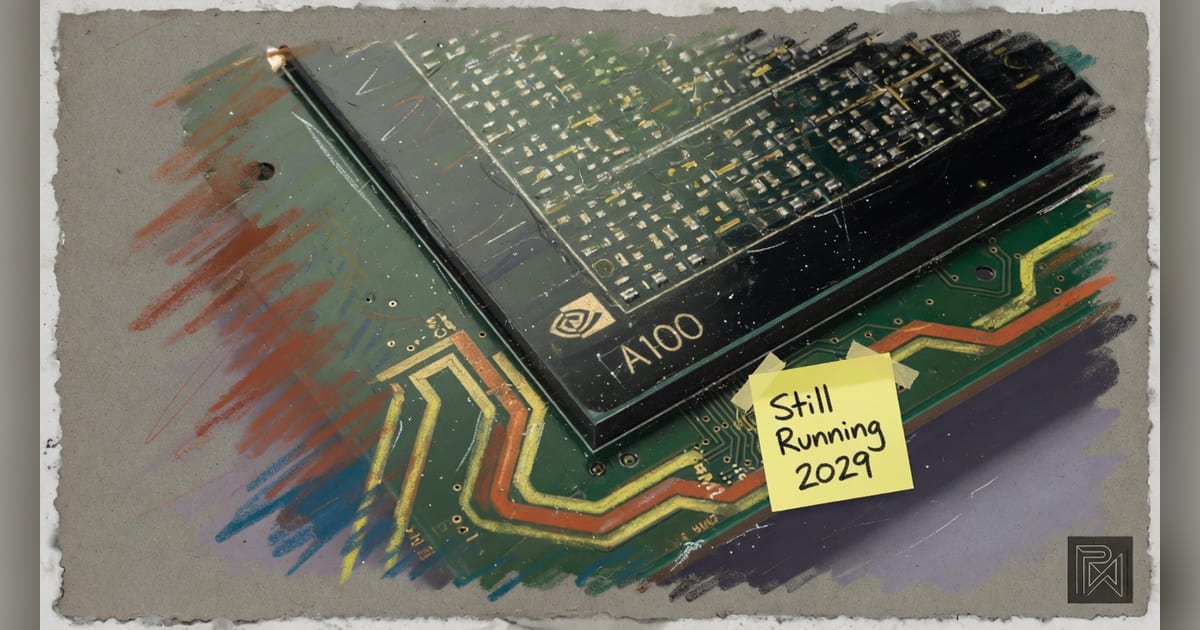
Jensen Huang (@JensenHuang) said on August 13th that Nvidia's A100 fleet can remain "mission-capable" through 2029, amplifying a CoreWeave contract that challenges the assumption that AI accelerators become stranded assets within a few years.
"The mighty A100 fleet are mission-capable from 2020 through 2029," Nvidia's co-founder and CEO wrote in a post on X. Huang credited CUDA with giving developers and Nvidia engineers a common software platform for upgrading systems built on the Ampere, Hopper and Blackwell architectures throughout their operating lives.
The immediate evidence came from CoreWeave. During its August 11th earnings call, the AI cloud provider said it had signed an A100 contract extending into 2029 "at an attractive price." CoreWeave described the deal as an example of older Nvidia infrastructure earning revenue after its original customer contracts expire.
A contract tests GPU depreciation assumptions
Nvidia introduced the A100 on May 14th, 2020 as the first data-center GPU based on its Ampere architecture. A contract running into 2029 would put some of that infrastructure to work as much as nine years after the product's introduction, spanning several generations of faster Nvidia hardware.
CoreWeave has a direct financial reason to emphasize that lifespan. Chief Financial Officer Nitin Agrawal told investors that a typical five-year customer contract requires heavy upfront capital spending, financed through debt, customer prepayments and corporate capital. CoreWeave expects the initial contract to repay the asset-level debt attached to a cluster. Any renewal or resale after that point can add revenue without the original financing burden.
That argument matters because CoreWeave's expansion remains capital intensive. CoreWeave reported $2.575 billion in second-quarter revenue, alongside a $626 million net loss and $640 million in net interest expense. Capital expenditures reached $9.4 billion during the quarter as CoreWeave continued adding data-center capacity.
Longer GPU revenue lives could improve the returns on that spending. Shorter lives would leave CoreWeave replacing expensive hardware while carrying the financing and infrastructure costs associated with its expansion. CoreWeave said its earlier Ampere and Hopper fleets remain largely sold out and that prices for older generations are holding near or above levels seen a year earlier.
The 2029 contract supplies one concrete data point. It does not establish that every A100 cluster will remain fully utilized or economically competitive for the same period. Workload requirements, electricity costs, customer pricing and the performance gains delivered by newer hardware will determine which older systems continue earning revenue.
CUDA is Nvidia's durability argument
Huang's endorsement turns CoreWeave's contract into a broader defense of Nvidia's full-stack model. Nvidia sells accelerators on a rapid release schedule while CUDA gives developers a stable programming layer across generations.
Nvidia's current CUDA architecture matrix lists toolkit and driver support for Ampere as ongoing. The documentation also says the CUDA driver API is backward compatible, allowing newer drivers to run applications compiled with older CUDA toolkits. Nvidia's framework support matrix continues to list the A100 beside Hopper and Blackwell systems in supported configurations.
Software support cannot erase the performance difference between a 2020 A100 and newer accelerators. It can keep the older hardware available for workloads that do not require the fastest training or inference performance. CoreWeave told investors that customers are using prior-generation infrastructure across a wider range of AI workloads, while its newest clusters serve the most demanding jobs.
Nvidia benefits from the same asset-life thesis
Nvidia also has a financial stake in CoreWeave's success. On January 26th, Nvidia invested $2 billion in CoreWeave Class A shares at $87.20 each. The two businesses agreed to deepen their relationship, including deployments of multiple Nvidia generations and the use of Nvidia's balance sheet to help CoreWeave secure land, power and data-center buildings.
Huang's post supports both sides of that relationship. CoreWeave gains validation for the useful life of the assets underpinning its debt-funded cloud. Nvidia reinforces the case that customers are buying a computing platform whose software can preserve older hardware even as Nvidia introduces faster chips.
The A100 contract shows how that model can work in practice. New architectures command the workloads that need maximum performance. Older GPUs can move to inference, enterprise deployments and other jobs where availability and price matter as much as benchmark leadership. Keeping both generations productive allows Nvidia's annual hardware cadence to coexist with infrastructure designed to operate for most of a decade.