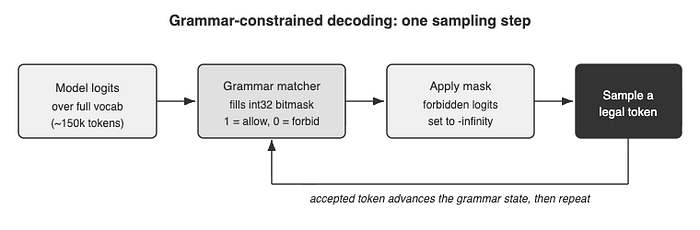
XGrammar uses bitmasking for efficient constrained decoding in AI, ensuring structurally sound outputs. Efficiency over retries brings a new approach.
Imagine a world where AI-generated content is always structurally correct. That's what XGrammar aims to achieve with its innovative approach to constrained decoding. This method ensures that AI doesn't just guess but follows strict rules, producing outputs that fit predefined structures. How does it work? to the mechanics.
The Mechanics of Control #
At the heart of XGrammar's strategy is a simple yet powerful idea: use a bitmask to regulate what the AI model can and can't do. By setting the logits of disallowed tokens to negative infinity, the system effectively blocks AI from making illegal moves in its output. This isn't about teaching the AI right from wrong but about setting boundaries it can't cross.
Visualize this: you're generating a JSON object. The first step is constrained to a single legal token: the opening brace '{'. The rest? Masked out and inaccessible. This hard-coded approach may sound restrictive, but it guarantees that the output will conform to the necessary structure without needing retries or corrections.
Why Efficiency Matters #
Constrained decoding isn't just about structure. It's about efficiency. XGrammar precomputes context-independent tokens, avoiding the computational overhead of checking legality at every step. This contrasts with traditional prompting-based methods, which can bog down systems with repeated corrections. One chart, one takeaway: efficiency trumps trial and error.
Understanding the Limitations #
Of course, there's a catch. This method ensures structural correctness but doesn't guarantee semantic accuracy. It's like ensuring a book is grammatically correct without checking if the plot makes sense. Numbers in context: XGrammar's approach highlights the trade-offs between speed and semantic depth, a choice many will have to weigh.
So, why should you care? If you're in AI development, this method offers a new way to ensure reliability without sacrificing performance. But if you're looking for AI to deliver deep insights, remember: structure isn't everything. Can we really afford to separate form from meaning?
Get AI news in your inbox
Daily digest of what matters in AI.