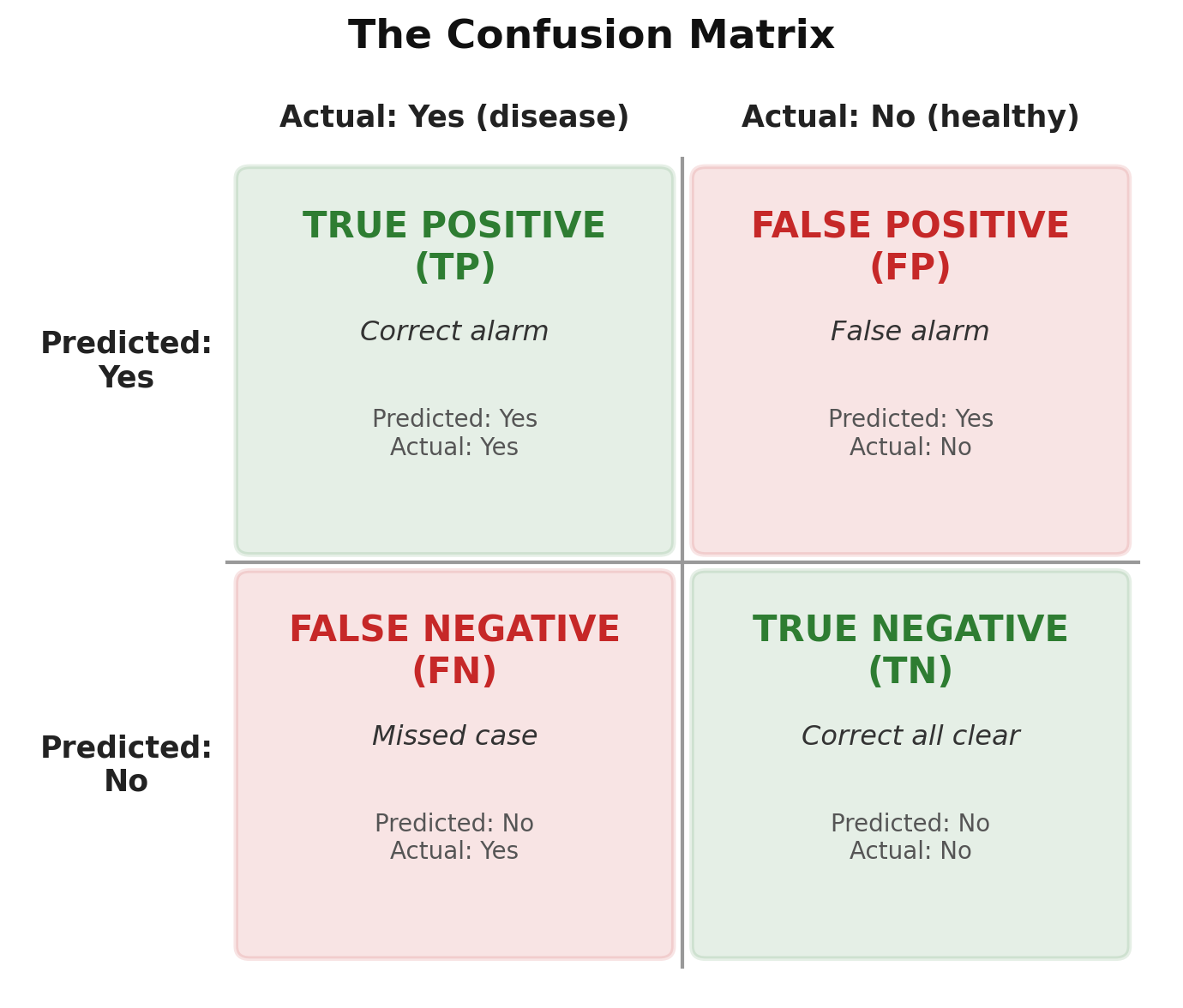
Accuracy is a vanity metric that hides catastrophic failures in imbalanced datasets. If you're building a diagnostic tool where 90% of the population is healthy, a model that simply predicts "healthy" for every single person is 90% accurate, yet it's completely useless because it misses every single sick patient.
If you are doing a deep dive into model evaluation, stop looking at the accuracy percentage. If your precision is 99% but your recall is 10%, your model is essentially a coward—it only predicts "positive" when it is absolutely certain, leaving the majority of actual cases undetected. To actually diagnose if a model is performing, you have to tear apart the confusion matrix. I've been digging into this because I kept seeing "high accuracy" benchmarks for LLM agents that failed miserably in real-world edge cases.
Here is the breakdown of what actually matters:
Precision: Of all the times the model predicted "Positive," how many were actually positive? High precision means fewer false alarms.Recall (Sensitivity): Of all the actual positive cases, how many did the model actually catch? High recall means you aren't missing the target.F1 Score: The harmonic mean of the two. This is the only number I trust when the class distribution is skewed.
If you are doing a deep dive into model evaluation, stop looking at the accuracy percentage. If your precision is 99% but your recall is 10%, your model is essentially a coward—it only predicts "positive" when it is absolutely certain, leaving the majority of actual cases undetected.

For anyone building a practical tutorial or a deployment pipeline for a classifier, I'd suggest calculating these three metrics from scratch to see where the model is actually bleeding.

[Next KV Caching: Why Your LLM Inference Costs are Sky-High →](https://promptcube3.com/en/threads/3236/)
All Replies (3) #
M
Precision-recall curves usually clear this up faster than just looking at the confusion matrix.
0
S
Does using F1-score actually fix this or is that just another way to lie to ourselves?
0
A
Had a fraud model do this once. It looked perfect until we checked the false negatives.
0