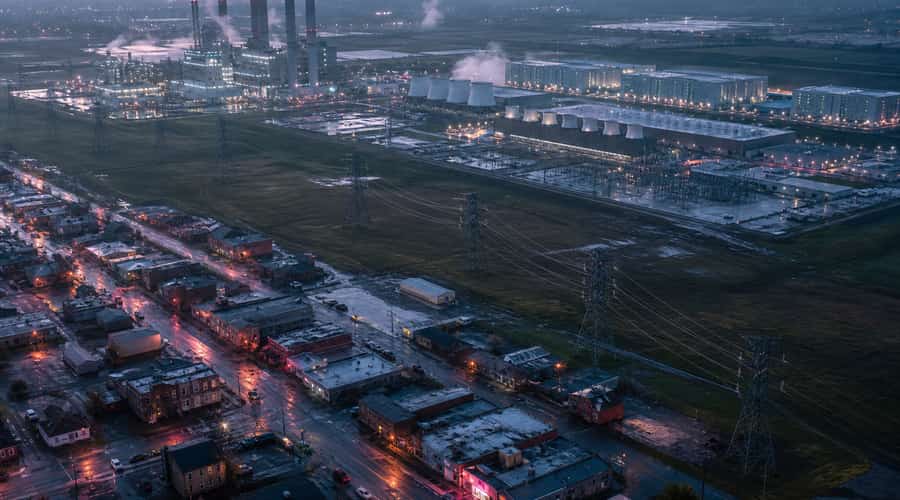
Local moratoriums are spreading faster than Congress can regulate, and the fights over water and power bills are becoming the real check on the AI buildout.
Bernie Sanders and Alexandria Ocasio-Cortez want to stop new AI data centers cold, and the towns hosting them are starting to sound like they agree.
On March 25, Sanders and Ocasio-Cortez introduced the Artificial Intelligence Data Center Moratorium Act, a bill that would halt construction or expansion of any data center drawing 20 megawatts or more until Congress writes rules guaranteeing the buildout won't spike utility bills, harm the environment, or run roughshod over workers. It would also block exports of AI computing hardware to countries without similar safeguards. The bill has almost no chance of clearing the Senate. The Trump administration has made unfettered AI expansion a stated priority, and the industry has the lobbying muscle to match. But Sanders and Ocasio-Cortez aren't inventing a grievance. They're catching up to one. More than 100 local communities have already passed their own data center moratoriums, and a dozen states are working on statewide versions.
In Cheyenne, Wyoming, officials traced a rare bacterium, Cupriavidus gilardii, into the city's reclaimed water system this year, and pinned it on wastewater discharged during construction of Meta's 715,000-square-foot data center campus. The contamination came from Fortis, a contractor handling the fill-and-flush process used to clean and test cooling systems before a facility goes live. It never reached drinking water. It landed in water Cheyenne uses for irrigation, and the city had to shut down its reclamation program to run additional tests. Fortis stopped discharging the wastewater and started hauling it offsite once the city's board of public utilities flagged the substance. Meta says it's working with the contractor to resolve the issue. It's a small, unglamorous story. It's also exactly the kind of thing a moratorium bill is built to point at.
The money story is bigger. Belden Brick Company has been making brick in Sugarcreek, Ohio, for 141 years, and its electricity bill has jumped roughly 90% over the past year. Most of that came from a single line item: a monthly capacity charge that went from about $1,600 to nearly $12,000. Plaskolite, a plastics manufacturer with plants in Ohio and Pennsylvania, watched its annual capacity charges climb from around $200,000 to nearly $1.2 million in the same stretch. Neither company added a machine or hired a shift. What changed was the regional grid. PJM Interconnection, which manages the power market across a swath of the Midwest and Mid-Atlantic, saw its capacity price jump from $28.92 per megawatt-day in 2024 to $329.17 today, a rise of more than 1,000%, driven largely by data center demand. Industrial electricity prices in Pennsylvania were up 31% year over year as of December, and 26% in Ohio, against a 7% national increase for industrial users.
You don't need a moratorium bill to feel that. You just need a factory in the wrong grid zone.
The gas plants are the part regulators haven't priced in yet #
The Environmental Integrity Project counted at least 74 gas-fired power plants now planned specifically to serve data centers, representing 143 gigawatts of new capacity. Run the models, and those plants could emit 662 million tons of greenhouse gases a year, roughly what Australia emits annually, or the equivalent of adding 140 million more cars to American roads. Almost half of the proposed plants are in Texas. Another 20 are clustered in the Ohio River Valley, across Pennsylvania, Ohio, and West Virginia, the same states already absorbing the capacity-price shock. That's the same buildout showing up twice on the same balance sheet, once as a bill and once as a smokestack.
None of this is stopping the capital. Meta is pushing ahead with its $27 billion Hyperion campus in Louisiana. Google is building its $10 billion Project Mica in Missouri. OpenAI, Oracle, and SoftBank are still moving on the roughly $500 billion Stargate program. The hyperscalers have the money and the political tailwind, and Washington under Trump has shown no appetite for slowing them down. But money and political will didn't save Apple and other tech firms from years of grid-capacity fights around Dublin, where Ireland's own data center boom collided with a power grid that couldn't keep up, and new connections got rationed for years. The U.S. has a hundred Cheyennes and a hundred Sugarcreeks, and each one is a place where a moratorium can pass locally even while Sanders and Ocasio-Cortez's bill dies in Washington.
That's the real risk for AI labs and hyperscalers penciling out five-year capex plans. It was never going to be one federal law. It's going to be a thousand small ones, a sewer permit here, a capacity charge there, a county commission vote nobody in San Francisco noticed until the site got rezoned. The industry can outspend Sanders. It's going to have a much harder time outspending Cheyenne's board of public utilities.
Also read: Most Americans now want the government to seize half of AI companies' equity • Starbucks is quietly building the software it used to buy from IBM and Microsoft • Zhipu's co-founder says open AI is safer just as its stock triples in a year