One of the consequences of the AI boom is that cooling servers has become a serious engineering challenge.
The more powerful the AI hardware becomes, the more heat it generates during operation. And at a certain point, simply blowing more air through a server rack stops being a particularly efficient method of cooling.
That’s why when I visited Meta’s AI Infrastructure in Texas, one of the technologies I was most interested in wasn’t actually the AI hardware. It was the plumbing.
The Cooling Shift #
Traditional data centers, that’s data centers used for compute tasks such as searching for your favorite creator on Instagram or liking a post on Facebook, will more often than not use air cooling to keep the hardware at an optimal temperature.
Even a few years ago, using air cooling methods to cool AI hardware was an achievable solution. In fact, I visited a data center in Altoona, Iowa, where racks of 16 Nvidia H100s were kept cool completely through air cooling with minimal water usage. Minimal amounts of water were used at the start of the data center cooling process to cool the air during warmer months, but no water was ever being sent directly to the hardware.
It’s only more recently that newer AI hardware designs have created the demand for a newer, more optimal method of cooling.
Enter closed-loop liquid cooling.
There’s a common misconception that AI data centers are automatically big water users. The reality depends on the cooling design — Meta’s data centers use a closed-loop system that recirculates water in a sealed loop, using very little on an ongoing basis.
The majority of Meta’s newest AI-optimized data centers use closed-looped, liquid cooling as it is the most efficient way to cool GPU servers — both from a resources point of view, but also from an infrastructure point of view.
What Is Closed-Loop Cooling? #
The basic idea behind closed-loop liquid cooling is actually pretty simple.
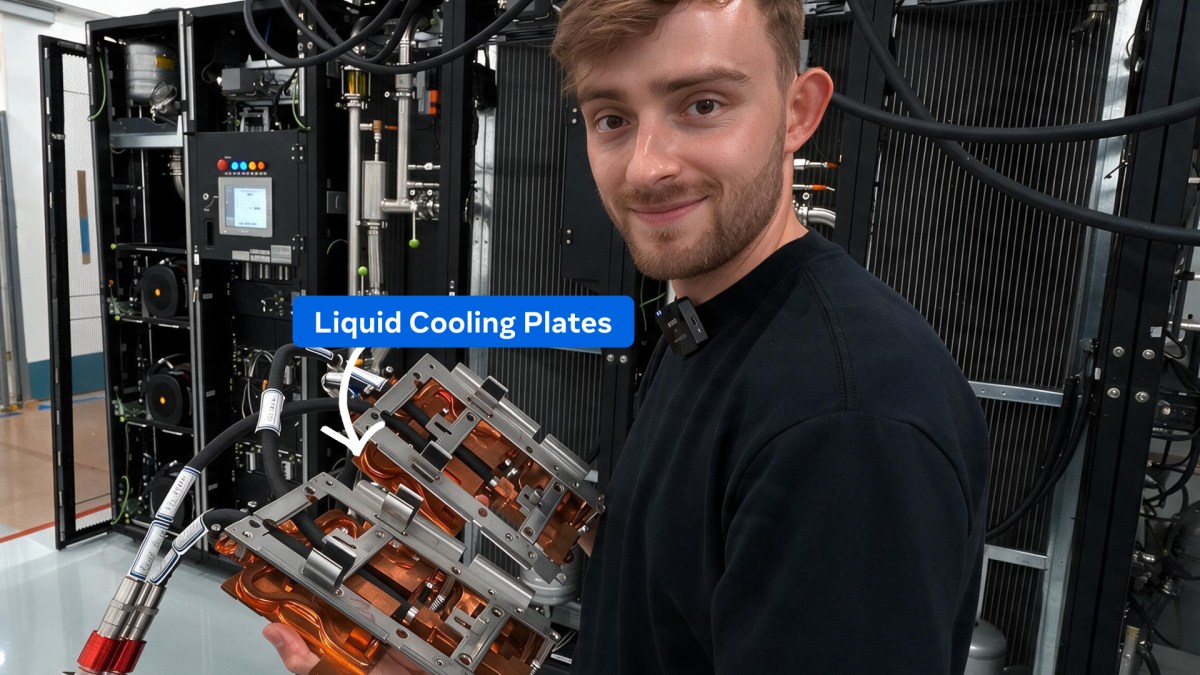
A liquid coolant (a mix of water and glycol) is passed through the server hardware to move heat away from the server racks. But instead of that liquid being expelled from the facility, it is pumped through a series of heat exchangers, which are used to dissipate and transfer the heat away from the liquid. Once the liquid has cooled down, it is sent back around to the server racks in a continuous looping process.
So the same water and glycol mixture is being used over and over again to keep these chips cool. In fact, Meta expects to use these coolants for up to a decade without needing to replace them.
The heat transfer methods can vary depending on the location and environment the data center is in. When Meta needs to place liquid-cooled equipment into facilities that do not have the liquid cooling infrastructure built into the buildings, they utilize a system called Air-Assisted Liquid Cooling. This consists of racks that contain pumps and heat exchangers that essentially act similar to the large building system described above, with the same closed-loop cooling just on a smaller, more distributed scale.
Why is closed-loop liquid cooling the most ideal method? Because it’s resource efficient. In fact, a typical AI-optimised data center using a closed-loop liquid cooling system with dry coolers uses less water annually than a couple of full-service restaurants. When you compare water usage to real use cases, as opposed to numbers, suddenly the low usage is actually really impressive.
Optimizing for Efficiency #
This innovative liquid cooling system isn’t just about saving water, it’s also a much more efficient use of the space inside of the racks and data centers. If you were to attempt to cool these same servers with air, you’d likely need nearly double the size of the server tray in order to add in the required air cooling equipment. That means you have a much bigger tray, but still the same compute capacity, and eventually, you’d reach diminishing returns with larger and larger air-cooled solutions.
With direct-to-chip closed-loop liquid cooling, the engineers can fit many more GPUs in the same sized server rack, resulting in fewer racks required. So a facility of the same size is now able to scale its capacity without needing to take up more space.
Meta’s Open-Source Liquid Cooling Infrastructure #
If you’ve seen any of my video content on Meta’s infrastructure, you’ll know that they design and develop their own systems across their entire infrastructure stack, all the way from designing their own chips to the cooling systems and power infrastructure. So what do they do with these designs once they’ve deployed them?
Consistent with Meta’s Open Compute Project legacy, these advances are being shared with the industry. The Open Compute Project (founded 2011) is an open-source hardware and software initiative that aims to make data center infrastructure more efficient, scalable, and sustainable. In 2025, Meta announced IcePack, a liquid-cooled network rack platform that’s being shared openly for free via the Open Compute Project.
Using AI to Optimize Data Center Cooling #
The Meta Engineering teams are doing a great job of finding the optimal cooling methods for their data centers. But there’s another interesting part to this story: they’re also using reinforcement learning to help optimize their cooling infrastructure.
As we found out in this short article, cooling a data center isn’t as simple as choosing a temperature and leaving the system running. Conditions change. The environment changes depending on the location of the data center. The amount of work the servers are doing changes, and so does the amount of cooling. Therefore, the cooling infrastructure has to be purpose built, flexible, and deployed to address these specific considerations across every location.
So Meta’s engineering team has been experimenting with reinforcement learning to help inform the design and operations of their cooling systems. This reinforcement learning-based approach has since been scaled to the air-cooled data centers in Meta’s fleet.
Rather than experimenting directly on a live data center, where getting that decision wrong could potentially cause issues with operations, Meta’s engineers built a physics-based simulator of a data center environment.
The simulator can model variables such as weather conditions, server load, and the behavior of the cooling equipment. This gives the reinforcement learning model a safe environment in which to test different decisions to learn how to reduce the amount of cooling that is required while still keeping the servers within their optimal operating conditions.
And just to be clear, while this started as an experiment, it isn’t one anymore.
In a pilot at one of Meta’s data centers, this reinforcement learning-based approach reduced the amount of energy consumed by the air cooling supply fans by an average of 20% while also reducing water usage by 4% across different weather conditions.
Those aren’t insignificant numbers, and when you apply those reductions across an entire data center fleet, that’s a really impressive efficiency gain that doesn’t go unnoticed.