- ai-agent
- clef
- decision-models
- reliability
- benchmark
When Cloudflare released Clef on October 1, its launch post carried a table of ten public benchmarks, seven of them led by a Clef model. The Hacker News thread passed 600 points in a day, and one of the first replies was six words long: "Public benchmarks are easy to cheat" (Traictory, Hacker News).
Fair. So we ran the test nobody could have trained for. Construct's agent has about 40 small decisions written for a decision model, and every one of them was written around Jev: the prompts, the questions, and the thresholds, all built against Jev over the last two weeks. That is Jev's home turf. We pointed the same requests at Clef and Clef-flash without changing a line, and scored all three against labelled cases.
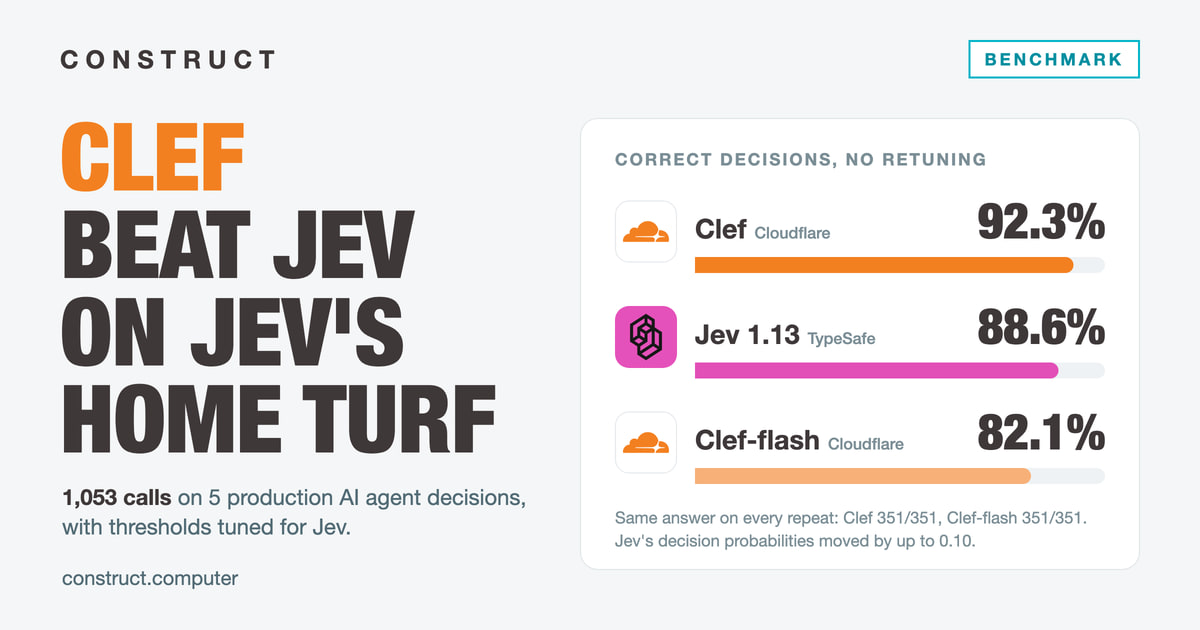
Clef is Cloudflare's open-weight decision model, a drop-in alternative to TypeSafe's Jev. On 117 labelled cases across five of our production decisions, Clef reached the right outcome on 92.3% of calls using thresholds set for Jev, against 88.6% for Jev and 82.1% for Clef-flash. Both Clef models returned the identical probability on every repeated call, and Jev did not.
We build Construct, an AI employee with its own computer. Every number below comes from our own runs on October 4, 2026 (UTC): 117 cases, three calls each, three models, 1,053 calls in the main run, plus about 800 more in follow-up controls. Facts about the models themselves come from Cloudflare's and TypeSafe's documentation, checked the same day. The full method, confidence intervals and per-case results are in the paper: Compatible APIs, Incompatible Thresholds: A Drop-In Replacement Study of Clef and Jev on Decision Specifications from a Production Agent (PDF, 13 pages).
- Accuracy, drop-in: Clef 92.3%, Jev 88.6%, Clef-flash 82.1%, all on thresholds set for Jev. The gap between Clef and Jev is not statistically significant.
- Accuracy, own thresholds: Clef 93.2%, Jev 90.9%, Clef-flash 90.6%, with each threshold chosen on held-out cases.
- Repeatability: Clef and Clef-flash gave the same probability on all 351 calls each. The probability Jev's decisions act on moved by up to 0.10, and 2 cases changed verdict.
- Code changed to swap models: one string.
- Failed calls: 0 of 1,053.
- Cost: $23 per million decisions on Jev, $35 on Clef-flash, $93 on Clef. The main run cost about five cents.
What are Clef and Clef-flash? #
Clef and Clef-flash are decision models from Cloudflare: you send a state and a set of typed questions, and they return a probability for each allowed answer instead of generating text. Clef is a 27 billion parameter model built on Qwen3.8, and Clef-flash is a 9 billion parameter model built on Qwen3.5. Both are released under Apache 2.0 with weights on Hugging Face, both run on Workers AI, and both accept the same request format as Jev (Cloudflare).
If decision models are new to you: they are the fast, cheap judgment calls around a language model. Is this the same person? Does this email need a reply? Should this tool call wait for a human? TypeSafe calls the category System One models, after Kahneman's fast, intuitive System 1. Our first post on Jev explains the idea and how we put one inside an AI agent's memory.
| Jev, Clef and Clef-flash compared, October 2026 | |||
|---|---|---|---|
| Jev 1.13 | Clef | Clef-flash | |
| --- | --- | --- | --- |
| Maker | TypeSafe AI | Cloudflare | Cloudflare |
| Size | Not published | 27B parameters | 9B parameters |
| Weights | Closed | Open, Apache 2.0 | Open, Apache 2.0 |
| Question types | Choice, Score, Noul | Same | Same |
| Input | Text and JSON | Text, JSON and images | Text, JSON and images |
| Context | 64k tokens per request | 64k tokens | 64k tokens |
| Price per million input tokens | $0.042 | $0.24 | $0.09 |
| Output tokens | Free | Free | Free |
| Workers AI model ID | typesafe/jev |
@cf/cloudflare/clef |
@cf/cloudflare/clef-flash |
Two details in that table matter later. Clef reads images, which Jev does not today. And the prices are per input token, so the model that counts fewer tokens for the same request closes some of the gap.
How we benchmarked Clef against Jev #
We did not write a new test for Clef. We took five decisions that already exist in Construct's code and ran each one's real request builder and real interpreter, the same functions production calls.
| The five production decisions in the benchmark | |||
|---|---|---|---|
| Decision | What it decides | Cases | Threshold today |
| --- | --- | --- | --- |
| Entity match | Is this newly mentioned person, project or company one the agent already knows? | 30 | 0.70 |
| Email triage | Newsletter, receipt, spam, request, or keep? | 15 | 0.80 |
| Memory extract gate | Does this conversation hold anything worth remembering? | 24 | 0.05 |
| Notification priority | Does this automation notice deserve a toast, or can it wait? | 24 | 0.85 |
| Tool-call risk | Should this tool call wait for the user's go-ahead? | 24 | 0.80 |
Entity match is live in production. The other four are built and switched off, waiting on shadow data. Their thresholds were set by judgment with Jev in mind and have never been fitted to data, for Jev or anything else.
Swapping the model was the least interesting part of the work. This is the whole change:
// Before
await env.AI.run("typesafe/jev", { state, questions }, options);

// After
await env.AI.run("@cf/cloudflare/clef", { state, questions }, options);
Cloudflare says Clef is "fully Jev-API compatible". On our requests that held: Choice, Score and Noul questions, JSON state, and the response shape all worked unchanged, and all 702 Clef calls returned valid answers.
The rest of the method, briefly:
- Cases: 117, all synthetic, weighted toward the edges of each decision. We drafted and labelled them with an AI assistant (Claude) before any of the three models saw them. No label came from Jev or Clef, and the labels have not yet been independently reviewed by a second person.
- Runs: each case three times per model, one call at a time, models interleaved so they shared the same network conditions, with the gateway cache skipped.
- Scoring: a call is correct when the production interpreter reaches the labelled outcome at the production threshold. We also report each model's best threshold, found on the same cases, which flatters all three equally.
- Route: Cloudflare's REST API through our AI Gateway, from a laptop. Fine for accuracy. Wrong for latency, which gets its own section.
Clef vs Jev accuracy: the results #
With no retuning at all, Clef had the highest score of the three, and the highest or equal-highest on four of the five decisions, on thresholds that were set for a different model.
| Accuracy by decision at the production threshold, with accuracy at each model's own best threshold in brackets | |||
|---|---|---|---|
| Decision | Jev 1.13 | Clef | Clef-flash |
| --- | --- | --- | --- |
| Entity match | 72.2% (82.2%) | 86.7% (93.3%) | 80.0% (86.7%) |
| Email triage | 93.3% (93.3%) | 86.7% (93.3%) | 73.3% (86.7%) |
| Memory extract gate | 100% (100%) | 100% (100%) | 95.8% (100%) |
| Notification priority | 95.8% (100%) | 100% (100%) | 75.0% (100%) |
| Tool-call risk | 87.5% (95.8%) | 87.5% (95.8%) | 83.3% (100%) |
| All five | 88.6% (93.7%) | 92.3% (96.6%) | 82.1% (94.9%) |
The honest size of this result: Clef leads Jev by 3.7 points on 117 cases, with a 95% interval of -1.1 to +8.8 points. That is not statistically significant, and we would not stretch it into "Clef beats Jev". Three of the entity cases are ones our product resolves in code before any model is asked (identical names, and names that differ only in case). Jev did worst on exactly those, and without them the lead shrinks to 2.0 points (92.1% against 90.1%). What we can say is narrower and more useful. Cloudflare's public numbers predicted Clef would be at least as good as Jev on decision tasks, and on private prompts it had never seen, written for its competitor, it was not measurably worse.
Jev deserves its due here too. It won email triage outright, it never made a wrong merge, and it was perfect on the extract gate. This is a close race between two good models.
Is Clef deterministic? #
Yes, on everything we sent it. We called each model three times with the same request for all 117 cases. Clef returned the same probability, to four decimal places, on all 351 calls. So did Clef-flash. To rule out a cache, we sent the same requests again with changes that do not touch the model's input (a unique query string, reformatted JSON, reordered keys): same answers, a cache miss on every response, and a new inference ID each time.
The probability each Jev decision acts on moved between identical calls by up to 0.10, and two cases changed verdict from one call to the next. Across every probability Jev returned, the largest move was 0.16, and 100 of the 117 cases came back with at least one number different. TypeSafe describes Jev as returning "similar answers for similar inputs", which is a promise of consistency, not determinism, and a wobble of this size is consistent. But a decision layer acts when a probability crosses a line, so any wobble means a case near the line is decided by which call you happened to make.
Cloudflare's post explains why Clef behaves differently: the decision step is non-autoregressive, with choices derived directly from the model's internal representations and no text sampled along the way. We can confirm the practical result. For anyone who has debugged an agent that did something different the second time, this is the finding that matters most, more than a few points of accuracy.
Jev's scores moved under the same version name #
This one surprised us. On September 20 we calibrated our live entity matcher on Jev. Real matches scored 0.71 to 0.82, everything else scored 0.34 or less, and we put the merge threshold at 0.70, in the gap.
Two weeks later we asked the same three calibration probes again.
All three now fall under the bar. To be sure this was not a noisy afternoon, we asked each probe 20 more times: none of the 60 calls reached 0.70, and the highest was 0.66. Clef, asked the same 20 times, returned the identical number every time. The served version was jev-1.13.0 both times, so the alarm we built to catch version changes stayed quiet. On this benchmark Jev still never merged two different people, which is the expensive mistake, but it made only 44% of the merges it should have. In production, a missed merge becomes a duplicate.
We do not know why the scores moved. Our first suspect was our own route: we call Jev through Cloudflare's Workers AI, which cannot pin a version. So we repeated everything against TypeSafe's own API with the version pinned to jev-1.13.0. Same result: none of 60 calls reached 0.70, and Jev's answers still varied between identical calls on 104 of 117 cases. The route is not the cause. Three probes are still three probes, and our September baseline is one call each. We are not claiming Jev got worse in general. The lesson is about our own setup: a threshold is only as stable as the model under it, and a version string is not a guarantee. Open weights can change that, if you use them: a model you pin or host yourself cannot move under its thresholds. The hosted Clef alias we tested carries no version either, so we will re-ask these same probes on Clef in two weeks.
Entity matching: where the three models differ most #
Entity matching is the decision where a mistake is permanent. A wrong merge fuses two real people in the agent's memory, so precision matters more than recall. AI agent memory covers what that memory holds and how you can correct it.
- Clef caught the aliases this decision exists for: "Jose Garcia Marquez" against the accented spelling at 0.98, "Stripe, Inc." against "Stripe" at 0.98, "I.B.M." against "IBM" at 0.99. Its one wrong merge was "Acme" into a lone "Acme Corporation" at 0.78, a case reasonable people would argue about.
- At a 0.80 threshold, Clef made 10 of 15 correct merges and no wrong ones. That is our starting point for shadow mode, not a recommendation: it was picked on these same 30 cases, and "Acme" against "Acme Corporation" sits at 0.78, just under it.
- Jev is not worse at telling people apart. Drop its threshold to 0.50 and it makes 64% of the correct merges, still with no wrong ones, close to Clef's 67% at 0.80. Its problem at 0.70 is that its scores moved, not that it lost the ability to rank the pairs.
- Clef-flash is quick to say yes. It matched "Acme Labs Europe" to "Acme Labs" at 0.76 and the bare concept "pricing" to "pricing model" at 0.89. For a merge, that is too eager. For a gate that only skips work, it is fine.
- All three refused a one-letter surname typo, "Mendelsohn" against "Mendelson". Good. Those can be two people.
Thresholds do not transfer between decision models #
If you take one thing from this post into your own migration, take this. A threshold is a property of a model and a prompt together. Move the model and the threshold is wrong, even when the new model is better.
The three models are not far apart in ability. Asked to rank our cases from "should act" to "should not", all three do it well: on the four decisions we could measure this way, the ranking score (AUROC) is 0.93 or higher for every model and a perfect 1.00 on two decisions. What differs is the number each model attaches to the same judgment.
| The most accurate threshold per model on two decisions, against the configured threshold | ||||
|---|---|---|---|---|
| Decision | Configured | Jev's best | Clef's best | Clef-flash's best |
| --- | --- | --- | --- | --- |
| Tool-call risk | 0.80 | 0.49 | 0.22 | 0.31 |
| Notification priority | 0.85 | 0.60 | 0.85 | 0.61 |
Clef-flash shows the effect best. On Jev's thresholds it scored 82.1%. With thresholds chosen for it on held-out cases it scored 90.6%, level with Jev's 90.9% on the same footing, and Clef stayed ahead at 93.2%. The 9B model was never bad at these decisions. It was being read with another model's ruler.
The thresholds in the table were found on the same cases they are scored on, which is why the bracketed figures in the results table (96.6%, 94.9%, 93.7%) run higher than the held-out ones. Treat them as a direction and not as settings. The practical rule is simple: swap the model in shadow, log probabilities for a week, and set the threshold from that.
How fast is Clef? What we could and could not measure #
Cloudflare reports a median of 209 ms for Clef and 38.8 ms for Clef-flash, against 524 ms for Jev. We are not going to confirm or dispute those numbers, because our harness was the wrong instrument.
We called all three models through Cloudflare's REST API from a laptop. The fastest call we saw for any model was 340 ms, and for every model the floor sat between 340 and 384 ms. That floor is the path: authentication, the public API, the gateway, and the round trip. You cannot see a 38 ms model through a 340 ms window.
| Latency per call through the REST API from a laptop, 351 calls per model. Not a production measurement. | |||
|---|---|---|---|
| Jev 1.13 | Clef | Clef-flash | |
| --- | --- | --- | --- |
| Fastest call | 384 ms | 352 ms | 340 ms |
| Median | 454 ms | 654 ms | 449 ms |
| 95th percentile | 591 ms | 1,262 ms | 1,024 ms |
For transparency, those are the raw numbers. On this path Clef-flash matched Jev at the median, Clef was slower, and both Clef models had longer tails, three days after launch. None of that tells you what a Worker sees when it calls the model through the AI binding, next to the GPU, which is how we call it in production. That measurement is next, and we will publish it here.
What does Clef cost compared with Jev? #
Clef's list price is 5.7 times Jev's, which is the first thing the Hacker News thread did arithmetic on. Two things soften that.
First, Clef counted 28% fewer tokens than Jev for the same request: 387 per call against 541. Per decision, the gap is about 4 times, not 5.7.
Second, look at the unit. A million Clef decisions cost $93. All 1,053 calls in this benchmark cost about five cents. An agent that makes a thousand decisions a day spends about nine cents a day on Clef and two on Jev, next to a language model bill many times that. If you run billions of decisions a day, price it carefully, and look at Clef-flash at $35 per million. For everyone else, accuracy and repeatability are worth more than the difference.
Clef vs Jev: which decision model should you use? #
| Which decision model fits which job, based on our benchmark and each vendor's documentation | ||
|---|---|---|
| If you need | Pick | Why |
| --- | --- | --- |
| The best accuracy without retuning | Clef | Highest drop-in accuracy on our decisions, 92.3% |
| The same answer every time | Clef or Clef-flash | Identical probabilities on every repeated call |
| To pin a version, self-host, or fine-tune | Clef or Clef-flash | Open weights under Apache 2.0 |
| To classify images | Clef or Clef-flash | Both have a vision encoder; Jev is text only |
| The lowest price per token | Jev | $0.042 per million input tokens |
| Zero wrong merges at your current thresholds | Jev | 100% precision on entity matching, at the cost of recall |
| A high-volume gate that only skips work | Clef-flash, with its own thresholds | 90.6% once retuned on held-out cases, at about a third of Clef's price |
| Anything that merges, deletes or sends | Clef, at a high threshold | Clef-flash was too eager on lookalike names |
The broader field is moving fast. Besides Jev and Clef there are open decision models such as Laya, Kev and OpenDecider, and Cloudflare's own table includes several of them. We have only tested the three in this post.
What we are switching, and why Cloudflare makes it easy #
Construct already runs on Cloudflare: Workers, Durable Objects, AI Gateway, and Workers AI for the small models. How our agents get computers we mostly do not pay for describes that stack. So Clef is not a new vendor for us. It is a new model ID on a binding we already call.
- Entity matching goes to Clef in shadow first, starting at 0.80. Jev keeps deciding while Clef's answers are recorded beside it. The threshold we ship will come from that data, and we switch only if real traffic agrees with this benchmark.
- Background decisions default to Clef, each with its own threshold measured in shadow.
- Interactive decisions wait for the latency test. If Clef-flash is as fast from a Worker as Cloudflare reports, it is the natural fit for anything a person is waiting on.
- Clef-flash stays away from anything that merges or deletes until it has its own thresholds.
There is a quieter benefit. In our Jev post we said that decisions which read your conversations or email "wait for the paperwork", because sending that text to another provider is a privacy decision. A first-party Cloudflare model keeps that text on the platform that already runs the rest of Construct, which removes the main reason most of our decisions are still switched off.
We are also watching Cloudflare's new fine-tuning work, which it calls Reinforcement Learning for Calibrated Decisions. Our decision layer already records the label, the probability and what the product did for every decision, with no user text. That is close to the dataset such a system wants.
Read next
We put Jev inside our AI employee
How to try Clef #
- On Workers AI: call
@cf/cloudflare/clefor@cf/cloudflare/clef-flashthrough the AI binding or the REST API. The request is astateplus a map ofquestions, the same as Jev. - Coming from Jev: change the model ID and keep everything else. Then re-measure every threshold.
- Self-hosted: the weights are at
Cloudflare/clefandCloudflare/clef-flashon Hugging Face under Apache 2.0. - Read the probabilities, not the
confidencefield. It means different things on Clef and Jev, and on Jev it changed meaning between our September and October runs. Readprobabilitiesand both models behave the same. - Pace a REST benchmark. Cloudflare's REST API throttled our token at roughly 90 calls a minute. The Workers binding is the route for real traffic.
A minimal request:
curl https://api.cloudflare.com/client/v4/accounts/$ACCOUNT_ID/ai/run \
  -H "Authorization: Bearer $API_TOKEN" \
  -d '{
    "model": "@cf/cloudflare/clef",
    "input": {
      "state": { "entity": { "type": "person", "name": "Dr. Priya Shah" } },
      "questions": {
        "match": {
          "type": "choice",
          "instructions": "Which candidate is the same entity?",
          "criteria": {
            "node-priya": "Priya Shah (person)",
            "none": "No candidate is clearly the same entity"
          }
        }
      }
    }
  }'
What this benchmark does not show #
- It is small. 117 cases, 15 to 30 per decision. A 3.7 point lead at that size is suggestive.
- It is synthetic. The cases are written to cover each decision's edges. Production traffic is mostly the easy middle, so real accuracy for all three models is probably higher.
- The labels are ours, drafted with an AI assistant. No second person has checked them yet. A few are judgment calls, like whether "Acme" should merge into the only "Acme Corporation" in memory. We said no. Dropping the five most arguable ones does not change the order.
- Thresholds are tuned on small sets. The held-out figures are the fair ones, and they are still noisy at 15 to 30 cases per decision.
- Latency is unmeasured. See above.
- One day. Everything ran on October 4, through Cloudflare, with Jev repeated on TypeSafe's own API. Clef was three days old. Jev's scores moved in two weeks. Either could look different next month, which is the argument for running your own cases on a schedule.
The paper has the statistics behind each of these, the five cases no model got right, and every case where any model slipped. The cases, labels and every call are published as JSON beside it: Compatible APIs, Incompatible Thresholds: A Drop-In Replacement Study of Clef and Jev on Decision Specifications from a Production Agent.
Cloudflare published benchmarks, and people on the internet said benchmarks are easy to cheat. The fix for that is boring: write down your own cases, label them, and run every new model through them. Ours took an afternoon and a few cents, and it told us more about our own system than any leaderboard could.
Where Construct fits #
Construct is an AI employee with its own computer: a workspace filesystem, long-term memory, a schedule, email, and workflows you can read before you run them. Decision models make the small calls around the edges, such as whether a person your agent just read about is one it already knows. Planning and writing run on general-purpose language models.
Two boundaries, stated plainly. As of this post, Jev still makes the live entity-matching decision and Clef has only run in this benchmark; this page will say when that changes. And the other four decisions in this benchmark are built but switched off in production until shadow data supports them.
If decision models are new to you, start with we put Jev inside our AI employee. For why small, repeatable judgments matter so much in long tasks, read your agent has a half-life. And if the category itself is new, begin with what is an AI employee.
Frequently asked questions #
- What is Clef?
- Clef is an open-weight decision model from Cloudflare, released on October 1, 2026 with a smaller sibling, Clef-flash. You send a state and typed questions, and it returns a probability for each allowed answer instead of generating text. Clef has 27 billion parameters, Clef-flash has 9 billion, both are Apache 2.0, both run on Workers AI, and both accept the same request format as TypeSafe's Jev.
- Is Clef better than Jev?
- On Construct's benchmark of 117 labelled cases across five production AI agent decisions, Clef reached the right outcome on 92.3% of calls using thresholds set for Jev, against 88.6% for Jev and 82.1% for Clef-flash. With each model's own thresholds, chosen on held-out cases, the scores were 93.2%, 90.9% and 90.6%. Clef's lead over Jev is 3.7 points on a small synthetic set and is not statistically significant, so it is not a general verdict. Jev won email triage and made no wrong merges.
- Is Clef compatible with the Jev API?
- Yes, in Construct's test. The same requests written for Jev, with Choice, Score and Noul questions and JSON state, ran on Clef and Clef-flash after changing only the model ID to @cf/cloudflare/clef or @cf/cloudflare/clef-flash. All 702 Clef calls returned valid answers. One difference: Clef's confidence field is not the winning label's probability, so read the probabilities map.
- Is Clef deterministic?
- In Construct's test, yes. Each of 117 cases was sent three times, and Clef and Clef-flash returned the identical probability on every repeat. The probability Jev's decisions act on moved by up to 0.10 between identical calls, and two cases changed verdict. Cloudflare attributes this to a non-autoregressive decision step that samples no text.
- How much does Clef cost compared with Jev?
- List prices per million input tokens are $0.24 for Clef, $0.09 for Clef-flash and $0.042 for Jev, with output free on all three. Clef counted 28% fewer tokens than Jev for the same requests in Construct's test, so a million decisions cost about $93 on Clef, $35 on Clef-flash and $23 on Jev.
- Do Jev thresholds work on Clef?
- Not reliably. In Construct's test the most accurate threshold for a tool-call risk decision was 0.49 on Jev, 0.22 on Clef and 0.31 on Clef-flash, against 0.80 in production. Clef-flash scored 82.1% on Jev's thresholds and 90.6% with thresholds chosen for it on held-out cases. Swap the model in shadow, log probabilities, and set each threshold again.
- How fast is Clef?
- Cloudflare reports a median of 209 ms for Clef and 38.8 ms for Clef-flash, against 524 ms for Jev. Construct's benchmark could not confirm or dispute that, because it called the models through Cloudflare's REST API from a laptop, a path with a floor of about 340 ms for every model. On that path the medians were 654 ms for Clef, 449 ms for Clef-flash and 454 ms for Jev.
- When should you use Clef-flash instead of Clef?
- Use Clef-flash for high-volume gates that only skip or lower something, with thresholds measured for it. In Construct's test it reached 90.6% with its own thresholds, level with Jev, at about a third of Clef's price. Use Clef, at a high threshold, for anything that merges, deletes or sends, because Clef-flash was too eager on lookalike names.
Keep reading #
We put Jev inside our AI employeeWe shipped TypeSafe's Jev into our AI employee's memory five days after launch: measured latency, how we set a 0.7 threshold, where Jev fails, and what it costs.
Nobody merges an emailAgents made work cheap to produce and no cheaper to check. Why software absorbed the flood, why the rest of the business did not, and the five things that make agent work checkable.
Your agent has a half-lifeWhy AI agents keep failing on long multi-step jobs: a 95% reliable agent finishes 48 steps 8.5% of the time. The fix is a resumable run, not a better model.
What is an AI agent with its own computer?An AI agent with its own computer keeps working in a cloud workspace after you close your laptop. How it works, the risks, and who offers one, from $9 a month.
- ai-agent
- always-on-agent
- ai-employee
- product