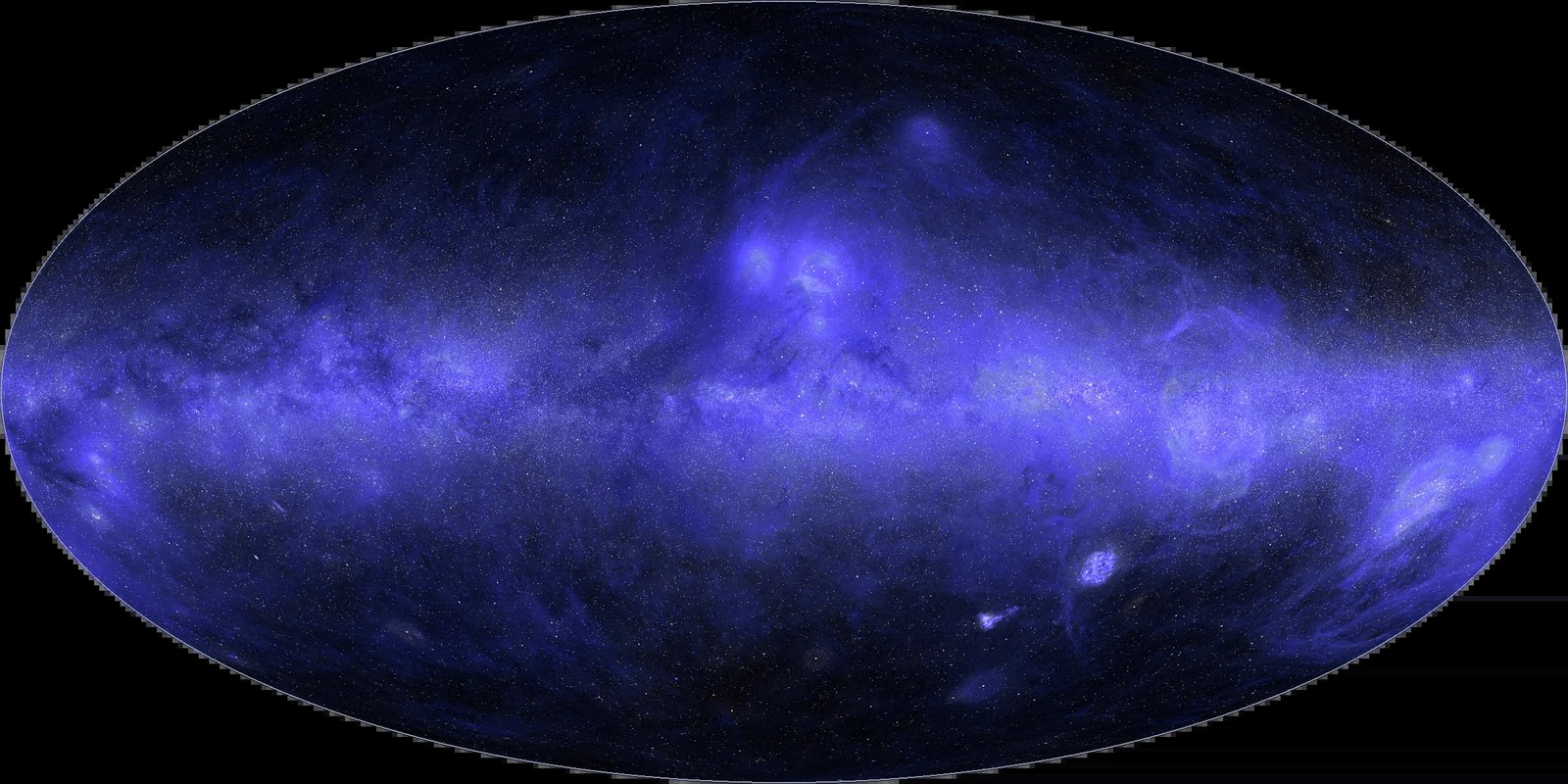
The full ultraviolet sky map made with Claude Science, with the centre of the Milky Way in the middle. About a third of it is predicted rather than measured. Image: Brice Ménard / Anthropic
An astrophysicist has used Anthropic’s Claude Science to stitch together what Anthropic calls the first complete map of the whole sky in ultraviolet light, filling the third of the sky no UV telescope has ever observed with predictions made by Claude. Brice Ménard, of Johns Hopkins University, described the project in a post Anthropic published on October 8.
Ménard is also a researcher at Anthropic, so this is the company showcasing its own product through one of its own people. The map has not been through peer review, and the accuracy figures below are Ménard’s own.
Why the ultraviolet sky had holes #
The ozone layer absorbs UV light, so the only way to see the sky at these wavelengths is from space. NASA’s GALEX mission imaged about two-thirds of the sky between 2003 and 2013 in some 38,000 observations, but it deliberately avoided very bright stars, including much of the plane of the Milky Way, to protect its detectors. Data from NASA’s Swift and South Korea’s FIMS/SPEAR filled in some gaps, not all of them.
Ménard, who teaches astrophysics, says he had long had to apologise to students when showing them the UV sky:
The only UV map I could show was full of holes.
Brice Ménard, Johns Hopkins University and Anthropic
Filling those holes properly takes weeks of pixel-level calibration, he writes, the kind of useful but low-priority job that most fields leave on the shelf.
How Claude built the map #
Over the summer, Ménard gave Claude Science, the research workbench Anthropic launched in June, a simple brief: gather every public UV dataset, put them on a common scale, merge them and fill in every unobserved patch. Claude split the work across a team of AI agents, which found and downloaded the surveys, removed glare from bright stars and cross-calibrated data from different telescopes onto one coordinate grid.
To fill the gaps, Claude learned how UV brightness relates to the same patches of sky seen in visible, infrared and radio light, then applied that relationship where no UV data exists, with an uncertainty estimate for each point. In tests where known areas were hidden and then predicted, Ménard says the model came within about 10% of the real measurements. Claude then added UV light from more than 100 million stars, estimated from the European Space Agency’s Gaia satellite.
The finished map, published on Ménard’s Johns Hopkins page, includes layers that mark each pixel as measured or predicted.
“Claude did not get everything right on the first try” #
One evening Ménard spotted faint circles in the dimmest areas: the footprints of individual GALEX images, each carrying a slightly different glow from Earth’s atmosphere. Claude had listed this as a known issue at the start, yet the map passed two rounds of review by other agents without it being caught. Once told, the agents traced the cause and corrected all 38,000 observations in a couple of hours.
The map went through more than a dozen versions over several days. Ménard would plan the next steps with Claude, then leave it to run hours of computation while he got on with other work:
For once, I was able to pursue a project like this without sacrificing time I would otherwise have devoted to research. Brice Ménard, astrophysicist
It is the latest in a run of science showcases for Claude, after Claude Science set a particle physics record at nine loops and a Harvard physicist wrote 36 papers with Claude in three months while warning that it “loves to declare victory”. The missed GALEX circles are a reminder of the same point: the agents’ own checks were not enough without a human looking at the result.
Why it matters #
This is not a discovery, and a third of the map is a prediction rather than an observation. But it shows AI agents taking on the slow data-wrangling work that science rarely makes time for, and doing it in days under expert supervision. How well the predicted regions hold up will only be clear once astronomers outside Anthropic put the map to use.
Sources: Anthropic: The missing map of the sky (Brice Ménard); Brice Ménard, UV sky map (Johns Hopkins University); Anthropic: Claude Science.