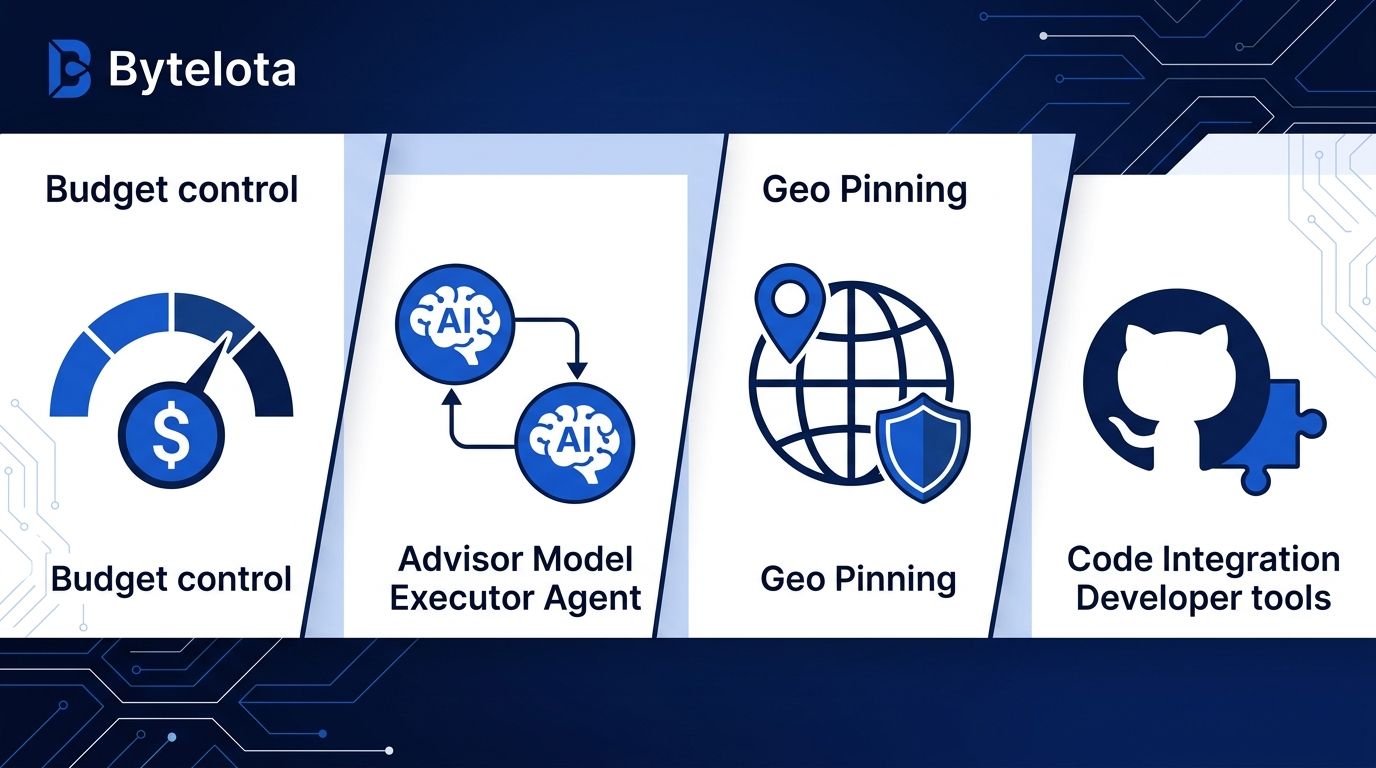
Gartner says 40% of enterprise agentic projects will get killed by 2027. The cited reason is not model quality — it is governance: runaway costs, no region control, and fragile skill infrastructure. On August 7, Anthropic shipped four new controls for Claude Managed Agents that directly target this problem. If you are running agents in production, all four are worth reading before your next deploy.
Session Budgets: Hard Caps That Actually Work #
The most important addition is session budgets. You can now pass an optional budget
field when creating a session — a hard ceiling on that session’s total spend, priced at public list rates. The platform tracks usage.list_cost
as the session runs and stops issuing new model requests the moment that number crosses your budget.
The stop reason is budget_reached
, and this is where the implementation gets interesting: the session s rather than terminates. The in-flight request finishes (so the final cost may edge slightly past your cap), but agent state is preserved. Change or remove the budget and the session resumes where it left off. That is the right behavior. Killing agent state on a cost threshold would be destructive; pausing and allowing a human or an orchestrator to decide what to do next is correct.
Deployments work the same way — set a budget once on the deployment and every session it starts inherits that cap automatically. This matters for teams running agents at scale who want consistent guardrails across hundreds of sessions without per-session configuration.
The need for this feature is not hypothetical. Documented incidents in 2026 include a $1.3 million API bill in 30 days from uncapped agent loops, one enterprise spending $500 million in a single month with no usage controls, and Microsoft citing runaway token bills when it pulled Claude Code licenses for much of its internal workforce. Hard caps are table stakes for production deployment. Read the session budget cookbook for the full implementation pattern.
Advisor Models: Opus Quality at Sonnet Prices #
The advisor model pattern is the most architecturally interesting addition in this update. You configure a smarter model as an advisor in the agent’s multiagent roster — it must be at least as capable as the executor — and the primary thread can consult it mid-turn for strategic guidance. Planning, getting unstuck, reviewing output before finishing a task.
The practical result: your executor does the mechanical work at executor-model rates, and you pay Opus rates only for the planning turns. Configure it with a max_tokens
cap on each advisor call (new in this August release) and you also control latency, since long advisor responses slow the overall loop. The advisor tool documentation has the full roster configuration.
The concrete pattern: a coding agent running on Sonnet 5 for routine edits, consulting Opus 5 only when it needs to plan a refactor or review its own work. That is roughly the same quality signal with a fraction of the full-Opus token bill.
GitHub-Hosted Skills: Drop the Skill Endpoint Server #
Previously, Claude Managed Agents skills required hosted endpoints — custom infrastructure you built and maintained. GitHub-hosted skills remove that requirement. Mount a repository using the github_repository
resource (URL, mount path, auth token), and the platform automatically scans the repo’s root .claude/skills/
directory at session start. Every skill folder it finds there becomes available to the agent without additional configuration.
Skills are discovered once per session from the repo state at checkout — immutable within a running session, which is good for reproducibility. The agent reads each skill’s SKILL.md
plus any scripts it ships. What this unlocks in practice: your skill library lives in version-controlled GitHub repos, shareable across teams, updated through standard pull requests, with no hosting overhead. See the skills documentation for the full resource configuration.
Inference Geo Pinning: Region Control, With a Caveat #
You can now pin where model inference runs for a Claude Managed Agents agent. Set inference_geo
in the agent’s model object at creation time, with a per-session override available. Current options are "us"
and "global"
.
One clarification worth making: inference geo and workspace geo are separate controls. Workspace geo (set in the Claude Console at the workspace level) controls where your data is stored at rest and where endpoint processing runs. Inference geo controls only where model computation happens. Configure both independently.
The honest caveat: if your team has strict GDPR requirements and needs inference to stay in the EU, the direct Anthropic API does not yet have a dedicated EU region. You will still need to route through AWS Bedrock EU profiles or Vertex AI EU regional endpoints for that use case. Geo pinning solves the US-constrained and global routing cases well; the EU gap is real.
What This Means for Production Builders #
These four features represent Anthropic acknowledging that simplicity alone does not sell to enterprises. Session budgets, advisor patterns, versioned skill stores, and compute region control are standard governance expectations in any production workload — they just did not exist for Claude Managed Agents until now.
What is still missing: EU-specific inference geo, native webhooks on budget_reached
(you currently need to poll), per-agent budget aggregation across sessions, and an observability dashboard for multi-session spend tracking. The governance layer is now present; the observability layer is catching up.