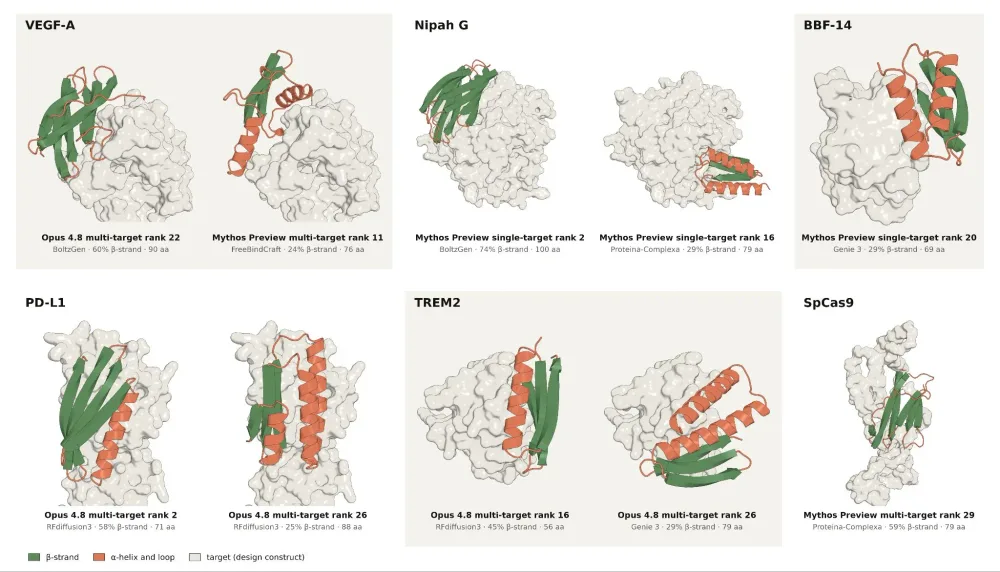
Claudedesigned functional binders for 14 of 15 targets — validated by Adaptyv Bio and Twist Bioscience, not internal benchmarks — is the kind of result that forces a rethink of where LLM-driven protein engineering actually sits right now. Most published de novo pipelines using RFdiffusion or Chroma report single-digit to low-teens success rates per design round. A 93 percent hit rate, if the denominator and affinity thresholds hold up, isn't incremental. It's a category shift.
What the benchmark actually tells us #
The human expert wrote the prompt. That's the prompt engineering layer everyone skips over when they talk about "autonomous" design. Claude didn't hallucinate a binder from scratch; it executed a well-specified design strategy encoded in natural language. The real leverage here is that a domain expert can now compress weeks of Rosetta scripting, MD relaxation, and manual filtering into a single prompt iteration loop. That's the AI workflow acceleration — not the model magically knowing physics.
Adaptyv and Twist doing the wet-lab validation is the critical piece. Self-reported metrics in this space have been unreliable for years. Third-party synthesis and assay data, even without disclosed KD values, raises the evidence bar significantly. Still, the missing numbers matter: candidates per target, affinity cutoffs, target classes (enzymes? PPIs? allosteric sites?), and whether any designs failed expression or solubility screens. Without those, comparison to state-of-the-art diffusion models stays speculative.
Where the bottleneck moves next #
If this reproduces, the constraint shifts from design to functional validation. High-throughput synthesis and binding assays are already scalable. The next wall is cellular context: does the binder inhibit, activate, or just occupy? Does it fold in vivo? Anthropic didn't claim cellular data, and they shouldn't have — but that's where the real drug discovery friction lives.
What I'm watching #
- A technical report with target identities, candidate counts per target, and affinity distributions
- Independent labs replicating the prompt strategy on held-out target sets
- Whether the same prompt template generalizes across target classes or overfits the test set
The prompt itself — if Anthropic releases it — becomes a more valuable artifact than any single binder sequence. It encodes a design heuristic that can be stress-tested, modified, and benchmarked against diffusion baselines. That's the real open science contribution here.
Next Reasoning prefills might be a sign of benchmark distillation →