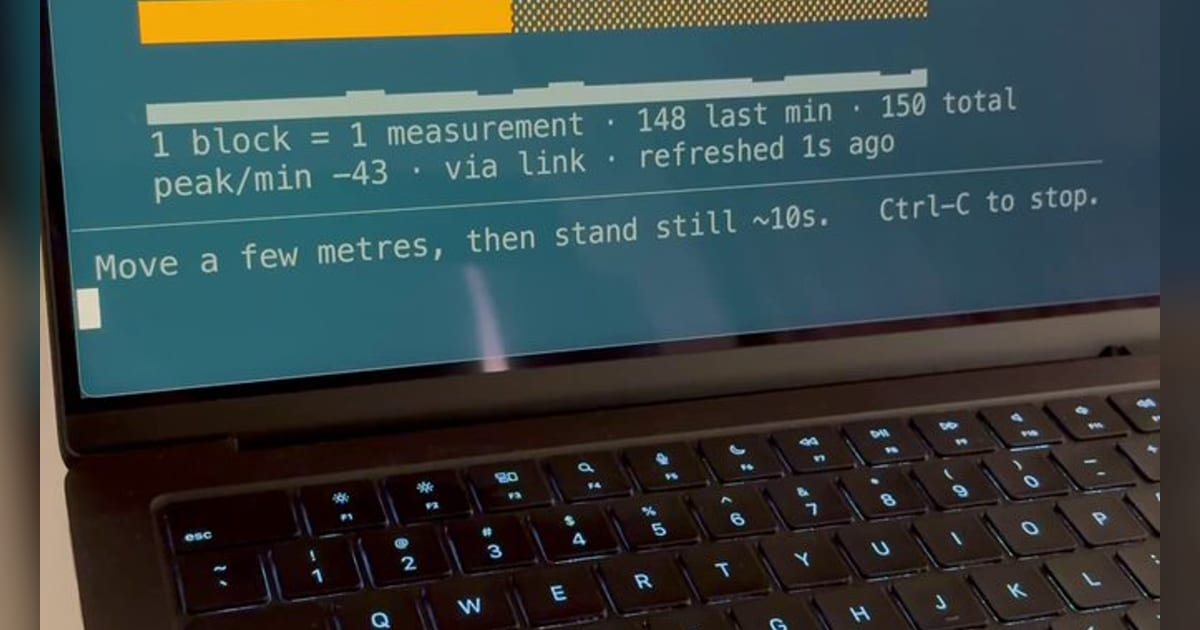
Ben Zhang (@un1c0rnioz), a robotics engineer at 1X, used Claude to build a Bluetooth signal meter after losing his phone in an office where mobile device management had disabled Apple's Find My service. Zhang said the meter took about a minute to generate and led him to the missing device as he walked around watching the signal strengthen. (site.twstalker.com)
https://x.com/un1c0rnioz/status/2084686552299634805 Zhang described the search in an August 4th thread on X, four days after publishing the first release of findphone, the open-source macOS utility that grew from the experiment. His public GitHub profile says he builds robots at 1X and previously interned at Tesla, Apple and several other technology companies. (site.twstalker.com)
The dates and commit history add detail to the viral one-minute account. The first meter appears to have solved Zhang's immediate problem. The version he released for other people received a further round of engineering: GitHub shows 13 commits beginning on July 31st and continuing through August 1st, with every visible commit listing Zhang and a Claude account as co-authors. The later changes added a universal macOS build, privacy redaction, stricter command handling, a redesigned display and proximity sounds. (github.com)
That progression captures the practical divide in AI-generated software. Claude produced enough code to answer a specific, time-sensitive need, while turning that code into a reusable utility required packaging, testing assumptions and handling cases that did not matter during the original office search.
Zhang called the result "JIT software," borrowing the just-in-time label for code created at the moment a user encounters a problem. The description is precise here: he did not search for and install a general-purpose device-tracking product. He asked an AI system for a way to exploit hardware already available in his laptop and phone, then ran the generated tool long enough to recover the device. (site.twstalker.com)
How the phone finder works
Findphone is a dependency-free Swift command-line program for macOS 13 or later. Its main display converts Bluetooth received signal strength, measured in negative dBm, into a proximity bar. A reading moving closer to zero generally means the target is nearer. Zhang's documentation tells users to follow the trend while moving rather than treating any individual reading as a reliable distance measurement. Walls, metal furniture and human bodies can all weaken the signal. (t.co)
The program combines three sources of signal data. A Bluetooth Low Energy connection can provide a fresh reading roughly three times per second. Passive Bluetooth advertisements offer another source, though Apple devices rotate advertising addresses and only transmit names intermittently. For paired devices, the program can also read classic Bluetooth signal data exposed by macOS, although Zhang found that the operating system may cache those readings for several seconds. (t.co)
Zhang clarified in a reply that the missing phone had already been paired with his computer. That condition matters because findphone is a short-range recovery tool rather than a replacement for Apple's device network. It cannot make a phone ring, calculate a direction or locate hardware beyond Bluetooth range. The repository estimates an indoor range of roughly 10 to 20 meters, with less reach through walls. (site.twstalker.com)
The released version also addresses a privacy issue created by scanning an office full of devices. Its redaction mode masks Bluetooth addresses and replaces names in survey mode. The documentation warns that some public Bluetooth addresses are stable hardware identifiers, making them unsuitable for inclusion in screen recordings. (t.co)
The MDM restriction is built into Apple's controls
Apple's device-management framework allows an administrator to disable Find My Device on managed hardware. Apple's documentation lists an allowFindMyDevice
restriction that, when set to false, prevents use of Find My Device in the Find My app. The control is available on iOS, iPadOS and macOS, confirming the constraint Zhang described. (developer.apple.com)
The result was a narrow workaround rather than a bypass of that policy. Findphone did not restore Find My, access Apple's location network or defeat the management profile. It read a nearby Bluetooth signal that remained available and presented the measurements in a form Zhang could use while searching the room.
That narrowness is the point of the experiment. AI coding tools can make disposable software economical for problems too specific to support a conventional product. Zhang's public release also shows the work that begins when disposable code becomes software other people are expected to download and trust. The minute-long generation produced the answer. The following commits produced the product.