We’ve got some good news to start the month: Claude Fable 5.1 is live, and it’s already available for everybody to use in Kilo. You can use it in JetBrains, you can use it in VS Code, you can use it in the Kilo CLI. You can use it wherever you work.
When Fable 5 launched, we called it “remarkably powerful and autonomous, but it ain’t cheap.” Fable 5.1 doesn’t abandon the heavyweight category. It makes a stronger case for when to use it. But they’ve made an effort to improve cost by both lowering cache read rates and making several improvements to the kind of deep-thinking work the model does at higher effort levels.
The pitch is straightforward: better performance on difficult engineering work, substantially cheaper cache reads, and fewer safeguards interrupting legitimate security tasks. Together, those changes address some of the friction that made the original Fable a model you might reserve for special occasions. Similar to Fable 5, Fable 5.1 always has adaptive thinking on.
The only question about a top-in-class model is whether it can finish your task correctly, with less supervision, at a cost you can justify. Early data points to yes.
Better at the work after the first prompt #
Finding the actual cause of a bug, following a change across multiple services, and checking that the fix works is more useful.
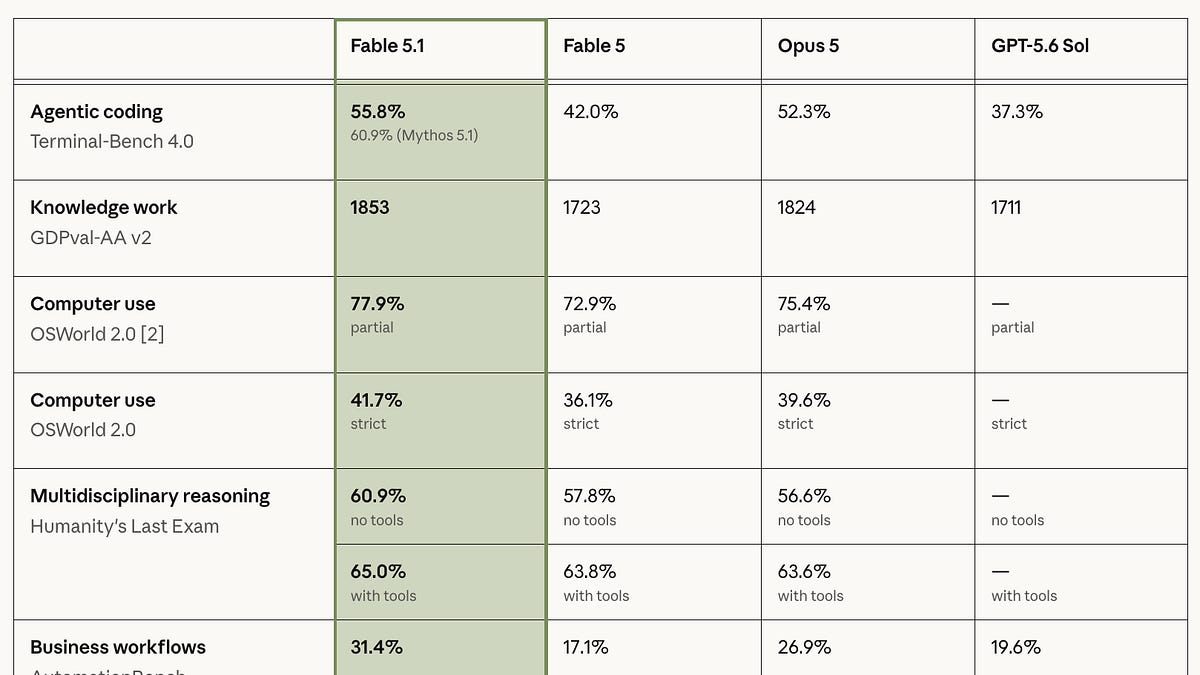
Anthropic says Fable 5.1 is better at avoiding shortcuts and sustaining that kind of multi-step work. Its reported benchmark results show improvements over Fable 5, from 42% to 55.8% on Terminal-Bench 4.0 and 17.1% to 31.4% on AutomationBench.
The benchmark versions differ from those cited in our original Fable launch post, so those older scores aren’t an apples-to-apples comparison, but they’re helpful data points. We’ll be running it through KiloBench soon and sharing the results with our community.
Same base rates. Cheaper cache reads. #
One big change is the pricing. Here’s what Claude Fable 5.1 costs:
The first two numbers haven’t changed. The third has: cache reads are 75% cheaper than Fable 5’s $1 per million cache read.
This is important because coding agents repeatedly work with context: instructions, repository content, and the conversation built up through tool calls and revisions. When that input is cached and reused, cheaper cache reads can drastically reduce the bill.
Anthropic estimates approximately 25% lower costs for typical workloads, with savings of up to approximately 45% for highly agentic workloads, relative to Fable 5. Your savings will depend on your workload and how much cached context it reuses. Larger repos are not necessarily more expensive, it depends on how you manage the context and assigned tasks. An output-heavy task won’t benefit in the same way as a long-running session with substantial cache usage.
The model still has a premium rate card, but, according to Anthropic, the economics of keeping it working through a complicated problem have improved.
But it’s not the only player in the game #
Frontier labs keep shipping meaningfully better models without a proportional price increase. Efficiency gains are increasing, making the cost convergence with open-weight models as real as the intelligence gains from the other side of the divide.
A few recent data points:
OpenAI
cut GPT-5.6 Terra’s price by 20% and Luna’s by 80%just three weeks after launch, explicitly framing it as passing efficiency gains on to customers rather than a promotional discount. Terra now sits at $2/M input, putting it in direct contention with Anthropic’s Sonnet 5 and Google’s Gemini 3.1 Pro at the same price point.xAI
shipped Grok 4.5 with what it callsroughly 2x the token efficiency of comparable leading models— resolving an average SWE-Bench Pro task in about a quarter of the output tokens Opus 4.8 (max) uses on the same benchmark, at $2/$6 per million tokens.
Anthropic also made Sonnet 5’s introductory pricing permanent, rather than letting it lapse to $3/$15 as originally scheduled for September 1, and Claude models from 4.6 onward include the full 1M-token context window at standard rates with no long-context surcharge.
But that seems like small change compared with the drop in cache read rates for Fable 5.1. Why? Because this is a model designed for high-level planning and orchestration.
Nonetheless, the overall spectrum of SOTA model pricing doesn’t appear to have changed much. GPT models have gained the most in efficiency, but looking at Artificial Analysis’s Cost per Intelligence Index – the weighted average cost in USD per Artificial Analysis Intelligence Index task – we see that Anthropic models continue to have high overhead.
So is it worth the cost? Security experts say yes #
Fable 5.1 can now be used to discover software vulnerabilities. Anthropic also reports that its updated cybersecurity safeguards produce fewer false positives. With fewer interruptions for legitimate security work, the latest Fable is a powerhouse that can fall back to Opus when needed but otherwise keep running to look for errors and vulnerabilities.
That’s relevant to ordinary development, not just dedicated security teams. Investigating unsafe input handling or checking a trust boundary shouldn’t automatically derail a defensive code review. Anthropic says penetration testing, exploit generation, and binary-based vulnerability scanning continue to redirect to Opus models.
And Mythos 5.1? It is the same underlying model as Fable 5.1, with different safeguards for vetted cybersecurity and life sciences work. It remains restricted-access.
Fable can handle more legitimate vulnerability-discovery work without a safeguard intervention. If you’re using an open-source coding agent like Kilo for shipping real code, that kind of deep work is essential.
Tip: Give Fable 5.1 a hard task, not an unlimited mandate #
The latest Fable looks most compelling for work where getting the answer right requires sustained investigation: a stubborn bug, a cross-service refactor, or a complex implementation with tests and clear acceptance criteria. I learned this the hard way when I gave it some open tasks for helping update the stats on the Kilo Leaderboard. It came back after 5 minutes with a lot of new ideas. They were great ideas! And well thought out. But not what I was looking for…
So the advice from our original launch post still holds. Define the scope. Make the verification requirements explicit.
More capable doesn’t mean every task needs the most expensive model. Kilo’s model-choice approach still makes sense: use a lighter model where it’s sufficient, and bring in Fable when deeper reasoning and independent execution justify the cost.
Fable 5.1’s strongest argument is that it addresses the practical objections to its predecessor: the cost of repeated context, interruptions during legitimate work, and—for eligible customers—the data retention barrier. For now Fable still retains data, but Anthropic is starting a rollout of Enterprise Frontier Safeguards (EFS), which will give customers “complete privacy (the same as a zero data retention policy) while still being state-of-the-art at preventing adversarial use.”
That makes it worth evaluating on a difficult task you already understand, with results you can actually check. Frontier intelligence is here to stay. And Kilo is here to help you take advantage of the best models for the task, whether they’re free, mid-range, or at the higher end of the frontier.